
Contractor Insurance Requirements Before Signing a Client Contract
Before signing a client contract, a contractor should review every insurance requirement and confirm that the business can actually comply with it. A contract may require more than a standard general liability policy, and signing first can leave the contractor responsible for buying expensive endorsements, increasing policy limits, or accepting uninsured obligations.
Insurance requirements may appear in several sections of the agreement, including insurance, indemnification, risk allocation, subcontracting, warranties, and general conditions. Contractors should send the complete contract—not only the certificate-of-insurance paragraph—to their insurance agent or broker before agreeing to the terms.
The U.S. Small Business Administration recommends evaluating business risks, comparing policy terms, and reviewing coverage as operations change. Insurance requirements should therefore be considered before pricing and accepting a project, not after work is scheduled to begin.
Pre-Contract Insurance Checklist
Before signing, confirm the following:
- Your legal business name matches the proposed contract.
- Every service and operation is covered by your policies.
- Required liability limits are already in place or available.
- Deductibles and self-insured retentions are acceptable.
- Workers’ compensation requirements have been reviewed.
- Business vehicles have appropriate commercial coverage.
- Additional insured endorsements are available.
- Ongoing and completed operations requirements can be satisfied.
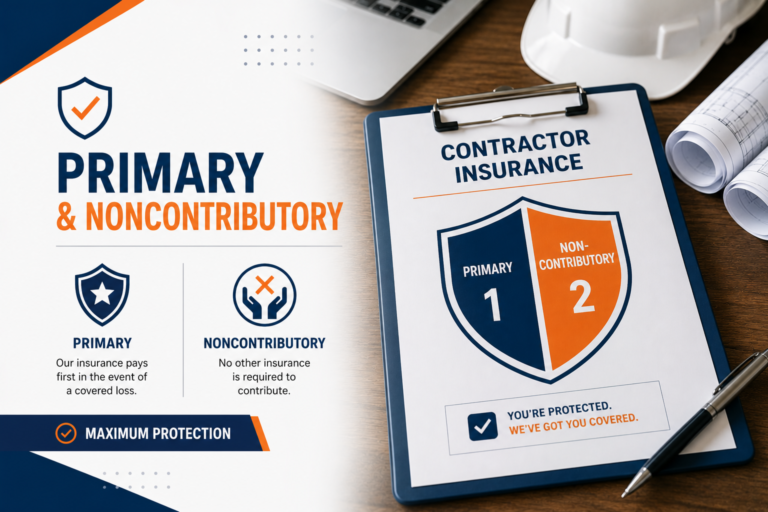
- Primary and noncontributory wording is available.
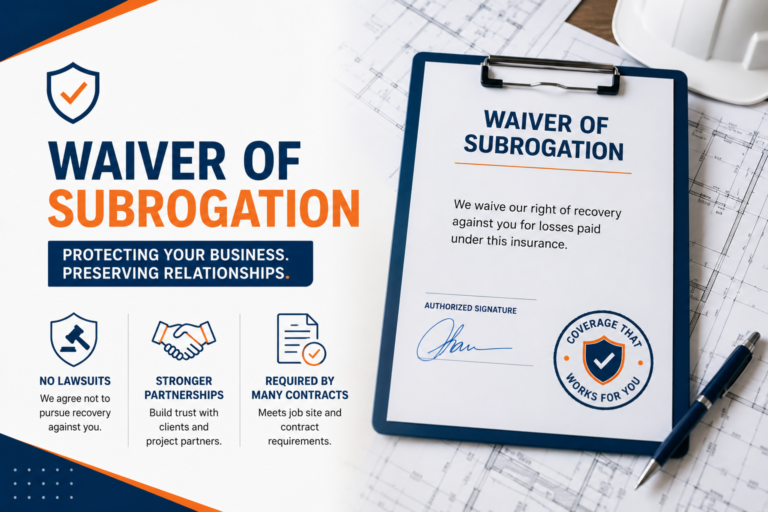
- Waivers of subrogation can be provided.
- Subcontractor insurance obligations are realistic.
- Professional, pollution, cyber, or other specialized coverage is addressed.
- Required certificates and endorsements can be issued before work begins.
- Insurance costs are included in the project price.
A client may legally require proof of insurance as a condition of hiring a contractor, even when a particular policy is not universally required for every business by state law. Texas insurance guidance, for example, confirms that a client can require a professional to carry insurance and provide evidence of it.
1. Confirm the Correct Contracting Entity
The business named in the contract should match the named insured on the insurance policy.
Potential problems arise when:
- The policy names the owner individually, but the contract names an LLC.
- The contractor recently changed business entities.
- A DBA appears in the contract but not in the insurance records.
- A related company owns the policy but is not performing the work.
- The contractor operates in a state not listed in the application.
For example, if “Smith Home Services LLC” signs the agreement, a policy issued only to “John Smith” may not clearly insure the contracting entity.
Before signing, compare the contract with:
- Policy declarations
- Business registration
- Contractor license
- Tax identification information
- Vehicle registrations
- Customer proposals and invoices
Ask the insurance agent to correct or clarify any inconsistency.
2. Describe the Work Accurately
Insurance companies classify contractors according to the work they perform. A policy written for painting, cleaning, or handyman services should not automatically be assumed to cover roofing, electrical work, structural repairs, demolition, excavation, or mold remediation.
Review the scope of work for:
- Services outside your normal trade
- Work at unusual heights
- Structural alterations
- Demolition or excavation
- Welding or hot work
- Hazardous materials
- Water intrusion exposure
- Work in occupied buildings
- New construction
- Government or industrial locations
- Design or consulting responsibilities
Tell your agent about any new or occasional operation before signing. An excluded activity does not become covered merely because it appears in a client contract.
3. Review General Liability Requirements
Commercial general liability insurance is commonly required because it may address eligible claims involving third-party bodily injury, property damage, and personal or advertising injury.
The contract may specify:
- Each-occurrence limit
- General aggregate
- Products-completed operations aggregate
- Personal and advertising injury limit
- Damage-to-rented-premises limit
- Medical payments limit
- Per-project aggregate
- Deductible or self-insured retention restrictions
A common contract may request $1 million per occurrence and $2 million aggregate, but these are not universal limits. Larger projects may require higher primary limits or commercial umbrella insurance.
Do not confuse the general aggregate with the each-occurrence limit. A policy showing a $2 million aggregate does not necessarily satisfy a contract requiring $2 million for each occurrence.
4. Check Policy Exclusions
A certificate may show general liability coverage without revealing exclusions that affect the specific project.
Review exclusions involving:
- Roofing
- Residential construction
- Condominiums or multifamily properties
- Water damage
- Exterior insulation systems
- Demolition
- Earth movement
- Mold or pollution
- Work above a specified height
- Subcontracted operations
- Damage to the contractor’s own work
- Property in the contractor’s care, custody, or control
A low-cost policy may not satisfy the client’s expectations if the work itself falls within an exclusion.
Ask the agent to confirm whether the project is eligible and whether any endorsement limits coverage for the location, customer, or operation.
5. Confirm Completed Operations Coverage
A contractor’s exposure may continue after the project is finished.
Completed operations coverage can become relevant when finished work later causes qualifying bodily injury or property damage. Examples include:
- A plumbing connection leaks months later.
- Installed wiring allegedly causes a fire.
- A mounted fixture falls.
- Roofing work permits water intrusion.
- An HVAC installation damages the building after startup.
The contract may require the contractor to maintain completed operations coverage for several years after completion. It may also require the client to remain an additional insured during that period.
Before signing, verify:
- The products-completed operations aggregate
- Whether the project’s work is eligible
- Whether completed operations additional insured coverage is available
- How long the contract requires coverage to continue
- Whether the requirement applies after the business closes or changes insurers
Do not assume an ongoing operations endorsement automatically covers completed work.
6. Understand Additional Insured Requirements
A client may require the contractor to add one or more parties as additional insureds.
These may include:
- Customer
- Property owner
- General contractor
- Developer
- Landlord
- Property manager
- Lender
- Municipality
- Affiliates, officers, employees, or agents
Additional insured status provides limited coverage under the contractor’s policy, subject to the endorsement. It does not give the client ownership of the policy or separate liability limits.
Determine whether the requirement applies to:
- Ongoing operations
- Completed operations
- A specifically scheduled party
- Anyone required by a written contract
- All project participants listed in the agreement
A certificate of insurance cannot create additional insured status. Texas insurance regulators state that a certificate may reflect additional insured status only when the underlying policy or endorsement actually provides it.
7. Review Primary and Noncontributory Wording
A contract may require additional insured coverage to be primary and noncontributory.
“Primary” generally means the contractor’s policy is intended to respond before the additional insured’s other applicable insurance.
“Noncontributory” generally means the contractor’s insurer will not seek contribution from that other insurance for a qualifying claim.
This requirement is separate from additional insured status. A client may be an additional insured without receiving primary and noncontributory treatment.
Confirm whether the policy already contains appropriate blanket wording or whether a separate endorsement must be purchased.
8. Check Waiver-of-Subrogation Requirements
A waiver of subrogation limits an insurer’s right to pursue a protected party after paying a covered claim.
A contract may require waivers under:
- General liability
- Workers’ compensation
- Commercial auto
- Commercial property
- Builder’s risk
- Umbrella or excess liability
The waiver can be scheduled for a named party or provided through a blanket endorsement triggered by a qualifying written contract.
Requesting a waiver on the certificate does not create it. The actual policy must contain the appropriate endorsement. Texas regulators prohibit certificates from promising rights or protections beyond the underlying policy.
9. Verify Workers’ Compensation Requirements
Workers’ compensation requirements vary by state, business structure, trade, and number of employees.
A client may require:
- Statutory workers’ compensation coverage
- Employers’ liability limits
- Coverage in every state where work is performed
- Waiver of subrogation
- Proof that owners are included or excluded
- Official exemption documentation
The U.S. Department of Labor directs private employers to the appropriate state authority because workers’ compensation rules are primarily state-based.
Do not assume that issuing Form 1099-NEC makes a worker an independent contractor. The IRS examines behavioral control, financial control, and the relationship between the parties when determining worker status.
If the project requires you to hire workers, confirm their classification and coverage before agreeing to the contract.
10. Review Commercial Auto Insurance
A client may require commercial auto liability when vehicles are used in connection with the work.
The requirement may apply to:
- Owned autos
- Hired autos
- Non-owned autos
- Any auto
- Trailers
- Heavy trucks
- Employee-owned vehicles used for business
Commercial auto coverage should be reviewed when the contractor transports materials, tools, employees, or equipment. Business auto policies may provide protections and limits different from personal auto policies.
Confirm that the required limit is available and that all drivers and vehicles have been disclosed.
11. Determine Whether Specialized Insurance Is Required
Some client contracts require policies beyond general liability.
Professional Liability
Professional liability may be needed when the contractor provides:
- Design services
- Engineering
- Inspections
- Consulting
- Project management
- Technical recommendations
- Design-build work
Check the retroactive date, claims-made conditions, and required period for maintaining coverage after completion.
Pollution Liability
Pollution coverage may be needed for:
- Mold remediation
- Lead or asbestos work
- Chemical handling
- Refrigerants
- Fuel tanks
- Environmental cleanup
- Contaminated soil
Cyber Liability
Cyber coverage may be relevant when the contractor stores payment information, customer addresses, access codes, building plans, or employee records.
Builder’s Risk
Determine whether the owner or contractor is responsible for builder’s risk insurance covering the work in progress, materials, and certain project property.
Surety Bonds
A contract may require bid, performance, payment, license, or permit bonds. A surety bond is not the same as insurance for accidents or lawsuits. It guarantees specified contractual or legal obligations. The SBA explains that surety bonds can help small businesses qualify for contracts by providing the customer with a guarantee that contract obligations will be completed.
12. Examine Indemnification Language
Insurance requirements should be reviewed together with the indemnification clause.
An indemnification provision may require the contractor to defend or reimburse the client for certain losses. However, the insurance policy may not cover every contractual promise.
Potential concerns include language requiring the contractor to:
- Indemnify the client for the client’s own negligence
- Defend claims before fault is determined
- Cover damages outside the contractor’s operations
- Accept unlimited liability
- Pay losses excluded by insurance
- Indemnify numerous unrelated parties
The enforceability of these provisions varies by state. Some states restrict indemnification for another party’s sole negligence in construction contracts.
An insurance agent can explain coverage, but legal counsel should review broad indemnification, limitation-of-liability, and risk-transfer language.
13. Review Subcontractor Requirements
Client contracts often require the contractor to impose equivalent insurance obligations on every subcontractor.
You may need to:
- Require specified limits
- Collect certificates and endorsements
- Add the client as an additional insured
- Obtain completed operations coverage
- Require primary and noncontributory wording
- Obtain waivers of subrogation
- Maintain records for several years
- Verify lower-tier subcontractors
Federal contracts can expressly require prime contractors to maintain insurance, require appropriate coverage from subcontractors, retain evidence, and provide it to the contracting officer when requested.
Before signing, determine whether suitable subcontractors can meet the requirements and whether their insurance costs will affect your bid.
14. Confirm COI and Endorsement Deadlines
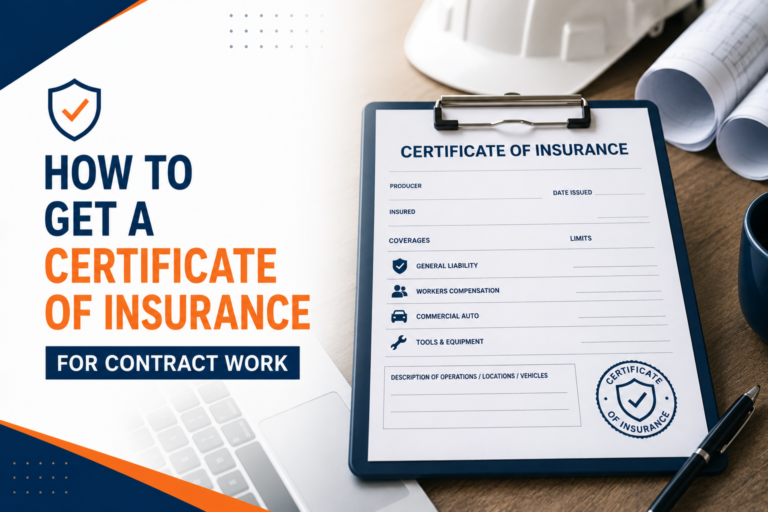
The contract may prohibit work until the client receives acceptable insurance documentation.
Required documents may include:
- Certificate of insurance
- Additional insured endorsements
- Completed operations endorsement
- Primary and noncontributory endorsement
- Waiver-of-subrogation endorsement
- Workers’ compensation evidence
- Commercial auto certificate
- Umbrella certificate
A certificate is proof of insurance, not the insurance contract itself. It cannot expand coverage, provide unsupported cancellation rights, or override exclusions.
Ask the client whether documents must be:
- Sent directly by the agent
- Uploaded through a compliance portal
- Approved before mobilization
- Renewed during the project
- Retained after completion
15. Calculate the Insurance Cost Before Pricing the Job
Contract requirements can increase your costs through:
- Higher limits
- Umbrella insurance
- Additional insured endorsements
- Waivers of subrogation
- Specialized policies
- Project-specific deductibles
- Increased payroll or subcontractor exposure
- Bond premiums
- Extended completed operations coverage
Ask the agent for a written estimate before finalizing the price.
A profitable contract can become unprofitable when the contractor discovers after signing that it must purchase several new policies or maintain expensive coverage for years after completion.
Frequently Asked Questions
Should contractors send client contracts to their insurance agent?
Yes. Send the complete insurance, indemnification, and subcontractor provisions before signing.
Can a client require higher insurance limits?
Generally, yes. A client can make specified limits a contractual condition, even when the contractor’s existing limits are lower.
Is a certificate of insurance enough?
Not necessarily. The client may require actual endorsements supporting additional insured, completed operations, primary and noncontributory, and waiver-of-subrogation provisions.
Does additional insured status automatically include completed operations?
No. Completed operations may require a separate endorsement.
Can contract wording change an insurance policy?
No. The contract can obligate the contractor to obtain coverage, but it cannot make an insurer provide protection that the policy does not contain.
Should a contractor sign before obtaining an insurance quote?
It is safer to confirm availability and cost first. Otherwise, the contractor may accept obligations that are expensive or impossible to satisfy.
Is a surety bond the same as liability insurance?
No. A bond guarantees specified obligations, while liability insurance addresses qualifying claims and lawsuits.
Can a client require insurance from subcontractors?
Yes. The prime contract may require the contractor to impose insurance standards on every subcontractor and lower-tier subcontractor.
Conclusion
Before signing a client contract, contractors should confirm that their policies match the project’s operations, limits, endorsements, and post-completion obligations.
Review general liability, workers’ compensation, commercial auto, umbrella, completed operations, and any specialized coverage. Pay particular attention to additional insured requirements, primary and noncontributory wording, waivers of subrogation, indemnification clauses, and subcontractor obligations.
Do not rely solely on a certificate of insurance. The underlying policies and endorsements determine what coverage exists.
Send the complete contract to your insurance agent or broker, obtain pricing for any changes, and seek legal review of unusually broad indemnification or risk-transfer provisions. The best time to identify an insurance problem is before the agreement is signed—not after the client demands documentation or a claim occurs.
Editorial review: This guide was researched and reviewed by the Coverage Editorial Team using government agencies, insurance regulators, licensing authorities, policy documentation, and current industry pricing sources.