How to Get a Certificate of Insurance for Contract Work
To get a certificate of insurance for contract work, contact the insurance agent, broker, or company that manages your business insurance policy. Provide the client’s legal name and address, the project details, and a copy of the contract’s insurance requirements. The insurance professional can then issue a certificate showing the coverage your business currently carries.
A certificate of insurance, commonly called a COI, is often required before a contractor can enter a job site, begin subcontracted work, sign a commercial lease, or receive final approval for a project.
Requesting a basic certificate is usually straightforward. Problems arise when the contract requires higher limits or special provisions—such as additional insured status, a waiver of subrogation, primary and noncontributory coverage, or completed operations protection—that are not already included in the contractor’s policy.
A COI summarizes existing insurance. It cannot create coverage that the contractor has not purchased, and it does not replace the actual policy or endorsements.
What Is a Certificate of Insurance?
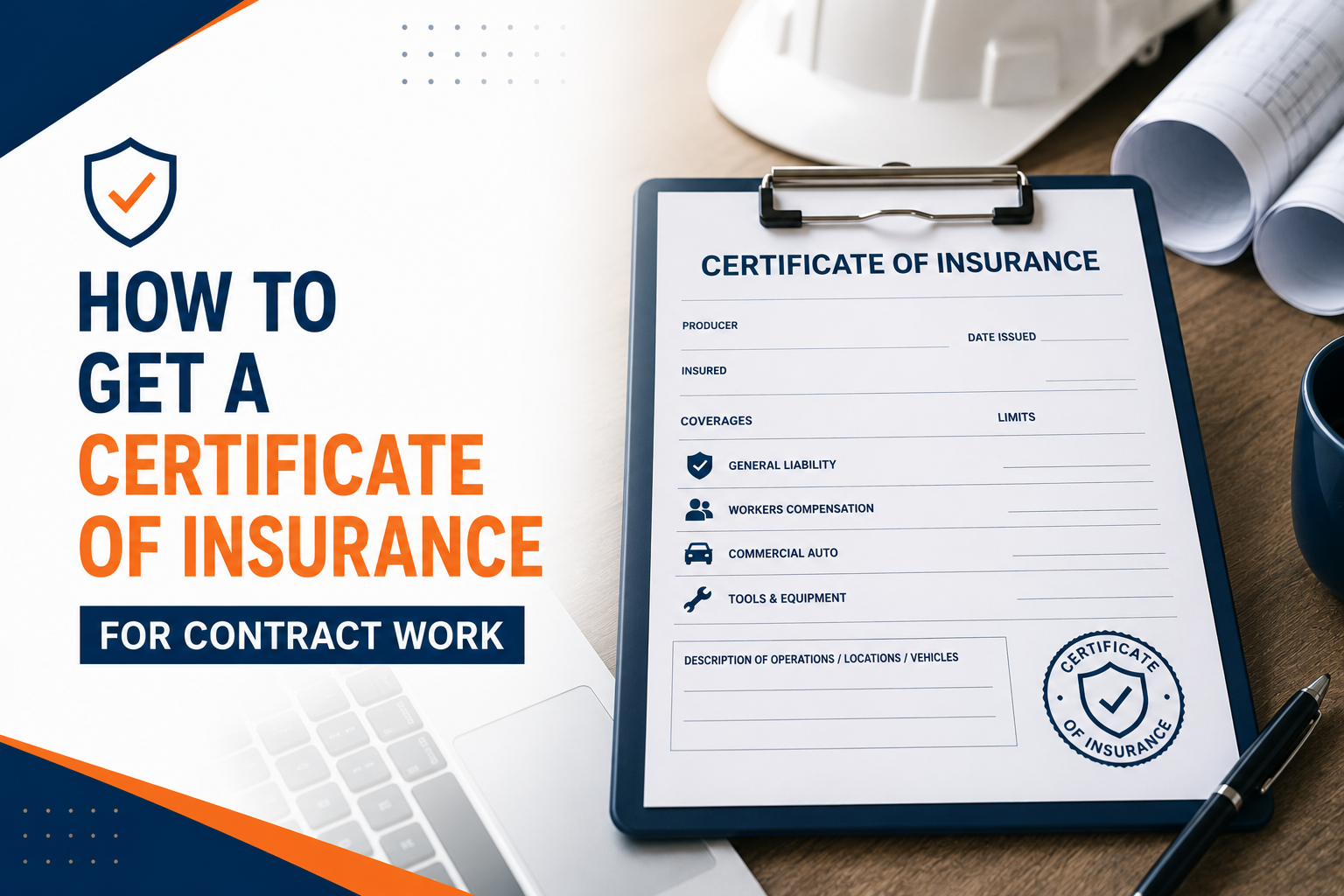
A certificate of insurance is a document summarizing selected information from one or more insurance policies.
A contractor COI may show:
- The contractor’s legal business name
- The insurance agent or broker
- The insurance companies providing coverage
- Policy numbers
- Effective and expiration dates
- General liability limits
- Commercial auto liability
- Workers’ compensation
- Employers’ liability
- Commercial umbrella or excess liability
- The certificate holder
- A brief description of operations
Certificates are commonly used to provide evidence that insurance existed when the document was issued. However, the policy itself controls coverage.
Texas insurance regulators explain that a certificate cannot provide, amend, extend, or alter coverage beyond what is contained in the insurance policy. It also cannot identify a party as an additional insured unless the policy or applicable endorsement actually grants that status.
When Do Contractors Need a COI?
A contractor may be asked to provide a certificate before:
- Starting work for a general contractor
- Entering a commercial or residential job site
- Performing maintenance for a property manager
- Renting office or warehouse space
- Working for a government agency
- Obtaining or renewing certain licenses
- Bidding on a commercial project
- Delivering materials or equipment
- Hiring subcontractors
- Receiving final contract approval
Homeowners may also request a certificate before allowing a contractor to begin a remodel or repair. The California Department of Insurance advises consumers to request a COI showing the contractor’s insurance company, policy number, and coverage limits.
A certificate can help demonstrate professionalism, but it is not a substitute for maintaining appropriate coverage. The SBA recommends that businesses assess their risks, work with a licensed insurance professional, compare policy terms, and review coverage as their operations change.
How to Get a Certificate of Insurance Step by Step
1. Review the Contract’s Insurance Requirements
Before contacting your insurance provider, read the entire insurance section of the contract.
Look for requirements involving:
- General liability limits
- Commercial auto liability
- Workers’ compensation
- Employers’ liability
- Professional liability
- Pollution liability
- Commercial umbrella insurance
- Additional insured status
- Waiver of subrogation
- Primary and noncontributory wording
- Per-project aggregate
- Completed operations coverage
- Cancellation-notice requirements
Do not assume that a standard $1 million general liability policy will satisfy every contract. A project may require higher limits, special endorsements, or coverage that your current policy does not include.
Send the complete contract language to your agent rather than summarizing it. A small wording difference can change what documentation or endorsement is needed.
2. Gather the Certificate Holder’s Information
The certificate holder is the person or organization requesting proof of insurance.
Obtain the exact:
- Legal name
- Mailing address
- Project name
- Project number
- Work location
- Contact name
- Email address
- Delivery deadline
Do not guess or shorten the organization’s legal name. The certificate holder may need to match the name appearing in the contract.
For example, a contract may be signed with “ABC Property Management LLC,” while the contractor informally knows the company as “ABC Properties.” Using the wrong entity can result in the certificate being rejected.
3. Contact Your Insurance Agent, Broker, or Insurer
A contractor normally requests a COI from the insurance professional who services the policy.
The request may be submitted through:
- Telephone
- Online customer portal
- Mobile application
- Agency certificate-request form
Provide the certificate holder’s information, project details, requested delivery date, and full insurance requirements.
Do not create or modify the certificate yourself. Changing limits, expiration dates, policy numbers, or additional insured wording can misrepresent the actual coverage and create serious legal and contractual consequences.
ACORD itself does not provide insurance or process claims. Contractors using an ACORD certificate should direct questions to the producer identified on the form.
4. Confirm Whether Endorsements Are Required
A basic certificate only summarizes the policies. Some contracts require separate endorsements that modify coverage.
Common requests include:
Additional Insured Status
An additional insured is a person or organization granted certain protection under the contractor’s liability policy.
A client may request additional insured status for liability arising from the contractor’s ongoing work, completed work, or both.
Listing the client as the certificate holder does not automatically make it an additional insured. Texas regulators state that a certificate cannot name a party as an additional insured unless the policy or endorsement actually provides that status.
Waiver of Subrogation
A waiver of subrogation can limit an insurer’s ability to seek reimbursement from another party after paying a covered claim.
This provision must be supported by the policy or an endorsement. Typing “waiver of subrogation applies” onto the certificate does not create the waiver if the insurance contract does not provide it.
Primary and Noncontributory Coverage
This wording may require the contractor’s policy to respond before another insured party’s policy and without seeking contribution from that other insurance.
The requirement typically must be supported by an endorsement.
Completed Operations Additional Insured Coverage
Some contracts require additional insured protection to continue after the contractor finishes the project.
This is different from ongoing operations coverage. Contractors should verify the duration, scope, and record-retention requirements before signing the contract.
5. Pay for Policy Changes When Necessary
A basic COI may be issued without a separate charge as part of routine policy servicing. However, the insurance company may charge additional premium when the request requires:
- Higher policy limits
- A commercial umbrella policy
- Additional insured endorsements
- A waiver of subrogation
- Per-project aggregate coverage
- Expanded completed operations protection
- New operations or project classifications
- Coverage in another state
The cost is associated with changing or expanding coverage—not merely creating the certificate.
Contractors should identify these costs before pricing a project. Agreeing to extensive insurance requirements without reviewing them can reduce the project’s profitability.
6. Review the Certificate for Accuracy
When you receive the COI, check it before sending it to the client.
Verify:
- The contractor’s legal name is correct.
- The business address is current.
- The policies are active.
- Policy expiration dates cover the project start date.
- Required insurance types are shown.
- Limits satisfy the contract.
- The certificate holder is listed correctly.
- Project information is accurate.
- Required endorsements have been issued.
- The issuing agent’s details are present.
The certificate may contain a description-of-operations section. Do not assume wording in this field overrides the policy. A certificate cannot expand coverage that the policy does not provide.
7. Send the COI and Supporting Endorsements
Send the certificate to the requesting party using the delivery method specified in the contract.
The client may require:
- Email delivery
- Upload through a compliance portal
- Direct delivery from the insurance agency
- Separate copies of endorsements
- Confirmation from the insurance company
Some organizations will not accept a certificate sent only by the contractor because they want to verify that it came directly from the issuing agency.
Keep a copy of everything submitted, including:
- The certificate
- Endorsements
- Original request
- Contract requirements
- Email confirmation
- Approval or rejection messages
What Information Do You Need to Request a COI?
A complete certificate request should generally contain:
| Required information | Example |
|---|---|
| Contractor’s policy or account information | Business name and policy number |
| Certificate holder | Client’s complete legal name |
| Certificate holder address | Official mailing address |
| Project information | Name, address, and contract number |
| Required coverage | General liability, auto, workers’ compensation |
| Requested limits | Limits listed in the contract |
| Additional insured requirement | Ongoing, completed operations, or both |
| Other endorsements | Waiver of subrogation or primary wording |
| Delivery instructions | Email address or compliance portal |
| Deadline | Date the certificate must be received |
Providing all information in one request can reduce delays and follow-up questions.
Certificate Holder vs. Additional Insured
These terms are often confused, but they have different meanings.
| Status | What it generally means |
|---|---|
| Certificate holder | Receives evidence of the contractor’s insurance |
| Additional insured | Receives limited protection under the contractor’s policy |
| Named insured | Person or business identified as a primary insured under the policy |
Being listed as the certificate holder does not automatically provide insurance protection.
Additional insured status must come from the policy or an endorsement. A certificate can reflect that status, but it cannot create it.
How Long Does It Take to Get a COI?
A simple certificate request may be completed quickly when:
- The contractor already has active coverage.
- The requested limits match the policy.
- No new endorsements are required.
- The contractor provides complete information.
The process may take longer when:
- The client requires higher limits.
- The contractor needs a new policy.
- Underwriting approval is required.
- The work involves a high-risk operation.
- The project is in another state.
- A commercial umbrella policy must be added.
- Contract wording must be reviewed.
- Several endorsements are required.
Contractors should request certificates before the project start date rather than waiting until they arrive at the job site.
Can You Get a COI Without Business Insurance?
No legitimate certificate can show active coverage that does not exist.
A contractor without insurance must first apply for and purchase the required policy. This normally involves providing information about:
- Services performed
- Annual revenue
- Payroll
- Employees
- Subcontractors
- Vehicles
- Tools and equipment
- Previous insurance
- Claims history
After coverage becomes effective, the agent can issue a certificate.
Do not use another contractor’s certificate or alter an expired document. A customer can contact the issuing agent or insurance company to verify the information.
Does a COI Guarantee Coverage?
No. A certificate does not guarantee that every future claim will be paid.
Coverage may be denied or limited when:
- The incident involves an excluded operation.
- The damage happened outside the policy period.
- The contractor’s policy was canceled.
- The claim exceeds the available limits.
- The contractor provided inaccurate application information.
- The loss involves defective work that is excluded.
- The required endorsement was never issued.
- The incident does not meet the policy’s coverage conditions.
The certificate only summarizes selected information. The declarations, coverage forms, exclusions, conditions, and endorsements determine whether the insurer must respond.
What Happens When a COI Expires During a Project?
A certificate may show that a policy expires before the project is completed.
The contractor should renew the insurance and provide an updated certificate. General contractors and property managers commonly track expiration dates and may suspend work or payment when updated proof is not supplied.
Renewal should also preserve any required endorsements. Do not assume an additional insured endorsement from an expired policy automatically applies to a replacement policy.
Contractors should maintain continuous coverage when completed work could later cause injury or property damage.
Common COI Request Mistakes
Providing an Incomplete Client Name
Use the full legal name and address appearing in the contract.
Waiting Until Work Is Scheduled to Begin
Special endorsements or higher limits may require additional processing.
Sending Only the Certificate
Some contracts require copies of actual additional insured, waiver, or primary and noncontributory endorsements.
Assuming the COI Changes the Policy
The certificate cannot create coverage, limits, or cancellation rights that the policy does not provide.
Ignoring Policy Expiration Dates
An active certificate at the beginning of a project may become outdated before the work is completed.
Agreeing to Requirements Before Reviewing Their Cost
Higher limits and endorsements can increase the premium. Review these costs before submitting a bid or signing a contract.
Frequently Asked Questions
Who provides a certificate of insurance?
The contractor’s insurance agent, broker, or insurance company normally issues the COI.
Can a contractor make a COI?
A contractor should not create or alter an insurance certificate. The document should be issued by an authorized insurance professional.
Is a certificate of insurance free?
A routine certificate is commonly issued without a separate fee, but policy changes, additional coverage, or endorsements may increase the premium.
Can I get a COI online?
Many insurance companies and agencies allow policyholders to request or download certificates through an online portal. Special requirements may still need review by an agent.
What is needed to get a certificate of insurance?
You generally need active business insurance, the certificate holder’s legal name and address, project information, contract requirements, and delivery instructions.
Does a COI make the client an additional insured?
No. Additional insured status must be granted through the policy or an endorsement.
How often should a COI be updated?
Provide an updated certificate when the policy renews, coverage changes, the client requests one, or a new project requires different information.
Can a customer verify the certificate?
Yes. A customer can contact the listed insurance agent or company using independently verified contact information.
Conclusion
Getting a certificate of insurance for contract work begins with having the correct business insurance in place.
Review the contract, collect the client’s complete legal information, and send the full request to your insurance agent or broker. Confirm whether the client needs only proof of coverage or also requires additional insured status, a waiver of subrogation, primary and noncontributory wording, completed operations protection, or higher limits.
Review the certificate and supporting endorsements before submitting them. A COI summarizes insurance, but it cannot modify the policy or guarantee that a claim will be covered.
Request documentation early, keep copies with the project records, and update the certificate whenever the policy renews or changes. A reliable COI process can prevent job-site delays, contractual disputes, and last-minute insurance problems.
Editorial review: This guide was researched and reviewed by the Coverage Editorial Team using government agencies, insurance regulators, licensing authorities, policy documentation, and current industry pricing sources.