
What Happens if a Subcontractor Does Not Have Insurance?
When a subcontractor does not have insurance, the consequences can extend beyond the subcontractor’s own business. The general contractor, project owner, and other parties may face uninsured injury claims, property damage lawsuits, additional insurance premiums, contract violations, job-site delays, and disputes over who must pay for the loss.
An uninsured subcontractor is not automatically covered by the general contractor’s insurance. The general contractor’s policy may protect the general contractor against certain claims arising from subcontracted work, but it may not defend the subcontractor, replace the subcontractor’s tools, cover its vehicles, or pay every claim caused by its operations.
Workers’ compensation presents an especially serious risk. In some states, a general contractor can become responsible for benefits owed to employees of an uninsured subcontractor. South Carolina, for example, states that subcontractor employees can be statutory employees of the general contractor and that the general contractor may be liable when the subcontractor fails to maintain workers’ compensation coverage.
Consequences of Hiring an Uninsured Subcontractor
| Potential consequence | Who may be affected |
|---|---|
| Subcontractor must pay claims personally | Subcontractor and business owners |
| General contractor faces additional liability | General contractor |
| Workers’ compensation responsibility shifts upstream | General contractor or project owner, depending on state law |
| Additional premium is charged after an audit | General contractor |
| Work is suspended or subcontract terminated | Subcontractor |
| Contract insurance requirements are violated | Both parties |
| Customer files claims against multiple businesses | Contractor, subcontractor, and project owner |
| Insurance coverage is disputed or limited | All parties involved |
| Licensing or government-contract problems arise | Subcontractor and prime contractor |
| Injured workers pursue other legal remedies | Subcontractor and possibly general contractor |
The specific outcome depends on the state, policy wording, written subcontract, type of loss, worker classification, and insurance requirements imposed by the project.
1. The Subcontractor May Have to Pay Claims Out of Pocket
Insurance provides financial protection for covered accidents and lawsuits. Without it, the subcontractor may be directly responsible for:
- Customer property repairs
- Third-party medical expenses
- Legal defense costs
- Court judgments
- Settlements
- Damaged or stolen tools
- Commercial vehicle accidents
- Employee injury expenses
- Business interruption costs
Consider a plumbing subcontractor that accidentally causes a large water loss inside an occupied home. If the subcontractor has no general liability insurance, it may have to pay for damaged flooring, walls, cabinets, furniture, temporary accommodations, and legal expenses using business or personal assets.
An LLC or corporation does not pay those expenses automatically. A business entity may provide certain legal protections, but it is not a replacement for liability insurance.
The California Department of Insurance warns business owners to verify subcontractor and vendor coverage because uninsured parties can expose the hiring business to unexpected financial losses.
2. The General Contractor May Be Sued
Customers frequently sue more than one party after a construction accident.
If an uninsured subcontractor causes an injury or property damage, a lawsuit may name:
- The subcontractor
- The general contractor
- The project owner
- The property manager
- Other subcontractors
- The architect or construction manager
The general contractor may be accused of:
- Negligent hiring
- Poor supervision
- Failure to enforce safety procedures
- Creating or allowing unsafe site conditions
- Breaching the construction contract
- Selecting an unqualified subcontractor
- Failing to verify required insurance
The general contractor’s liability policy may provide a defense against covered allegations, but that does not mean the uninsured subcontractor receives the same protection.
Coverage can also be affected by subcontractor exclusions, residential construction restrictions, classifications, policy conditions, and other endorsements. Commercial general liability coverage varies by insurer and policy, so the complete insurance contract must be reviewed rather than relying only on a certificate.
3. The General Contractor May Become Responsible for Worker Injuries
Workers’ compensation is one of the most important reasons to verify subcontractor insurance.
A subcontractor employee who is injured may normally seek benefits through the subcontractor’s workers’ compensation policy. If that policy does not exist, state law may shift responsibility to another business involved in the project.
South Carolina’s Workers’ Compensation Commission states that subcontractor employees may be treated as statutory employees of the general contractor. The general contractor can therefore be liable when the subcontractor does not maintain its own coverage.
New York similarly warns that general contractors can be liable for workers’ compensation claims involving uninsured subcontractors. Its Workers’ Compensation Board recommends collecting proof of coverage from every subcontractor.
Possible costs can include:
- Medical treatment
- Temporary disability benefits
- Permanent disability benefits
- Rehabilitation expenses
- Death benefits
- Legal expenses
- State assessments and penalties
The rules vary significantly by state. A general contractor should verify the requirements through the workers’ compensation authority where the project is located.
4. The General Contractor May Owe Additional Audit Premium
General liability and workers’ compensation policies are often subject to premium audits.
During an audit, the insurer may review:
- Payments made to subcontractors
- Certificates of insurance
- Workers’ compensation records
- Payroll reports
- General ledgers
- Tax forms
- Subcontracts
- Descriptions of work performed
If the general contractor cannot prove that a subcontractor carried its own insurance, the insurer may treat the subcontractor’s work as an exposure under the general contractor’s policy and charge additional premium.
New York’s Workers’ Compensation Board states that carriers routinely charge general contractors workers’ compensation premium for subcontractors who cannot demonstrate that they had their own policies.
The audit charge can be significant when:
- The subcontractor received substantial payments.
- The work involved a high-risk trade.
- Several uninsured subcontractors were used.
- Records are incomplete.
- Workers were incorrectly classified.
- The original payroll or subcontractor estimates were too low.
The general contractor may owe this additional premium even if no accident occurred.
5. The Subcontractor May Be Removed From the Project
Commercial subcontracts commonly require insurance as a condition of beginning and continuing work.
If the subcontractor fails to provide valid coverage, the general contractor may be permitted to:
- Refuse access to the job site
- Suspend the subcontractor’s work
- Withhold approval of invoices where the contract permits
- Require immediate purchase of insurance
- Replace the subcontractor
- Terminate the subcontract
- Seek reimbursement for resulting delays or costs
The exact remedies depend on the written agreement and state law.
On certain federal projects, insurance obligations can also flow down to subcontractors. FAR 52.228-5 requires prime contractors subject to the clause to maintain specified insurance, require appropriate insurance from subcontractors, and keep evidence available for review.
An uninsured subcontractor may therefore lose not only one project but also future opportunities with general contractors that maintain formal compliance programs.
6. The Subcontractor May Violate Licensing or Legal Requirements
Some types of insurance are required by law, licensing rules, or government contracts.
Requirements may include:
- Workers’ compensation
- Commercial auto liability
- General liability
- Professional liability
- Surety bonds
- Minimum policy limits
A subcontractor that operates without legally required insurance may face:
- Civil penalties
- Stop-work orders
- License suspension
- License revocation
- Personal liability for claims
- Difficulty renewing permits
- Government-contract disqualification
- Criminal consequences in serious cases
For example, New York states that uninsured employers can be responsible for all wage and medical benefits awarded to employees, legal representation, and assessments of up to $2,000 for every ten-day period of noncompliance.
These penalties are state-specific and should not be treated as universal. Contractors must check the rules applicable to their location and trade.
7. Worker Misclassification Can Create Additional Problems
Calling someone a subcontractor does not automatically make that classification legally correct.
The IRS evaluates worker status using facts involving:
- Behavioral control
- Financial control
- The relationship between the parties
A worker may be considered an employee when the hiring business has the right to control what work is performed and how it is performed. A written subcontract or Form 1099 does not override the actual relationship.
Misclassification can result in:
- Employment tax liability
- Unpaid payroll taxes
- Workers’ compensation premium assessments
- Wage-and-hour claims
- Employee-benefit disputes
- Penalties and interest
- Insurance coverage problems
Warning signs may include a worker who:
- Works only for one contractor
- Uses the contractor’s tools
- Follows a fixed schedule
- Is paid like an employee
- Receives detailed instructions
- Cannot hire assistants
- Performs a central part of the contractor’s regular business
The absence of subcontractor insurance can attract additional scrutiny because a genuinely independent business would often be expected to maintain its own coverage and operate with meaningful financial independence.
8. OSHA Responsibilities Do Not Disappear
A general contractor cannot rely on the subcontractor’s lack of insurance to avoid job-site safety responsibilities.
Under OSHA construction rules, the prime contractor retains overall responsibility under the contract, while subcontractors are responsible for the portions of work they agree to perform. OSHA states that prime contractors and subcontractors can have joint responsibility for subcontracted work.
Insurance does not replace:
- Safety training
- Hazard communication
- Fall protection
- Equipment inspections
- Site supervision
- Protective equipment
- Incident reporting
- Compliance with OSHA standards
An uninsured subcontractor may be more likely to lack formal safety procedures, but proof of insurance alone does not prove that a subcontractor operates safely. General contractors should evaluate both insurance compliance and safety performance.
Does the General Contractor’s Insurance Cover an Uninsured Subcontractor?
Not automatically.
The general contractor’s insurance may cover certain claims against the general contractor resulting from subcontracted work. That is different from making the subcontractor an insured.
The uninsured subcontractor may still lack protection for:
- Lawsuits filed directly against it
- Its legal defense expenses
- Employee workers’ compensation claims
- Damage to its own work
- Its owned vehicles
- Stolen tools
- Professional errors
- Pollution incidents
The policy may also contain exclusions or conditions affecting work performed by uninsured subcontractors.
A contractor should ask its insurance agent:
- Does the policy permit subcontracted work?
- Are there exclusions for uninsured subcontractors?
- Are certificates and written agreements required?
- Must the general contractor be an additional insured?
- Does completed operations coverage apply?
- How will uninsured subcontractors affect the audit?
- Are specific subcontractor limits required?
Never assume coverage based only on the policy title or declarations page.
What Should a General Contractor Do Before Hiring a Subcontractor?
Require insurance documentation before work begins.
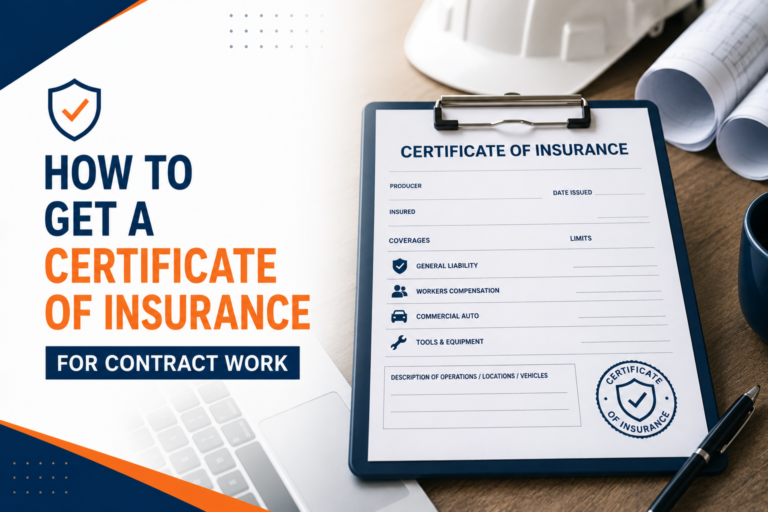
Obtain a Certificate of Insurance
The certificate should show:
- Correct subcontractor legal name
- General liability coverage
- Workers’ compensation
- Commercial auto coverage when applicable
- Umbrella or excess liability when required
- Active policy dates
- Required limits
Request the Actual Endorsements
Depending on the subcontract, request:
- Additional insured endorsement
- Completed operations endorsement
- Primary and noncontributory endorsement
- Waiver-of-subrogation endorsement
A COI cannot create these protections. Texas insurance regulators explain that a certificate cannot grant rights beyond those provided by the policy or executed endorsements.
Verify the Documents
Contact the issuing agent using independently verified information and confirm:
- The agency issued the certificate.
- The policies are active.
- The subcontractor is the named insured.
- The limits are accurate.
- Required endorsements exist.
- No cancellation is pending.
Track Expiration Dates
A valid certificate at the beginning of the project may expire before the subcontractor completes its work. Require renewal documents and suspend work when mandatory insurance lapses.
What if the Subcontractor Claims to Be Exempt?
A subcontractor may claim that it does not need workers’ compensation because it is a sole proprietor, has no employees, or qualifies for a state exemption.
The general contractor should:
- Request official exemption documentation.
- Verify the exemption through the state.
- Confirm that the subcontractor has no employees.
- Ask its own insurer how the exemption affects premium audits.
- Check whether the project contract still requires coverage.
A legal exemption does not necessarily mean the general contractor must accept an uninsured subcontractor. New York notes that owner-only businesses may purchase workers’ compensation because a general contractor requires it as a condition of receiving work.
Frequently Asked Questions
Is it illegal for a subcontractor to work without insurance?
It depends on the state, trade, business structure, employees, vehicles, and project. Some coverage may be legally required, while other insurance is required only by contract.
Is the general contractor liable for an uninsured subcontractor?
Possibly. The general contractor may be sued for its own alleged negligence and may also be responsible for certain workers’ compensation claims under state law.
Can a general contractor hire an uninsured sole proprietor?
It may be legally possible in some circumstances, but the general contractor can still require insurance contractually. Its own insurer may also charge additional premium.
Does a 1099 prove that the person is a subcontractor?
No. The IRS examines behavioral control, financial control, and the relationship between the parties.
Will the general contractor’s policy pay an uninsured subcontractor’s claim?
Not automatically. It may protect the general contractor against certain covered allegations without insuring the subcontractor itself.
Can an uninsured subcontractor be removed from a project?
Yes, when the subcontract requires insurance and permits suspension or termination for noncompliance.
What happens during an insurance audit?
The insurer may request certificates, payment records, payroll information, and contracts. Payments to uninsured subcontractors may generate additional premium.
Should a subcontractor with no employees still carry insurance?
General liability, commercial auto, and tools coverage may still be important. A general contractor or customer may also require workers’ compensation despite a possible exemption.
Conclusion
An uninsured subcontractor can create financial, legal, contractual, and insurance problems for every party involved in a project.
The subcontractor may have to pay claims personally, lose the contract, face penalties, or become unable to continue operating. The general contractor may be sued, charged additional audit premium, or become responsible for workers’ compensation benefits under applicable state law.
The safest approach is to establish insurance requirements in the written subcontract, collect certificates and endorsements before work begins, verify coverage directly with the issuing agency, and track expiration dates throughout the project.
Do not rely on verbal assurances, a Form 1099, or a certificate alone. Confirm that the subcontractor is a legitimate independent business and that its insurance covers the actual work it will perform.
Editorial review: This guide was researched and reviewed by the Coverage Editorial Team using government agencies, insurance regulators, licensing authorities, policy documentation, and current industry pricing sources.