
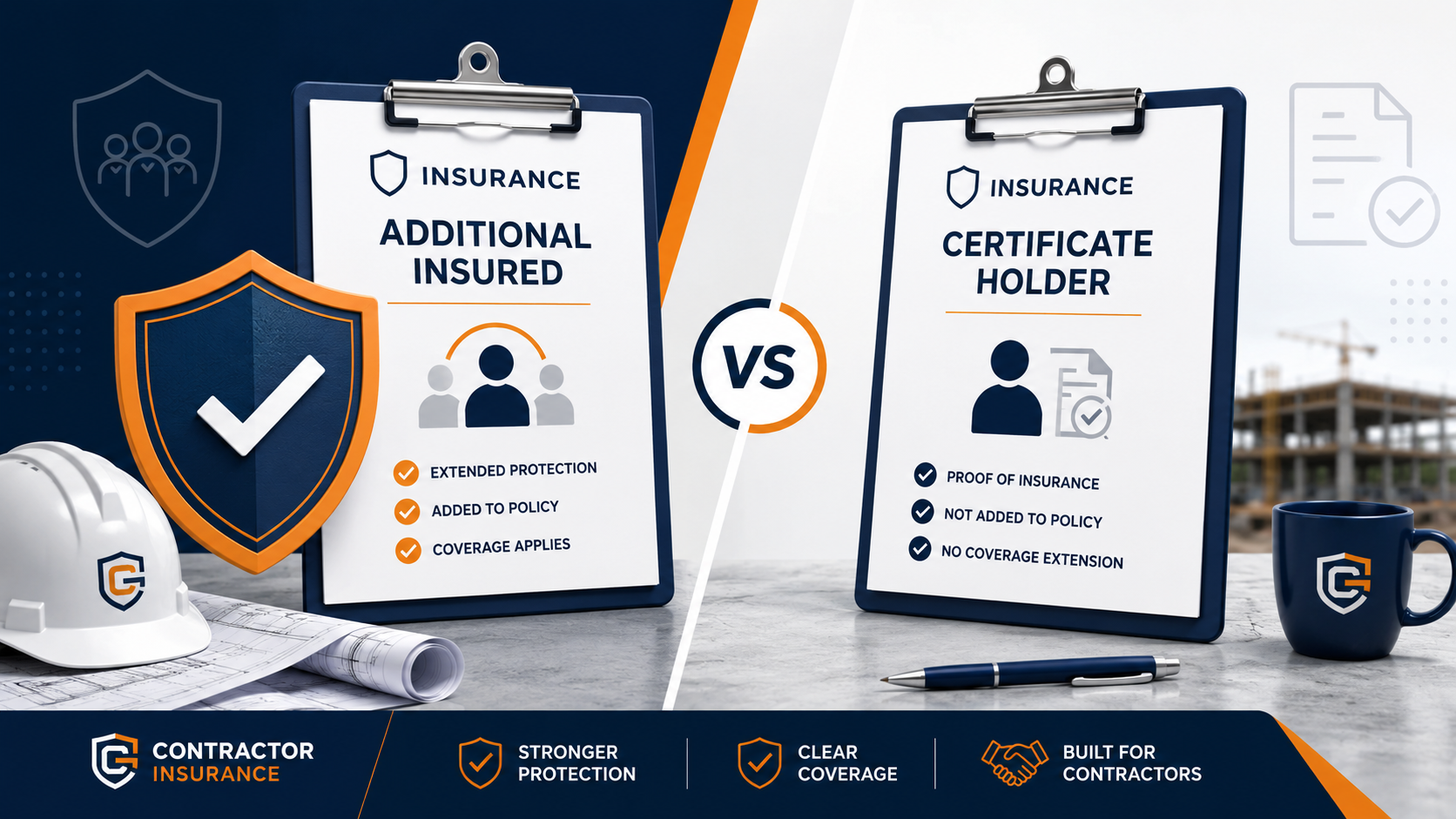
Additional Insured vs. Certificate Holder: What Is the Difference?
Contractors often hear the terms additional insured and certificate holder when a customer asks for proof of insurance. Although both may appear on the same certificate of insurance, they do not provide the same rights.
A certificate holder receives evidence that another business carries insurance. An additional insured receives limited protection under that business’s policy when the policy language or an endorsement grants that status.
The difference becomes critical after an accident. Being listed as the certificate holder does not automatically require the insurer to defend or cover that party. Additional insured status may provide that protection, but only for claims that fall within the endorsement and the underlying policy.
Additional Insured vs. Certificate Holder at a Glance
| Feature | Certificate Holder | Additional Insured |
|---|---|---|
| Receives a certificate of insurance | Yes | Usually |
| Receives proof that coverage exists | Yes | Yes |
| Automatically receives policy protection | No | Only when the policy or endorsement provides it |
| May receive a legal defense for a covered claim | No, based only on certificate holder status | Possibly |
| Can rely on wording typed onto the certificate | No | No |
| Requires an endorsement or qualifying policy provision | No | Usually |
| Shares the contractor’s liability limits | No coverage to share | Yes |
| Controls or owns the policy | No | No |
| Automatically receives cancellation notices | No | Not unless the policy, endorsement, or law provides notice rights |
A certificate of insurance cannot create rights that the underlying policy does not provide. Texas law, for example, states that a certificate cannot give the certificate holder new or additional rights beyond the referenced policy or an executed endorsement.
What Is a Certificate Holder?
A certificate holder is the person or organization that receives a certificate of insurance, commonly called a COI.
The certificate usually summarizes information such as:
- The insured contractor’s legal name
- Insurance company names
- Policy numbers
- Effective and expiration dates
- Types of insurance
- Policy limits
- Certificate holder information
- Certain endorsement indicators
A general contractor may ask a plumbing subcontractor for a certificate before allowing the plumber onto a jobsite. The general contractor becomes the certificate holder because it receives the document.
However, the certificate is only a summary. It is not the insurance contract, and it does not amend, extend, or alter the underlying coverage. The New York Department of Financial Services describes a certificate as a document that summarizes insurance information but does not give the holder rights beyond those provided by the policy.
What Rights Does a Certificate Holder Have?
Certificate holder status by itself usually provides no liability coverage.
It does not automatically give the holder the right to:
- Demand a legal defense
- Receive payment for a claim
- Change the policy
- Control the contractor’s insurance
- Access a separate policy limit
- Receive notice before cancellation
- Become an additional insured
The Connecticut Insurance Department specifically warns that a certificate does not make the holder an additional insured. That protection must come from an endorsement or the terms of the insurance policy.
Does a Certificate Holder Receive Cancellation Notice?
Not necessarily.
A certificate may include cancellation language, but the holder’s actual rights depend on the policy, an endorsement, or applicable law. The certificate cannot promise notice that the insurer has not agreed to provide.
Texas rules state that a person generally has notice rights only when those rights exist under the policy, an endorsement, or a law or regulation.
Therefore, contractors should not assume that listing a customer as a certificate holder guarantees 30 days’ notice before cancellation. A specific notice endorsement may be required.
What Is an Additional Insured?
An additional insured is a person or organization that receives limited coverage under another party’s insurance policy.
In a construction relationship:
- The subcontractor is usually the named insured.
- The general contractor or property owner may be the additional insured.
- Coverage usually applies only to liability connected to the subcontractor’s work.
- The endorsement defines the scope of protection.
An insurance endorsement changes the terms of the existing policy. It may add, remove, limit, or modify coverage. Therefore, the endorsement—not a statement typed onto the certificate—determines whether additional insured protection exists.
Example of Additional Insured Coverage
A general contractor hires an electrical subcontractor. The electrician leaves materials in a hallway, and a visitor trips over them.
The visitor sues both the electrician and the general contractor.
If the general contractor is an additional insured under the electrician’s general liability policy, the electrician’s insurer may defend the general contractor against qualifying allegations connected to the electrician’s operations.
If the general contractor is only the certificate holder, the certificate alone does not create that defense obligation.
Can Someone Be Both?
Yes. In fact, this is common.
A property owner or general contractor may be:
- Listed as the certificate holder on the COI; and
- Covered as an additional insured through an endorsement.
The certificate provides evidence of insurance. The endorsement provides the actual additional insured status.
These are separate functions. A party can appear in the certificate holder box without being an additional insured. It can also qualify under a blanket endorsement even when its name does not appear on a scheduled endorsement.
Does Checking the Additional Insured Box Create Coverage?
No.
Many certificates include a column marked “ADDL INSD.” An agent may place a mark in that column to indicate that additional insured provisions may apply.
However, the mark does not change the policy.
The additional insured must still qualify under:
- A scheduled endorsement
- A blanket endorsement
- Another provision within the policy
The Texas Department of Insurance explains that a certificate cannot individually name a holder as an additional insured when the policy only contains a blanket endorsement. The certificate may state that the blanket endorsement exists, but the policy terms determine who qualifies.
Scheduled vs. Blanket Additional Insured Coverage
Contractors can provide additional insured status through scheduled or blanket endorsements.
Scheduled Additional Insured Endorsement
A scheduled endorsement identifies a specific person, company, or organization.
For example, the endorsement may list:
- The project owner
- The general contractor
- The construction manager
- The project address
The contractor may need to request a new endorsement each time a customer requires coverage.
Blanket Additional Insured Endorsement
A blanket endorsement may automatically cover parties when the contractor agrees to add them in a written contract.
This approach can be more convenient for businesses that regularly sign contracts. However, the requesting party must satisfy all conditions in the endorsement.
Common requirements may include:
- A written contract must exist.
- The agreement must be signed before the accident.
- The contractor must be performing work for the additional insured.
- Coverage cannot exceed what the contract requires.
- The endorsement may apply only to a direct contractual relationship.
Oregon guidance explains that a party may receive additional insured protection through a blanket endorsement or through an endorsement that specifically adds the person or organization.
Ongoing Operations vs. Completed Operations
Contractors must also determine whether the additional insured endorsement applies during the project, after completion, or both.
Ongoing Operations Coverage
Ongoing operations coverage applies while the named insured is actively performing the contracted work.
Examples include:
- A visitor trips over a subcontractor’s materials.
- A falling tool damages a parked car.
- A plumbing subcontractor causes a leak during installation.
- Roofing materials damage neighboring property during the project.
This coverage may end when the contractor’s work is completed.
Completed Operations Coverage
Completed operations coverage may apply after the work has ended.
Examples include:
- A pipe connection leaks weeks after installation.
- Incorrect wiring causes a later fire.
- A roof begins leaking after the project is finished.
- A railing detaches after the building is occupied.
A construction contract may require separate protection for both ongoing and completed operations. Oregon’s contract insurance guidance requires additional insured status for both when applicable to a contractor’s work.
Receiving ongoing operations coverage does not guarantee completed operations protection. Contractors should review the endorsement numbers and language instead of relying only on the certificate.
Does Additional Insured Status Cover Everything?
No. Additional insured coverage is limited.
It usually does not:
- Cover unrelated operations of the additional insured
- Remove exclusions from the contractor’s policy
- Increase the available liability limits
- Replace professional liability coverage
- Replace workers’ compensation
- Cover the additional insured under every policy
- Give the additional insured ownership of the policy
- Pay to correct defective work when no covered resulting damage exists
Coverage may also be limited to liability caused, at least partly, by the named insured’s work or actions.
For example, if a property owner causes an unrelated accident, the contractor’s additional insured endorsement may not apply. The exact result depends on the endorsement, policy, contract, state law, and allegations in the claim.
Do Additional Insureds Receive Separate Limits?
Usually not.
The named insured and additional insured generally share the same policy limits.
Suppose a contractor carries:
- $1 million per occurrence
- $2 million general aggregate
Adding a general contractor as an additional insured does not create another $1 million limit. Claims involving either party may reduce the same available limits.
This is one reason contractors should consider whether contractual requirements and project risks justify higher primary limits or commercial umbrella insurance.
Additional Insured vs. Named Insured
The named insured is the person or business that owns the policy. The additional insured receives only the protection granted by the policy or endorsement.
| Feature | Named Insured | Additional Insured |
|---|---|---|
| Purchases the policy | Yes | No |
| Pays the premium | Usually | Usually not |
| Can request policy changes | Yes | No |
| Receives broad policy rights | Yes | Limited |
| May cancel the policy | Yes | No |
| Shares policy limits | Yes | Yes |
| Coverage depends on connection to another party’s work | No | Usually |
An additional insured should not be confused with an additional named insured. The latter may receive broader policy rights and responsibilities.
Primary and Noncontributory Coverage
Contracts often require additional insured protection to be primary and noncontributory.
Primary means the contractor’s policy responds before the additional insured’s own insurance for a qualifying claim.
Noncontributory means the contractor’s insurer does not seek contribution from the additional insured’s insurance for that claim.
Additional insured status does not automatically guarantee this arrangement. The contractor may need a separate endorsement or policy provision.
Is a Waiver of Subrogation the Same?
No.
A waiver of subrogation restricts an insurer’s ability to recover claim payments from another party. Additional insured status may provide liability protection and a legal defense to that party.
A contract may require all three:
- Additional insured status
- Primary and noncontributory coverage
- Waiver of subrogation
Each requirement performs a different function. Each may also require its own endorsement.
What Contractors Should Request From Subcontractors
A general contractor should not stop after receiving a certificate.
The insurance review should include:
- Certificate of insurance: Confirms policy dates, insurers, limits, and basic coverage.
- Additional insured endorsement: Shows how and when the requesting party receives protection.
- Ongoing operations endorsement: Applies while the subcontractor performs the work.
- Completed operations endorsement: Applies to qualifying claims after completion.
- Primary and noncontributory endorsement: Establishes the intended order of coverage.
- Waiver of subrogation endorsement: Restricts certain recovery actions by the insurer.
- Renewal documents: Confirm coverage remains active throughout the project.
- Correct legal names: Prevent mismatches between contracts and insurance documents.
Government contract requirements often request copies of the actual endorsements in addition to certificates. Sonoma County, for example, requires policy language or endorsements that grant additional insured status.
Common Contractor Mistakes
Treating the Certificate as the Policy
A COI summarizes coverage. It does not replace the policy or endorsements.
Assuming Certificate Holder Means Additional Insured
The statuses are separate. Certificate holder status alone provides evidence, not liability protection.
Relying on the Additional Insured Box
A mark on the certificate does not amend the insurance contract.
Checking Only Ongoing Operations
Construction claims can appear months or years later. Completed operations protection may be equally important.
Using the Wrong Legal Name
The contract, certificate, and scheduled endorsement should identify the correct legal entity.
Ignoring Expiration Dates
A certificate issued at the start of a long project may expire before the work ends. Contractors should track renewals.
Assuming Cancellation Notice Is Automatic
Notice rights must come from the policy, an endorsement, or applicable law.
Frequently Asked Questions
Is a Certificate Holder Covered by the Contractor’s Policy?
Not solely because it is the certificate holder. Coverage requires the party to qualify as an insured under the policy or an endorsement.
Does an Additional Insured Need a Certificate?
The certificate is useful evidence, but the endorsement creates or confirms the coverage. Contractors should provide both when requested.
Can a Homeowner Be a Certificate Holder?
Yes. A contractor can issue a certificate showing the homeowner as the holder. That status alone does not make the homeowner an additional insured.
Can a Homeowner Be an Additional Insured?
Possibly. The insurer must allow it, and the endorsement must apply. However, additional insured requests are more common in commercial and subcontracting relationships.
Does Additional Insured Status Cost More?
It may. Some policies include blanket coverage, while others charge for scheduled endorsements or expanded completed operations protection.
Can a Certificate Guarantee Notice of Cancellation?
No. Notice rights depend on the insurance policy, an endorsement, or state law. The certificate cannot independently create them.
Does Additional Insured Coverage Replace Indemnification?
No. Insurance and contractual indemnification are related but separate risk-transfer tools. An attorney should review the indemnification clause, while an insurance professional should review the policy and endorsements.
Conclusion
The difference between an additional insured and a certificate holder comes down to coverage versus evidence.
A certificate holder receives a document showing that the contractor had specified insurance when the certificate was issued. It does not automatically receive protection under the policy.
An additional insured may receive limited liability coverage when the policy or an endorsement grants that status. However, the protection remains subject to policy limits, exclusions, conditions, and the connection between the claim and the named insured’s work.
Contractors should provide both the certificate and the required endorsements. General contractors and property owners should review ongoing operations, completed operations, primary and noncontributory wording, waiver of subrogation, policy limits, and expiration dates before work begins.
Editorial review: This guide was researched and reviewed by the Coverage Editorial Team using government agencies, insurance regulators, licensing authorities, policy documentation, and current industry pricing sources.