
What Does “Primary and Noncontributory” Mean in Contractor Insurance?
“Primary and noncontributory” is insurance wording commonly required in construction contracts, subcontractor agreements, commercial leases, and service contracts.
When a contractor’s insurance is primary, that policy is intended to respond first to a covered claim involving an additional insured. When the coverage is noncontributory, the contractor’s insurer generally agrees not to seek contribution from the additional insured’s own insurance for that claim.
For example, a general contractor may require a plumbing subcontractor to add the general contractor as an additional insured on a primary and noncontributory basis. If both parties are sued over an accident arising from the plumber’s work, the plumber’s policy may respond before the general contractor’s policy, subject to the endorsement, policy terms, applicable limits, and circumstances of the claim.
This wording does not automatically appear in every general liability policy. It must be supported by the policy’s “other insurance” provisions or an applicable endorsement. Writing the phrase on a certificate of insurance does not create the coverage by itself.
Primary and Noncontributory Meaning at a Glance
| Term | What it generally means |
|---|---|
| Primary | The contractor’s policy responds before the additional insured’s other applicable insurance |
| Noncontributory | The contractor’s insurer does not seek to share the covered loss with the additional insured’s insurer |
| Additional insured | A client or other organization receiving limited protection under the contractor’s policy |
| Certificate holder | A party receiving evidence that the contractor has insurance |
| Endorsement | A document that adds, removes, or changes policy terms |
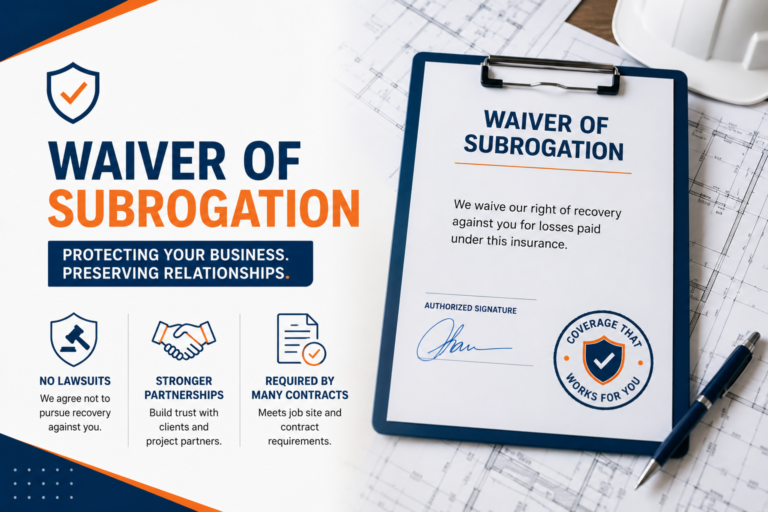
| Waiver of subrogation | A separate provision limiting an insurer’s right to pursue recovery from another party |
New York State contract requirements provide a practical example: required contractor liability coverage must be primary and noncontributory, while insurance maintained by the state is treated as excess and does not contribute with the contractor’s insurance.
What Does “Primary” Mean?
Primary insurance is the policy intended to respond first when more than one policy could potentially cover the same insured and claim.
In a contractor relationship, the parties may include:
- The contractor or subcontractor
- A general contractor
- The project owner
- A property manager
- A landlord
- A government agency
- Other organizations named in the contract
Suppose a remodeling subcontractor adds the general contractor as an additional insured. Both businesses have their own general liability policies.
If a customer files a covered property damage claim arising from the remodeling subcontractor’s work, primary wording may require the subcontractor’s policy to respond before the general contractor’s own liability policy.
The general contractor’s policy may then remain excess, potentially responding only after the applicable limits of the subcontractor’s policy have been exhausted.
Primary Does Not Mean Automatically Covered
Primary status determines the intended order in which applicable insurance responds. It does not establish that:
- The contractor was legally responsible
- The incident is covered
- The additional insured qualifies for coverage
- No exclusion applies
- The insurer must pay the full claim
- The policy limits are sufficient
The insurer must still review the allegations, additional insured endorsement, policy period, exclusions, limits, and facts of the incident.
What Does “Noncontributory” Mean?
Noncontributory wording generally means the contractor’s insurer will not request that the additional insured’s insurer contribute to the covered claim.
Without noncontributory wording, two insurers might attempt to divide defense costs, settlements, or judgments according to their policies’ “other insurance” provisions.
With primary and noncontributory treatment:
- The contractor’s policy is intended to respond first.
- The additional insured’s own policy is generally treated as excess.
- The contractor’s insurer does not seek contribution from that other insurance, subject to the endorsement.
El Dorado County, California, provides an official example of this requirement. Its contractor insurance instructions require the endorsement to state that coverage applies on a primary and noncontributory basis and that the county’s own insurance is excess and does not contribute with the contractor’s policy.
How Primary and Noncontributory Coverage Works
Consider the following example.
A plumbing subcontractor is hired for a commercial renovation. The subcontract requires the plumber to:
- Carry commercial general liability insurance
- Add the general contractor as an additional insured
- Provide coverage on a primary and noncontributory basis
During the project, a plumbing connection fails and causes extensive water damage. The building owner sues both the plumber and the general contractor.
If the claim is covered and the endorsement applies:
- The plumber’s insurer may defend the plumber.
- The plumber’s insurer may also defend the general contractor as an additional insured.
- The plumber’s policy may respond before the general contractor’s own policy.
- The plumber’s insurer generally would not request contribution from the general contractor’s insurer.
- Both insureds would share the plumber’s available policy limits.
If the claim resulted entirely from unrelated actions by the general contractor, additional insured coverage might not apply. The result depends on the allegations, endorsement language, policy terms, and applicable state law.
Is Primary and Noncontributory the Same as Additional Insured?
No. These are related but separate requirements.
Additional Insured Status
Additional insured status grants a client or other organization limited protection under the contractor’s policy.
Primary and Noncontributory Status
Primary and noncontributory wording determines how the contractor’s insurance interacts with the additional insured’s other available insurance.
A contract may require both:
- The client must be an additional insured.
- Coverage for that additional insured must be primary and noncontributory.
Adding a client as an additional insured does not automatically guarantee primary and noncontributory treatment. The policy or endorsement must support the requested arrangement.
Certificate Holder vs. Primary and Noncontributory Coverage
A certificate holder is simply the recipient of a certificate of insurance.
Being listed as a certificate holder does not automatically make the client:
- An additional insured
- Entitled to primary coverage
- Entitled to noncontributory protection
- Entitled to cancellation notice
- Covered under the contractor’s policy
The Texas Department of Insurance explains that certificates may not grant rights or state protections beyond those contained in the policy or executed endorsements. A certificate’s additional insured or waiver-of-subrogation indication should be used only when the supporting policy endorsement exists.
The same principle applies to primary and noncontributory wording. Typing the phrase into the description-of-operations section cannot create coverage that the insurance contract does not provide.
How Is Primary and Noncontributory Coverage Added?
A contractor should send the complete insurance section of the contract to the agent or broker before signing the agreement.
The insurance professional can then determine whether coverage is provided through:
- The policy’s existing “other insurance” provisions
- A scheduled endorsement
- A blanket primary and noncontributory endorsement
- An additional insured endorsement containing appropriate wording
- A combination of endorsements
Scheduled Endorsement
A scheduled endorsement may identify the specific organization receiving the protection.
The agent may need:
- Additional insured’s legal name
- Mailing address
- Project name
- Work location
- Contract number
Blanket Endorsement
A blanket endorsement may apply automatically when the contractor agrees in a qualifying written contract to provide primary and noncontributory coverage.
Blanket endorsements commonly contain conditions. For example, the written agreement may need to be signed before the work or accident occurs.
Contractors should not assume that every client automatically qualifies. The agent should review the contract and endorsement language.
Which Policies May Need the Wording?
Primary and noncontributory requirements most commonly apply to commercial general liability insurance, but contracts may also require them for:
- Business auto liability
- Commercial umbrella or excess liability
- Pollution liability
- Other specialized liability policies
New York State’s January 2026 contractor insurance requirements, for example, require commercial general liability, business automobile liability, and umbrella or excess liability coverage to apply on a primary and noncontributory basis relative to the state’s other available insurance.
The requirement does not generally work the same way for workers’ compensation. Contracts may instead request a waiver of subrogation under the workers’ compensation policy.
Primary and Noncontributory vs. Waiver of Subrogation
These provisions address different issues.
| Provision | Main purpose |
|---|---|
| Additional insured | Gives another party limited insured status |
| Primary and noncontributory | Establishes order of coverage and limits contribution from the additional insured’s insurer |
| Waiver of subrogation | Limits the insurer’s ability to pursue recovery against a specified party after paying a claim |
A contract may require all three.
For example, a general contractor may require a subcontractor to:
- Add the general contractor as an additional insured.
- Make that coverage primary and noncontributory.
- Provide a waiver of subrogation.
Each requirement must be supported by the relevant policy wording or endorsement. One does not automatically create the others.
Does the Wording Increase Policy Limits?
No. Primary and noncontributory wording generally does not increase the contractor’s coverage limits.
Suppose a contractor has:
- $1 million each-occurrence limit
- $2 million general aggregate
- $2 million products-completed operations aggregate
Adding a project owner and general contractor on a primary and noncontributory basis does not provide separate $1 million limits for each party. The contractor and all qualifying additional insureds generally share the available limits.
A large claim involving several insured parties can reduce or exhaust those limits. Contractors working on higher-value projects may need commercial umbrella or excess liability coverage.
Does It Apply to Completed Operations?
Not automatically.
A contract may require primary and noncontributory coverage for:
- Ongoing operations
- Completed operations
- Both periods
Ongoing operations coverage applies while the contractor is actively performing work. Completed operations coverage applies to certain claims arising after the work has been finished.
For example, completed operations coverage may become relevant when:
- A pipe connection later leaks.
- Installed wiring allegedly causes a fire.
- A mounted cabinet falls after installation.
- Completed roofing work causes later water intrusion.
An endorsement covering ongoing work does not necessarily protect the additional insured after completion. Contractors should confirm that completed operations additional insured coverage and primary wording are both included when the contract requires them.
Why Do Clients Require Primary and Noncontributory Coverage?
Clients use this requirement to transfer contract-related risk to the contractor performing the work.
A general contractor or project owner may want:
- The contractor’s policy to handle claims arising from the contractor’s operations
- The client’s own insurance to remain excess
- The client’s loss history and policy limits to be protected
- Fewer disputes between insurers about contribution
- Evidence that subcontractors satisfy contractual insurance standards
This requirement is particularly common in commercial construction, government contracts, property management agreements, and subcontractor relationships.
It does not eliminate the client’s need for its own insurance. The client’s policy may still respond to unrelated claims or losses exceeding the contractor’s available coverage.
How to Prove Primary and Noncontributory Coverage
A client may ask for:
- Certificate of insurance
- Additional insured endorsement
- Primary and noncontributory endorsement
- Completed operations endorsement
- Policy excerpts showing other-insurance provisions
The strongest evidence is the actual policy endorsement—not a sentence typed onto the COI.
Texas insurance rules prohibit certificates from altering, extending, or misrepresenting the underlying coverage. Certificates can reflect policy information, but they cannot substitute for insurance contract language.
Before submitting documents, contractors should verify:
- Correct legal names
- Policy numbers
- Effective dates
- Required coverage types
- Additional insured status
- Primary and noncontributory wording
- Completed operations protection
- Applicable limits
- Required endorsements
Common Contractor Mistakes
Assuming Additional Insured Status Is Enough
A client may be an additional insured without the contractor’s policy being primary and noncontributory.
Relying Only on the Certificate
The certificate cannot create or expand coverage. The policy endorsement must support the statement.
Ignoring Completed Operations
Primary wording for ongoing work may not satisfy a contract requiring protection after project completion.
Signing the Contract Before Insurance Review
The contractor may accept requirements that are unavailable, expensive, or broader than the current policy.
Using the Wrong Legal Name
The additional insured’s name should match the entity listed in the contract.
Assuming the Wording Creates More Limits
Primary and noncontributory status changes how policies interact; it does not provide additional liability limits.
Frequently Asked Questions
What does primary and noncontributory insurance mean?
It generally means the contractor’s policy responds before the additional insured’s other applicable insurance and does not seek contribution from that other insurer.
Is primary and noncontributory coverage automatic?
No. It must be supported by the policy or an endorsement.
Is it the same as additional insured status?
No. Additional insured status provides limited coverage. Primary and noncontributory wording determines how that coverage interacts with the additional insured’s own insurance.
Can a COI prove primary and noncontributory coverage?
A COI may indicate that the protection applies, but the underlying policy or endorsement controls. Clients may request the endorsement itself.
Does it cover the client’s own negligence?
Not necessarily. Coverage depends on the additional insured endorsement, allegations, state law, and relationship between the claim and the contractor’s operations.
Does it increase the contractor’s limits?
No. The contractor and qualifying additional insureds generally share the existing policy limits.
Does it apply after the job is finished?
Only when the policy and endorsements provide the required completed operations protection.
Does every subcontractor need it?
Not universally, but general contractors and project owners frequently require it through written subcontract agreements.
Conclusion
Primary and noncontributory contractor insurance means the contractor’s policy is intended to respond first to a covered additional insured claim without seeking contribution from the additional insured’s other applicable insurance.
The requirement is separate from additional insured status, certificate-holder status, and a waiver of subrogation. A contract may require all of them, and each must be supported by appropriate policy language or endorsements.
Contractors should review insurance requirements before signing a contract, confirm whether protection applies to ongoing and completed operations, and obtain the actual endorsements from their agent.
Do not rely solely on wording printed on a certificate of insurance. The policy and endorsements determine whether primary and noncontributory coverage exists and how it will apply after a claim.