
Does Contractor Insurance Cover Trailers and Mobile Equipment?
Contractor insurance can cover trailers and mobile equipment. However, one policy rarely covers every related risk.
A trailer may need commercial auto liability and physical damage coverage. Meanwhile, its contents may require tools and equipment insurance. Mobile machinery often needs a contractors’ equipment floater or another form of inland marine insurance.
Liability coverage can also change with the equipment’s use. A machine used only at jobsites may be treated differently from equipment driven on public roads.
Therefore, contractors should insure the trailer, its contents, and the equipment as separate exposures.
Quick Answer
| Property or risk | Coverage that may apply |
|---|---|
| Liability while towing a trailer | Commercial auto liability |
| Collision damage to the trailer | Commercial auto physical damage |
| Theft, fire, or vandalism affecting the trailer | Comprehensive physical damage |
| Tools stored inside an enclosed trailer | Tools and equipment insurance |
| Materials awaiting installation | Installation floater |
| Skid steers, excavators, and similar machinery | Contractors’ equipment or inland marine |
| Liability from off-road equipment operations | General liability or another policy, depending on classification |
| Equipment driven on public roads | Commercial auto may be required |
| Rented trailer or machinery | Hired auto, rented equipment, or leased equipment coverage |
| Employee injuries while operating equipment | Workers’ compensation |
| Losses above basic liability limits | Commercial umbrella |
The exact policy depends on ownership, road use, registration, transportation, storage, and contract requirements.
Does Commercial Auto Insurance Cover a Contractor’s Trailer?
It may cover a trailer, but coverage is not always automatic.
Commercial auto liability may extend to a trailer while an insured vehicle tows it. However, the business auto policy must treat the towing vehicle and trailer as covered autos.
Commercial auto policies can assign different coverage to different vehicles. They use scheduled vehicles and covered-auto symbols to define which autos receive liability or physical damage protection. (insurance.ca.gov)
Therefore, a contractor should not assume that every trailer attached to an insured truck has full coverage.
Liability Coverage
Commercial auto liability may respond when a trailer causes injury or property damage during towing.
For example, coverage may apply when:
- A trailer detaches and strikes another vehicle
- The trailer damages a parked car
- Equipment falls from the trailer
- The trailer swings into another lane
- The driver damages property while backing up
Liability coverage protects against qualifying claims made by other people. It does not usually pay to repair the contractor’s own trailer.
Physical Damage Coverage
The contractor may need separate collision and comprehensive coverage for the trailer itself.
Collision coverage may pay after:
- A rollover
- A crash
- An impact with another object
- Jackknifing
- Damage during a towing accident
Comprehensive coverage may protect against:
- Theft
- Fire
- Vandalism
- Hail
- Falling objects
- Certain weather losses
The trailer may need to appear on the policy schedule. In addition, the contractor should confirm its stated value and deductible.
Texas insurance guidance notes that commercial auto insurance can cover trailers and service vehicles used by a business. Still, selected coverage determines whether the policy includes liability, physical damage, or both. (tdi.texas.gov)
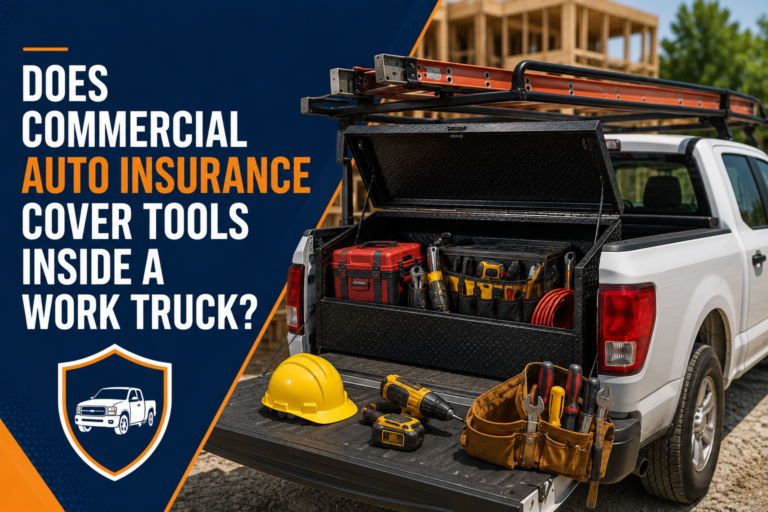
Does Trailer Insurance Cover the Tools Inside?
Usually, trailer coverage protects the trailer rather than every item stored inside it.
For example, thieves may steal an enclosed trailer containing $30,000 in tools. Commercial auto comprehensive coverage may pay for the trailer. However, the tools may require separate inland marine coverage.
Contractors commonly protect portable tools through:
- Tools and equipment insurance
- A contractors’ equipment floater
- Commercial inland marine insurance
The Texas Department of Insurance identifies contractors’ equipment and property in transit as common inland marine exposures. (tdi.texas.gov)
A single theft may therefore involve two claims:
- A commercial auto claim for the trailer
- An inland marine claim for its contents
Separate deductibles may apply.
What Is Mobile Equipment?
Mobile equipment generally includes machinery that can move but is mainly designed for use away from public roads.
Examples may include:
- Skid-steer loaders
- Mini excavators
- Backhoes
- Bulldozers
- Trenchers
- Graders
- Scissor lifts
- Boom lifts
- Forklifts
- Portable compressors
- Certain generators
Texas insurance rules describe mobile equipment as contractors’ and industrial equipment that is not primarily designed for highway use. Those rules place such movable property within commercial inland marine classifications. (tdi.texas.gov)
However, insurance policies may define mobile equipment differently. The classification can also change because of registration, road use, or permanently attached machinery.
What Insurance Covers Physical Damage to Mobile Equipment?
Contractors often insure mobile machinery through a contractors’ equipment policy or inland marine floater.
This coverage may protect equipment while it is:
- At a jobsite
- Stored in a yard
- Transported on a trailer
- Used at a customer’s property
- Kept at a temporary location
- Rented or leased, when included
Commercial inland marine policies can include contractors’ equipment floaters and transportation-related coverage. (insurance.ca.gov)
Covered Losses
Depending on the policy, coverage may apply to:
- Theft
- Fire
- Vandalism
- Wind
- Hail
- Collision
- Overturn
- Accidental impact
- Certain transportation losses
Still, the policy may exclude wear, poor maintenance, mechanical failure, and other causes.
Scheduled Equipment
High-value machinery often needs to be listed separately.
The schedule may include:
- Manufacturer
- Model
- Serial number
- Year
- Insured value
- Ownership status
The contractor should review the schedule after every purchase or sale.
Who Covers Liability From Mobile Equipment?
The answer depends on how the policy classifies the machine and what it was doing during the accident.
General liability may apply to some claims involving equipment used as part of jobsite operations. Commercial auto may apply when the equipment qualifies as an auto or creates a road-use exposure.
The California Department of Insurance treats commercial automobile and commercial general liability as separate casualty coverages. It also stresses that exclusions and policy definitions determine which contract responds. (insurance.ca.gov)
Consider these examples:
- A skid steer damages a customer’s wall at a jobsite.
- An excavator strikes an underground utility.
- A lift injures a visitor during operations.
- Self-propelled equipment collides with a car on a public road.
These events may not receive identical coverage.
Therefore, contractors should ask how the policy treats:
- Equipment used only off-road
- Equipment that crosses public roads
- Registered or licensed machinery
- Equipment with permanently attached tools
- Loading and unloading operations
- Transportation on a trailer
When Mobile Equipment May Need Commercial Auto Coverage
Some equipment creates an auto exposure because it travels on public roads.
Commercial auto may become necessary when the equipment is:
- Registered as a motor vehicle
- Licensed for highway use
- Regularly driven between jobsites
- Used to transport people or property
- Required by law to carry auto liability coverage
A machine’s appearance does not decide its insurance classification. Its design, registration, and actual use all matter.
For example, a dump truck with permanently attached equipment is still different from an excavator carried on a trailer. The contractor should give the insurer a full description of each unit.
What About Equipment Transported on a Trailer?
Transporting equipment creates several separate risks.
Damage to the Tow Vehicle
Commercial auto collision or comprehensive coverage may protect the insured truck.
Damage to the Trailer
The trailer needs its own physical damage protection when the contractor wants coverage for repair or replacement.
Damage to the Equipment
A contractors’ equipment policy may cover the machinery during transportation.
Damage Caused to Others
Commercial auto liability may respond when the truck, trailer, or transported load causes a qualifying accident.
For example, a poorly secured excavator may shift and cause the trailer to overturn. That event could involve the truck, trailer, equipment, and third-party property.
Contractors should confirm whether their inland marine policy covers loading, unloading, collision, and overturn.
Are Rented Trailers and Mobile Equipment Covered?
Not automatically.
A contractor may need special protection for property rented, leased, or borrowed from others.
Rented Trailers
A rented trailer may require:
- Hired auto liability
- Hired auto physical damage
- The rental company’s protection plan
- A scheduled or temporary commercial auto endorsement
The rental agreement may make the contractor responsible for theft, collision damage, loss of use, and related fees.
Rented Mobile Equipment
A contractors’ equipment policy may include rented equipment. However, it often has a separate limit.
For example, a policy may provide:
- $100,000 for owned machinery
- $25,000 for rented equipment
- A $2,500 deductible
That policy would leave a large gap if the contractor rented a machine worth $60,000.
The limit should reflect the equipment’s replacement value, not the rental fee.
Common Coverage Gaps
Contractors often discover gaps only after a claim.
The Trailer Is Not Scheduled
The towing vehicle may have liability coverage while the trailer lacks physical damage protection.
The Contents Are Not Insured
Trailer coverage does not necessarily replace tools or materials stored inside.
The Equipment Limit Is Too Low
The policy may have a lower limit for rented or unscheduled machinery.
Road Use Was Not Disclosed
An insurer may classify equipment differently when it regularly travels on public roads.
Employee Tools Are Excluded
Tools owned by employees may need a separate limit.
Mechanical Breakdown Is Excluded
A standard equipment policy may cover external accidents but not internal mechanical failure.
Contractual Charges Are Not Covered
A rental company may demand continuing rent, transportation costs, or loss-of-use fees. The insurance policy may not cover every charge.
Replacement Cost vs. Actual Cash Value
The valuation method affects how much the insurer pays.
Replacement Cost
Replacement cost generally reflects the cost of replacing damaged property with comparable new property.
Actual Cash Value
Actual cash value usually subtracts depreciation for age, condition, and wear.
The NAIC explains that actual cash value accounts for depreciation. Replacement cost is based on repairing or replacing property with comparable property. (content.naic.org)
For example, a used trailer may cost $18,000 to replace. However, its actual cash value may be only $11,000.
Contractors should confirm how the policy values:
- Trailers
- Scheduled machinery
- Unscheduled tools
- Rented equipment
- Custom modifications
Do Federal Commercial Vehicle Rules Apply?
Federal rules may apply when a contractor uses a truck-and-trailer combination in interstate commerce.
FMCSA defines certain vehicles as commercial motor vehicles when their gross vehicle weight rating reaches federal thresholds. The combination rating can include both the towing vehicle and trailer. (fmcsa.dot.gov)
For example, FMCSA explains that a pickup rated at 7,000 pounds and a trailer rated at 2,000 pounds would remain below the 10,001-pound threshold in that example. A heavier combination could qualify differently. (fmcsa.dot.gov)
However, federal insurance filing rules do not apply to every local contractor. They depend on factors such as operating authority, vehicle type, cargo, and motor-carrier status. (fmcsa.dot.gov)
State requirements may also apply. Contractors should review both state and federal rules when they cross state lines or operate heavier combinations.
What Other Insurance May Be Needed?
Workers’ Compensation
Workers’ compensation may cover eligible employees injured while loading, towing, or operating equipment.
Commercial Umbrella
A commercial umbrella may provide additional liability limits above commercial auto or general liability.
Installation Floater
An installation floater may cover materials awaiting installation. Examples include HVAC units, cabinets, and electrical equipment.
Equipment Breakdown
Equipment breakdown coverage may address certain internal mechanical or electrical failures. Standard inland marine coverage may exclude them.
Pollution Liability
Pollution coverage may be necessary when equipment carries fuel, chemicals, or other environmental exposures.
How Much Coverage Should a Contractor Buy?
Start with the maximum value exposed in one event.
Include:
- Tow vehicle value
- Trailer replacement cost
- Trailer modifications
- Tools stored inside
- Materials in transit
- Mobile equipment
- Rented machinery
- Employee tools
- Customer property
Then, review all sublimits.
Important restrictions may include:
- Maximum per trailer
- Maximum at one jobsite
- Per-item limit
- Rented equipment limit
- Theft sublimit
- Property-in-transit limit
- Employee-tools limit
- Deductible
The SBA recommends comparing policy terms and benefits, not only premiums. It also advises business owners to work with a licensed commercial insurance professional. (sba.gov)
Trailer and Mobile Equipment Insurance Checklist
Before purchasing coverage, confirm:
- Every owned trailer appears on the correct policy.
- Liability and physical damage coverage are both reviewed.
- Tools inside trailers have separate coverage.
- Mobile equipment is listed with accurate values.
- Rented and borrowed property is included.
- Road use has been disclosed.
- Loading and unloading coverage has been reviewed.
- Employee operators are properly covered.
- Replacement cost or actual cash value is understood.
- The umbrella includes the correct underlying policies.
- Federal and state vehicle rules have been checked.
Frequently Asked Questions
Does commercial auto insurance automatically cover a trailer?
Not always. Liability may extend while towing, but physical damage often requires the trailer to be scheduled.
Does trailer insurance cover tools inside?
Usually not automatically. Portable tools generally need tools and equipment or inland marine insurance.
Does general liability cover mobile equipment?
It may cover some jobsite liability claims. However, classification, exclusions, registration, and road use can change the result.
Does inland marine cover trailers?
It may cover certain equipment or movable property. However, road trailers are often insured through commercial auto physical damage coverage.
Are rented trailers covered?
Only when the policy includes the appropriate hired, rented, or temporary trailer protection.
Is equipment covered while being transported?
It may be covered under a contractors’ equipment policy. Contractors should confirm loading, unloading, collision, and overturn coverage.
Does insurance cover mechanical failure?
Not usually under standard physical damage coverage. Equipment breakdown protection may be required.
Does a contractor need coverage for an unused trailer?
The trailer can still face theft, fire, vandalism, and weather risks while parked.
Conclusion
Contractor insurance can cover trailers and mobile equipment. However, contractors often need several policies working together.
Commercial auto may cover towing liability and physical damage to a scheduled trailer. Tools and equipment insurance may protect the trailer’s contents. Meanwhile, a contractors’ equipment floater may cover excavators, lifts, skid steers, and other mobile machinery.
Liability coverage can change based on the equipment’s classification and use. Road travel, registration, rentals, and jobsite operations must all be disclosed.
Before buying coverage, list every trailer, machine, tool, and material. Then, calculate the maximum value exposed in one loss.
Finally, review policy limits, sublimits, deductibles, and exclusions with a licensed insurance professional. This process can prevent a towing accident, theft, or equipment loss from creating a major uninsured expense.
Editorial review: This guide was researched and reviewed by the Coverage Editorial Team using government agencies, insurance regulators, licensing authorities, policy documentation, and current industry pricing sources.