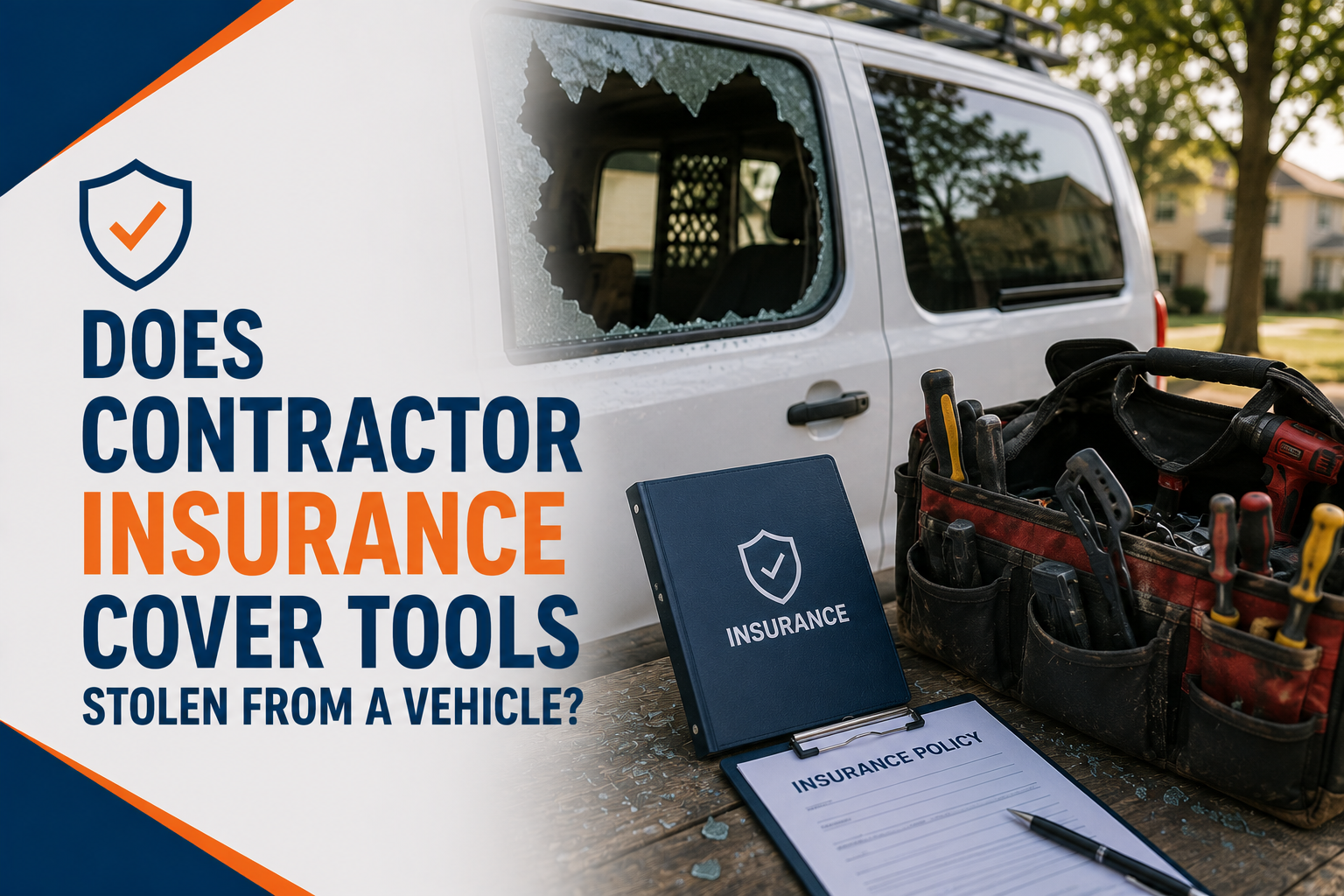
Does Contractor Insurance Cover Tools Stolen From a Vehicle?
Contractor insurance may cover tools stolen from a work truck, van, or trailer, but the claim is usually handled under contractors’ tools and equipment insurance or another form of inland marine coverage—not standard commercial auto insurance.
Commercial auto insurance primarily protects the vehicle and addresses auto-related liability. Even when comprehensive coverage pays for damage to the van or the theft of the entire vehicle, it may not pay for drills, saws, testing equipment, ladders, compressors, or other business property stored inside.
Inland marine insurance is designed for movable business property that travels between locations or is kept away from the contractor’s main premises. The Texas Department of Insurance identifies contractor equipment and property in transit as common inland marine exposures, while the California Department of Insurance describes inland marine as coverage for movable property and equipment floaters.
Whether a theft claim is covered depends on the exact policy, including its theft provisions, vehicle-storage conditions, coverage limits, deductibles, valuation method, and exclusions.
Quick Answer
Tools stolen from a vehicle may be covered when:
- The contractor has active tools and equipment or inland marine insurance.
- Theft is a covered cause of loss.
- The tools qualify as covered property.
- The vehicle was secured as required by the policy.
- The theft occurred within the coverage territory.
- The contractor reports the incident promptly.
- The contractor can document ownership and value.
- No unattended-vehicle, overnight-storage, or other exclusion applies.
Coverage may be denied or limited when the contractor carries only commercial auto or general liability insurance, leaves the vehicle unlocked, cannot prove ownership, exceeds a per-item sublimit, or violates a policy condition.
Which Insurance Policy Covers Stolen Contractor Tools?
Several policies may appear relevant after a vehicle break-in, but they protect different property and risks.
| Insurance policy | What it may cover after a vehicle theft |
|---|---|
| Commercial auto | Damage to or theft of the insured vehicle, if comprehensive coverage applies |
| Contractors’ tools and equipment | Covered tools stolen from the vehicle |
| Inland marine | Movable tools, equipment, and materials away from the main business location |
| Commercial property | Business property primarily kept at a scheduled location, sometimes with limited off-premises coverage |
| Business owner’s policy | Property and liability coverage, but off-premises tools may require an endorsement |
| General liability | Third-party injury and property damage claims, not theft of the contractor’s own tools |
| Crime insurance | Certain criminal losses, depending on the form, but not a substitute for a tools floater |
Texas insurance guidance distinguishes commercial auto protection for business vehicles from inland marine coverage for contractor equipment and property in transit.
Does Commercial Auto Insurance Cover Tools Inside the Vehicle?
Commercial auto insurance generally protects the insured vehicle rather than all business property carried inside it.
If someone breaks into a work van, commercial auto comprehensive coverage may pay for covered damage such as:
- A broken window
- Damaged locks
- A forced door
- Vandalism to the van
- Theft of the entire vehicle
The NAIC defines auto physical damage coverage as protection against material damage to the insured vehicle from risks that can include theft, vandalism, and fire. That definition focuses on the vehicle itself.
The tools and equipment inside normally require separate property coverage. A contractor should not assume that insuring a van for physical damage automatically insures everything stored in the cargo area.
A single incident may therefore involve two claims:
- A commercial auto claim for damage to or theft of the van
- An inland marine or tools and equipment claim for the stolen contents
How Inland Marine Insurance Covers Tools in a Vehicle
Despite its name, inland marine insurance generally covers movable property transported over land or used away from a fixed business location.
Depending on the policy, it may protect:
- Hand tools
- Power tools
- Diagnostic equipment
- Portable generators
- Compressors
- Ladders
- Landscaping equipment
- Surveying equipment
- Mobile machinery
- Materials transported to a job
- Rented or leased equipment, when included
Progressive Commercial describes inland marine as commercial property coverage for tools, equipment, materials, and products that move between locations or are stored away from the business. It also lists theft as a type of loss the coverage may address and notes that contractors carrying tools between job sites can benefit from this protection.
The policy may be called:
- Contractors’ tools and equipment insurance
- Equipment floater insurance
- Contractors’ equipment coverage
- Inland marine insurance
- Installation floater
- Miscellaneous property floater
These labels are sometimes used differently by insurers, so the contractor should verify the property, locations, and causes of loss covered by the actual form.
Example of a Tools Theft Claim
Assume an electrical contractor leaves a locked work van in a hotel parking lot while completing an out-of-town project. Someone breaks a rear door and steals:
- Cordless tool sets: $4,500
- Testing equipment: $3,000
- Specialty installation tools: $2,500
- Hand tools and storage cases: $2,000
The documented replacement cost is $12,000. The contractor has a $25,000 tools and equipment limit with a $1,000 deductible.
If the theft and all items are covered, the potential calculation might be:
| Claim calculation | Amount |
|---|---|
| Covered tool loss | $12,000 |
| Deductible | $1,000 |
| Potential insurer payment | $11,000 |
The actual payment could be lower if the policy applies depreciation, per-item limits, an unscheduled-property sublimit, or another restriction.
Coverage Questions That Determine Whether the Claim Is Paid
Two contractors can experience nearly identical thefts and receive different claim outcomes because their policies contain different conditions.
Was Theft a Covered Cause of Loss?
Some inland marine policies cover risks broadly unless excluded. Others cover only causes of loss specifically listed in the contract.
Confirm that theft is included and whether burglary must involve evidence of forced entry.
Was the Vehicle Locked?
Ask whether coverage requires:
- All doors to be locked
- Windows to be fully closed
- Tools to be stored in an enclosed compartment
- Keys to be removed
- Visible signs of forced entry
- An alarm or other security device
Leaving a van unlocked or leaving keys inside may create a serious coverage issue, depending on the policy.
Was the Vehicle Unattended?
Policies may define or restrict theft from an unattended vehicle.
Ask how the insurer treats a vehicle left:
- At a gas station
- Outside a restaurant
- In a customer’s driveway
- At a hotel
- At the contractor’s home
- On a public street
- At an unattended job site
Do not assume that “locked” always means “covered.”
Did the Theft Happen Overnight?
Some policies apply special conditions to tools left in a vehicle overnight. Coverage may depend on where the vehicle was parked and how the equipment was secured.
Before buying a policy, ask directly:
“Will this policy cover my tools if they are stolen overnight from my locked work van while it is parked at my home, a hotel, or a job site?”
The answer should be based on the written policy and endorsements, not only a verbal summary.
Were the Tools Scheduled or Unscheduled?
High-value equipment may need to be individually scheduled.
A schedule can list:
- Item description
- Manufacturer
- Model
- Serial number
- Insured value
Lower-value tools may be covered under a blanket or unscheduled limit.
For example, a policy may provide $30,000 of blanket tools coverage but limit payment for any one unscheduled item. An expensive camera, pipe locator, thermal scanner, or specialty saw could therefore require individual scheduling.
Who Owned the Tools?
The policy may cover tools:
- Owned by the contractor
- Owned by the named insured business
- Leased or rented by the contractor
- Borrowed from another company
- Owned by employees
These categories are not necessarily treated the same.
Employee-owned tools may need a separate limit or endorsement. Rented equipment may also require specific coverage based on the rental agreement.
Where Did the Theft Occur?
Coverage may be restricted by:
- Geographic territory
- Unscheduled locations
- International travel
- Storage facilities
- Job-site conditions
- Distance from the insured premises
Contractors who travel across state lines or work far from their primary location should confirm that the coverage follows their equipment throughout the full operating territory.
Common Limits That Can Reduce the Payment
Having a $50,000 overall policy limit does not guarantee that every $50,000 tool theft will be paid in full.
Review the following:
Blanket Coverage Limit
This is the maximum available for a group of tools and equipment.
Per-Item Limit
An unscheduled item may have a lower individual cap.
Theft Sublimit
The policy may provide less coverage for theft than for other covered losses.
Vehicle Theft Sublimit
Tools stolen from a vehicle may have a special limit separate from the overall equipment limit.
Newly Acquired Equipment Limit
Recently purchased tools may receive temporary coverage for a limited period before they must be reported.
Employee Tools Limit
Property belonging to employees may have a separate, lower limit.
Rented Equipment Limit
Coverage for equipment rented or leased from others may be restricted.
The limit should reflect the maximum value that could realistically be inside one vehicle at the same time—not merely the average amount carried each day.
Replacement Cost vs. Actual Cash Value
The policy’s valuation method affects how much the contractor receives.
Replacement Cost
Replacement cost generally reflects the expense of purchasing a comparable new item, subject to policy conditions and limits.
Actual Cash Value
Actual cash value generally includes a deduction for age, condition, and depreciation.
Suppose a stolen saw costs $1,500 to replace but has an actual cash value of $800. A replacement cost policy may provide a payment closer to the cost of a new comparable saw, while an actual cash value policy may pay closer to its depreciated value.
Contractors should confirm:
- Which valuation method applies
- Whether replacement must occur before full payment
- How depreciation is calculated
- Whether older or unscheduled tools receive different treatment
Does General Liability Cover Stolen Tools?
No, not ordinarily.
Commercial general liability insurance protects the business against qualifying claims alleging third-party bodily injury, property damage, and personal or advertising injury. It is not designed to insure the contractor’s own property against theft.
For example:
- A contractor damages a customer’s floor: general liability may apply.
- A customer trips over a contractor’s tool: general liability may apply.
- Someone steals the contractor’s tool from a van: property or inland marine coverage is needed.
General liability and tools insurance address different financial risks.
What if the Entire Work Vehicle Is Stolen?
Report the incident under both potentially applicable policies.
Commercial auto comprehensive coverage may insure the vehicle against theft. The tools and equipment policy may address the insured contents, subject to its terms.
The contractor should not assume that recovering the vehicle ends the tools claim. The van may be found without the equipment or with damaged tools inside.
Similarly, a tools policy generally does not replace the stolen van itself. Inland marine typically insures movable business property, while the licensed vehicle requires commercial auto insurance.
What to Do After Tools Are Stolen From a Vehicle
1. Contact the Police
Report the theft promptly and obtain the report or incident number.
Provide:
- Vehicle description
- License plate and VIN
- Location and estimated time of theft
- List of stolen tools
- Serial numbers
- Security-camera information
- Photographs of the damage
2. Preserve Evidence of Forced Entry
Photograph:
- Broken windows
- Damaged locks
- Cut hinges
- Pry marks
- Damaged doors
- Empty tool compartments
- The surrounding parking area
Do not repair the vehicle before documenting the damage unless an immediate temporary repair is necessary for safety or security.
3. Notify the Relevant Insurers
Report the incident to:
- Commercial auto insurer
- Inland marine or tools insurer
- Insurance agent or broker
Commercial policies generally require timely notice of claims. California insurance guidance advises businesses to report claims promptly under the terms of the insurance contract.
4. Prepare a Detailed Tool Inventory
For every stolen item, record:
- Brand
- Model
- Serial number
- Purchase date
- Purchase price
- Current replacement cost
- Ownership
- Photographs
- Receipt or invoice
The NAIC recommends maintaining current records of business equipment purchases and keeping receipts and detailed asset documentation to support claims.
5. Protect the Vehicle
After documenting the scene, arrange temporary repairs or secure storage to prevent additional theft or weather damage. Keep all receipts.
6. Cooperate With the Adjuster
Provide truthful and complete information. The insurer may request:
- Police report
- Proof of ownership
- Tool inventory
- Tax or accounting records
- Purchase receipts
- Photographs
- Vehicle repair estimate
- Surveillance footage
- Employee statements
How Contractors Can Prevent Tool-Theft Coverage Problems
Insurance is important, but loss prevention can reduce downtime and make claims easier to document.
Contractors should consider:
- Removing high-value tools overnight
- Using locked internal compartments
- Installing reinforced van locks
- Using alarms and immobilizers
- Parking in secure, illuminated areas
- Installing GPS trackers on expensive equipment
- Recording serial numbers
- Photographing tools periodically
- Keeping receipts in cloud storage
- Marking equipment with the business name
- Tracking which tools are assigned to each vehicle
The NAIC recommends maintaining detailed business-property records and notes that anti-theft devices such as alarms and GPS systems can help manage risk.
The most important preventive step is understanding the policy before a theft occurs. Ask the agent to explain, in writing, exactly how the policy handles unattended vehicles, overnight storage, forced entry, employee tools, rented equipment, and high-value unscheduled items.
Frequently Asked Questions
Are tools stolen from a locked work van covered?
They may be covered under contractors’ tools and equipment or inland marine insurance. Coverage depends on the theft provisions and vehicle-security conditions.
Does commercial auto comprehensive cover tools?
Commercial auto comprehensive generally protects the insured vehicle against non-collision losses such as theft or vandalism. Tools inside usually require separate property coverage.
Are tools covered if the vehicle was unlocked?
Possibly not. The insurer may deny or restrict the claim when the insured failed to satisfy vehicle-security conditions.
Does insurance cover tools left in a van overnight?
It depends on the policy. Some coverage forms impose special overnight or unattended-vehicle conditions. Ask the insurer about the exact parking and storage requirements.
Are employee-owned tools covered?
Not automatically. Employee tools may need a specific endorsement or separate limit.
Are rented tools covered?
Only when the policy includes rented or leased equipment and the applicable limit is sufficient.
Is a police report required?
The policy may require prompt notice to law enforcement for theft. A police report also helps document when, where, and how the loss occurred.
Will insurance pay the full replacement price?
That depends on whether the policy uses replacement cost or actual cash value, as well as the deductible, limits, sublimits, and proof of loss.
Conclusion
Contractor insurance can cover tools stolen from a vehicle, but only when the business has the appropriate property coverage.
Commercial auto insurance may pay for damage to or theft of the van, while contractors’ tools and equipment or inland marine insurance may cover drills, saws, testing devices, machinery, and other portable business property inside.
The policy details matter. Before relying on coverage, review theft protection, unattended-vehicle restrictions, overnight storage conditions, forced-entry requirements, per-item limits, deductibles, and valuation methods.
Maintain an updated inventory with serial numbers, photographs, receipts, and replacement costs. After a theft, contact the police, document the vehicle, notify every relevant insurer promptly, and preserve evidence.
The best policy is not simply the one with the highest overall limit. It is the one that covers the tools where the contractor actually keeps and uses them—including inside a work vehicle between jobs.
Editorial review: This guide was researched and reviewed by the Coverage Editorial Team using government agencies, insurance regulators, licensing authorities, policy documentation, and current industry pricing sources.