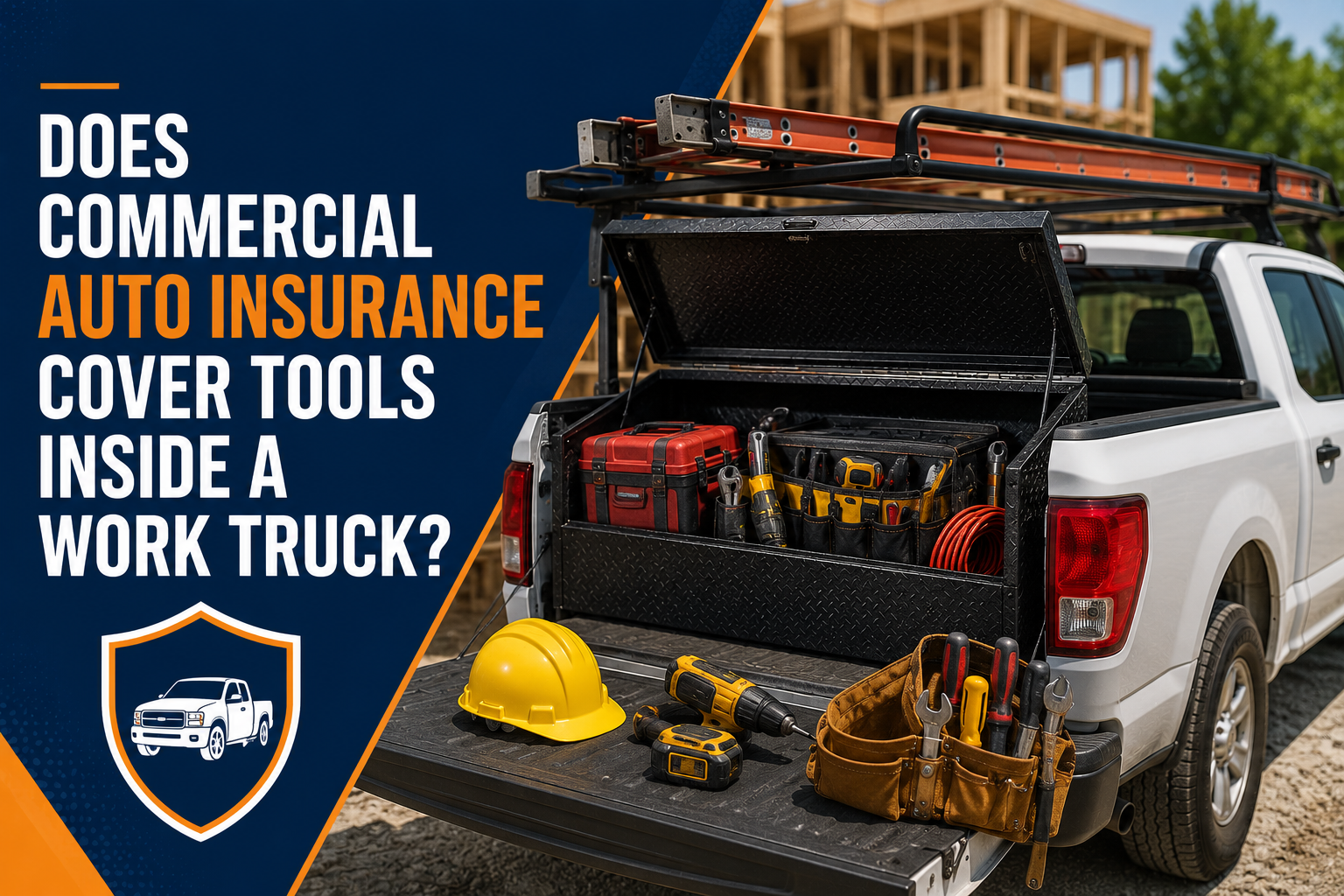
Does Commercial Auto Insurance Cover Tools Inside a Work Truck?
Commercial auto insurance usually does not cover portable tools and equipment inside a work truck. It mainly protects the vehicle itself and covers certain auto-related liability claims.
For example, comprehensive coverage may pay for a broken window after a break-in. It may also cover the theft of the truck itself. However, it will not usually replace the drills, saws, testing devices, or other removable tools stored inside.
Contractors normally need tools and equipment insurance for those items. Insurers often provide this protection through a commercial inland marine policy or contractors’ equipment floater. Inland marine insurance can cover movable business property while it is in transit or away from the contractor’s main location.
Quick Answer
A theft or accident involving a work truck may require more than one policy.
| Part of the loss | Policy that may apply |
|---|---|
| Broken window or damaged truck door | Commercial auto comprehensive |
| Theft of the entire truck | Commercial auto comprehensive |
| Damage to the truck in a collision | Commercial auto collision |
| Stolen portable tools | Tools and equipment or inland marine |
| Tools damaged in a vehicle accident | Tools and equipment or inland marine |
| Permanently installed shelving or equipment | Commercial auto or a specific endorsement |
| Materials awaiting installation | Inland marine or installation floater |
| Injuries or damage caused to others | Commercial auto liability |
Actual coverage depends on the policy, limits, deductibles, endorsements, and cause of the loss.
What Commercial Auto Insurance Covers
Commercial auto insurance protects vehicles used for business. These vehicles may include vans, pickups, service trucks, utility trucks, and certain trailers.
A business auto policy may include several types of coverage.
Auto Liability Coverage
Liability insurance may cover injuries or property damage that the contractor causes while driving.
For example, it may respond if an employee:
- Rear-ends another vehicle
- Damages a customer’s garage
- Strikes a parked car
- Causes an injury accident
- Damages a fence while backing up
The policy may also pay legal defense costs for a covered claim.
Collision Coverage
Collision coverage may pay for damage to the insured work truck after:
- A crash with another vehicle
- An impact with a wall or post
- A single-vehicle accident
- A rollover
This coverage protects the vehicle. It does not automatically protect every item stored inside.
Comprehensive Coverage
Comprehensive coverage generally applies to covered losses that do not involve a collision.
Examples may include:
- Theft of the truck
- Vandalism
- Fire
- Hail
- Falling objects
- Broken glass
- Certain water damage
Commercial auto insurance includes liability and physical damage protection for vehicles used in business. However, property transported inside the vehicle may require separate coverage.
Why Commercial Auto Usually Excludes Portable Tools
Portable tools are business property rather than part of the motor vehicle.
A commercial auto policy mainly insures:
- The truck or van
- Its standard equipment
- Declared vehicle modifications
- Auto liability exposures
In contrast, tools insurance covers movable property. That property may travel between the contractor’s shop, truck, trailer, and jobsite.
Insurance regulators classify commercial auto and inland marine as separate lines of insurance. California guidance describes inland marine as specialized property coverage for business property during transportation.
Therefore, contractors should not assume that physical damage coverage on a truck also covers its contents.
Example: Tools Stolen From a Work Truck
Suppose a plumber leaves a locked work truck in a hotel parking lot. During the night, someone breaks a rear window and steals $18,000 in tools.
The loss includes:
| Damage or loss | Amount |
|---|---|
| Broken window and door damage | $2,000 |
| Stolen plumbing tools | $12,000 |
| Stolen inspection camera | $6,000 |
| Total loss | $20,000 |
The commercial auto policy may cover the $2,000 vehicle damage, minus its deductible.
A tools and equipment policy may cover the $18,000 in stolen tools. However, a separate deductible may apply.
The tools claim may also depend on:
- Vehicle security requirements
- Evidence of forced entry
- The tools policy limit
- A per-item limit
- Proof of ownership
- Overnight parking restrictions
The commercial auto insurer and tools insurer may investigate the same event separately.
What Insurance Covers Tools Inside a Work Truck?
Contractors usually protect portable equipment through one of the following options.
Tools and Equipment Insurance
This coverage may protect:
- Hand tools
- Power tools
- Batteries and chargers
- Testing equipment
- Cameras and diagnostic devices
- Generators
- Compressors
- Ladders
- Portable machinery
The policy may cover the equipment while it is inside a truck, at a jobsite, or in transit.
Contractors’ Equipment Floater
An equipment floater is another form of inland marine insurance. It often covers larger or more valuable equipment.
Examples include:
- Skid-steer loaders
- Mini excavators
- Trenchers
- Scissor lifts
- Large generators
- Specialized trade equipment
The insurer may require the contractor to list expensive equipment individually.
Business Owner’s Policy Endorsement
A business owner’s policy, or BOP, combines commercial property and general liability coverage.
However, the standard property section may focus on property at the listed business location. Contractors may need an inland marine endorsement for tools that travel in work vehicles. Commercial property and inland marine address different locations and exposures.
Does Coverage Apply After a Vehicle Accident?
Tools and equipment insurance may cover portable property damaged during a covered vehicle collision.
For example, a contractor may roll a work truck while transporting:
- Power tools
- Testing devices
- Portable machinery
- Rented equipment
- Building materials
The commercial auto policy may cover the truck. Meanwhile, inland marine coverage may cover the damaged tools.
Still, the tools policy may require proper storage and securement. It may also exclude damage caused by poor packaging or improper transportation.
Contractors should ask whether coverage applies during:
- Loading
- Unloading
- Transportation
- Vehicle collisions
- Trailer overturns
California insurance guidance lists collision, derailment, and overturn of a transporting vehicle among potential inland marine losses. However, the actual policy decides whether coverage applies.
What About Permanently Attached Equipment?
Permanently installed equipment may receive different treatment from removable tools.
Examples include:
- Built-in shelving
- Ladder racks
- Tool drawers
- Partitions
- Mounted generators
- Service bodies
- Cranes
- Lift gates
- Refrigeration units
- Permanent electrical systems
The commercial auto policy may cover some attached equipment as part of the truck. However, the contractor must usually report valuable modifications.
An insurer may base the claim on the value of a standard truck unless the policy reflects the custom equipment. Therefore, contractors should provide:
- Purchase receipts
- Installation invoices
- Photographs
- A list of modifications
- Current replacement values
NAIC guidance advises businesses to review coverage for permanently attached vehicle equipment, such as generators and storage units.
What About Materials Inside the Truck?
A contractor may carry more than reusable tools.
The truck may also contain:
- Plumbing fixtures
- Electrical supplies
- HVAC equipment
- Cabinets
- Flooring
- Customer property
- Parts awaiting installation
- Rented equipment
These items may not fit within a standard tools policy.
An installation floater may protect materials that will become part of a project. Other inland marine coverage may protect property in transit or property belonging to customers.
Therefore, contractors should separate their vehicle contents into categories:
- Reusable business tools
- Materials awaiting installation
- Customer property
- Rented or borrowed equipment
- Permanently attached vehicle equipment
Each category may require different coverage.
Common Reasons a Tools Claim May Be Denied
Having a tools policy does not guarantee payment after every loss.
The Vehicle Was Unlocked
Some policies require contractors to lock the truck and close all windows.
Leaving keys inside may also create a coverage problem.
There Was No Evidence of Theft
The insurer may distinguish theft from unexplained disappearance.
A missing tool may not qualify when the contractor cannot explain:
- When it disappeared
- Where it disappeared
- How it disappeared
- Who had access to it
A police report, video, witness, or damaged lock can support the claim.
The Loss Happened Overnight
Some policies restrict overnight storage inside unattended vehicles.
Coverage may depend on whether the truck was parked:
- At the contractor’s home
- At a hotel
- On a public street
- At a jobsite
- Inside a locked garage
- In a secured commercial lot
Contractors should ask about each common parking location.
The Tool Exceeded the Per-Item Limit
A policy may provide $40,000 in total tools coverage but only $5,000 for one unscheduled item.
Therefore, a $12,000 inspection camera may need to appear on the policy schedule.
The Contractor Cannot Prove Ownership
The insurer may request:
- Receipts
- Invoices
- Serial numbers
- Photographs
- Credit card records
- Accounting records
- Warranty documents
A written inventory makes the claims process much easier.
How Much Tools Coverage Should a Contractor Buy?
The limit should reflect the maximum replacement value inside one truck.
Do not base the limit only on the average daily load.
For example, a contractor may usually carry $15,000 in tools. However, that amount may rise to $35,000 during a large project.
The contractor should include:
- Owned tools
- Employee-owned tools covered by the business
- Rented equipment
- Recently purchased items
- High-value diagnostic equipment
- Accessories and batteries
Then, the contractor should review all sublimits.
Important limits may include:
- Maximum per vehicle
- Maximum per item
- Theft sublimit
- Unscheduled-tools limit
- Employee-tools limit
- Rented-equipment limit
- Property-in-transit limit
The overall policy limit does not always apply in full to one truck.
Replacement Cost vs. Actual Cash Value
The policy’s valuation method affects the payment.
Replacement Cost
Replacement cost generally reflects the current price of a comparable new tool.
The insurer may require the contractor to replace the item before paying the full amount.
Actual Cash Value
Actual cash value normally subtracts depreciation.
For example, a tool may cost $2,000 to replace. However, its actual cash value may be only $900 because of its age and condition.
Contractors should compare valuation methods before choosing a policy. A lower premium may come with a much smaller claim payment.
What to Do After Tools Are Stolen
Take the following steps after discovering a break-in.
Protect the Vehicle
Move the truck to a safe location when possible. Avoid disturbing evidence until you photograph the damage.
Contact the Police
Report the theft promptly.
Provide:
- Vehicle details
- Jobsite or parking location
- Estimated time of theft
- Stolen-item list
- Serial numbers
- Video footage
- Witness information
Photograph the Damage
Take wide and close photographs of:
- Broken windows
- Damaged locks
- Forced doors
- Empty storage areas
- Pry marks
- The parking location
Notify Both Insurers
Contact the commercial auto insurer about vehicle damage.
Then, contact the tools or inland marine insurer about the stolen property. Prompt notice helps both insurers investigate the loss.
Prepare a Complete Inventory
List each stolen item with:
- Brand
- Model
- Serial number
- Purchase date
- Original price
- Current replacement cost
- Proof of ownership
NAIC guidance recommends keeping current business equipment records and maintaining backup copies away from the property.
How to Avoid Coverage Gaps
Contractors should review their work truck and tools coverage together.
Ask the insurance agent:
- Does commercial auto cover my custom truck equipment?
- Does my tools policy cover property inside vehicles?
- Are overnight thefts covered?
- Must there be forced entry?
- What is the limit in one truck?
- Are employee tools covered?
- Are rented tools included?
- Which items must be scheduled?
- Does the policy use replacement cost?
- Are materials awaiting installation covered?
- Does coverage apply during loading and unloading?
- Do separate deductibles apply?
The SBA recommends reviewing business insurance as the company buys equipment or changes its operations.
Frequently Asked Questions
Does comprehensive auto insurance cover tools inside a work truck?
Usually not. Comprehensive coverage may protect the truck against theft or vandalism. Portable tools generally need inland marine coverage.
Does commercial auto cover a toolbox attached to the truck?
It may cover a permanently attached toolbox if the insurer knows about it. The contractor should report the modification and its value.
Are tools covered after a truck accident?
They may be covered under tools and equipment insurance. The commercial auto policy usually covers the truck itself.
Does general liability insurance cover stolen tools?
No. General liability covers certain claims involving injuries or damage caused to other people. It does not ordinarily insure the contractor’s own tools.
Are employee-owned tools covered?
Not automatically. The policy may require an endorsement or apply a separate employee-tools limit.
Are rented tools covered inside the truck?
They may be covered when the tools policy includes rented equipment. A separate limit often applies.
Does commercial property insurance cover tools in a truck?
It may provide limited off-premises coverage. However, contractors often need inland marine insurance for adequate mobile-property protection.
Is a police report required after theft?
The policy may require prompt notice to law enforcement. A police report also provides useful evidence for the claim.
Conclusion
Commercial auto insurance usually does not cover portable tools stored inside a work truck.
It may cover damage to the truck, theft of the vehicle, and qualifying auto liability claims. However, contractors normally need tools and equipment or inland marine insurance for removable equipment.
One incident may involve both policies. Commercial auto may pay for a broken window, while tools insurance may replace the stolen equipment.
Before buying coverage, calculate the maximum replacement value inside each vehicle. Then, review vehicle limits, per-item limits, theft conditions, deductibles, and valuation methods.
Contractors should also report permanently attached equipment and custom truck modifications. Finally, they should keep receipts, serial numbers, and photographs for every valuable tool.
This coordinated approach can protect both the work truck and the equipment that keeps the business running.
Editorial review: This guide was researched and reviewed by the Coverage Editorial Team using government agencies, insurance regulators, licensing authorities, policy documentation, and current industry pricing sources.