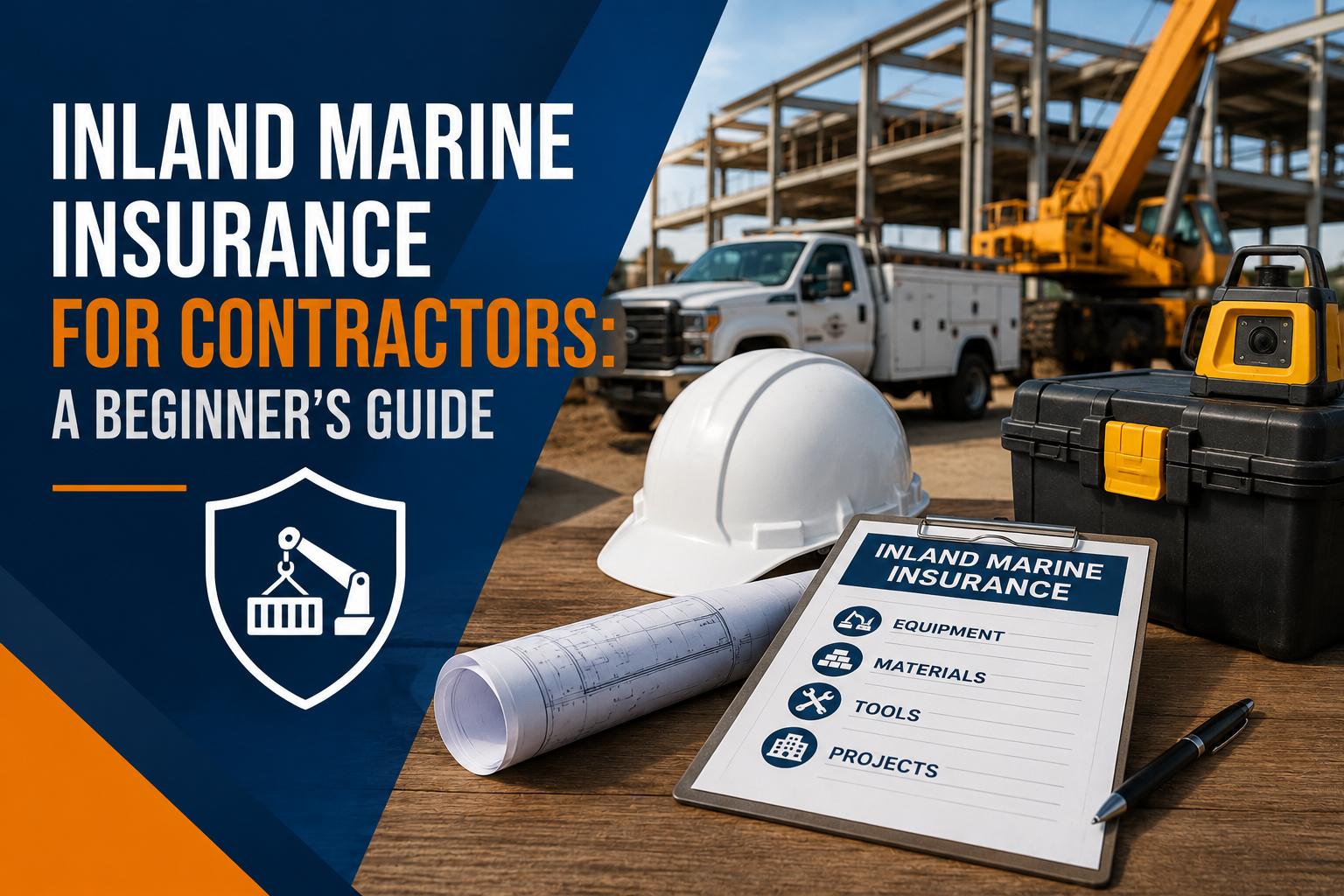
Inland Marine Insurance for Contractors: A Beginner’s Guide
Inland marine insurance helps protect a contractor’s tools, equipment, building materials, and other movable business property while it is being transported, stored away from the main business location, or used at a temporary jobsite.
Despite its name, inland marine insurance generally has little to do with boats or oceans. It developed from marine insurance used to protect goods during transportation and later expanded to cover property moving over land. Today, contractors commonly use it to insure portable equipment that may not be adequately protected by a standard commercial property policy.
For example, inland marine insurance may cover tools stolen from a work van, equipment damaged while being transported to a project, or a generator destroyed by a covered fire at a temporary jobsite. The Texas Department of Insurance specifically identifies contractor equipment and property in transit as common inland marine exposures.
Coverage varies by policy. Contractors should verify which property is insured, where coverage applies, what causes of loss are included, and whether special limits or security requirements apply.
Inland Marine Insurance at a Glance
| Question | General answer |
|---|---|
| What does it protect? | Movable tools, equipment, materials, and certain property in transit |
| Where can coverage apply? | Jobsites, vehicles, trailers, temporary storage, and other covered locations |
| Does it cover theft? | Often, subject to policy conditions and exclusions |
| Does it cover rented equipment? | Sometimes, when rented or leased property is included |
| Does it replace general liability? | No |
| Does it replace commercial auto? | No |
| Does it cover a contractor’s shop or office? | Possibly, but commercial property insurance is generally designed for fixed locations |
| Is it legally required? | Usually not universally required, but a contract, lender, or rental company may require it |
What Is Inland Marine Insurance?
Inland marine insurance is a category of commercial property insurance designed for property that is mobile, transported, or located away from a business’s primary premises.
The California Department of Insurance defines inland marine as a broad category of property insurance generally covering movable property or unusual risks. Commercial inland marine products can include equipment floaters, builder’s risk, and other specialized forms.
For contractors, the most relevant forms may be called:
- Contractors’ tools and equipment insurance
- Contractors’ equipment floater
- Equipment floater insurance
- Installation floater
- Rented equipment coverage
- Property-in-transit coverage
These names are not always interchangeable. One policy may focus on small portable tools, while another is designed for heavy machinery. An installation floater typically protects materials intended to become part of a project rather than the contractor’s reusable tools.
The policy name alone does not establish what is covered. The declarations, coverage form, endorsements, exclusions, and limits control the claim.
Why Contractors May Need Inland Marine Insurance
Contractors rarely keep all their business property at one permanent location. Tools and equipment frequently move among:
- A workshop or warehouse
- Work trucks and vans
- Enclosed trailers
- Customer properties
- Construction sites
- Temporary storage facilities
- Rental locations
- Projects in other cities or states
Commercial property insurance generally focuses on buildings and business property at scheduled premises. The National Association of Insurance Commissioners describes commercial property coverage as protection for a business’s location and physical assets, including equipment, inventory, and furniture.
That protection may become limited when property leaves the insured location. Inland marine insurance is intended to address many of those off-premises and transportation exposures.
A contractor may need it when losing the contents of one van, trailer, or jobsite container would create a financial loss the business could not comfortably absorb. The SBA advises business owners to insure against losses they would be unable to pay for independently and to reassess coverage when equipment or operations change.
What Can Inland Marine Insurance Cover for Contractors?
The exact covered property depends on the policy, but contractor inland marine insurance may include several categories.
Hand Tools and Power Tools
Coverage may include:
- Drills
- Circular saws
- Nail guns
- Grinders
- Sanders
- Wrenches
- Plumbing tools
- Electrical tools
- Tool storage systems
Smaller items may be insured under a blanket tools limit rather than listed individually.
Diagnostic and Specialty Equipment
Contractors may also insure higher-value portable equipment, including:
- Thermal imaging cameras
- Pipe inspection cameras
- Leak detection devices
- Electrical testing equipment
- Laser levels
- Surveying instruments
- Refrigerant recovery equipment
Expensive items may need to be individually scheduled with their make, model, serial number, and insured value.
Portable Machinery
Depending on the policy, coverage may extend to:
- Generators
- Air compressors
- Pressure washers
- Concrete mixers
- Welding equipment
- Floor sanders
- Landscaping machinery
- Portable pumps
Heavy Contractor Equipment
A contractors’ equipment floater may be used for larger machinery such as:
- Skid-steer loaders
- Mini excavators
- Trenchers
- Scissor lifts
- Boom lifts
- Compact loaders
- Backhoes
Heavy equipment may require scheduled coverage rather than the same blanket protection used for small tools.
Building Materials and Supplies
Certain inland marine policies may protect materials while they are transported, temporarily stored, or awaiting installation.
Examples include:
- Cabinets
- Flooring
- Plumbing fixtures
- Electrical equipment
- HVAC components
- Windows and doors
- Roofing materials
An installation floater may be more appropriate when materials are intended to become a permanent part of the completed project.
Rented, Leased, or Borrowed Equipment
A policy may include equipment rented, leased, or borrowed from others. However, this property frequently has a separate limit.
The contractor should compare the policy limit with the equipment’s replacement value—not its rental cost. A machine that costs $2,000 to rent could be worth $50,000 to replace.
The rental agreement may also make the contractor responsible for loss of use, transportation, continuing rental charges, or administrative fees. Those contractual charges are not necessarily covered simply because physical damage to the equipment is insured.
Employee-Owned Tools
Employee tools are not always automatically covered. A policy may exclude them, provide a separate sublimit, or cover them only when the contractor is legally responsible for the property.
Contractors whose employees regularly bring their own tools should discuss this exposure with their insurance agent.
What Types of Loss Can Be Covered?
Contractor inland marine insurance may cover direct physical loss or damage caused by events such as:
- Theft
- Burglary
- Vandalism
- Fire
- Smoke
- Wind
- Hail
- Lightning
- Falling objects
- Vehicle collision
- Accidental impact
- Overturn during transportation
- Certain water damage
Some forms provide broad coverage for direct physical loss unless a cause is excluded. Others cover only specifically listed events.
A policy that includes theft can still impose conditions involving locked vehicles, enclosed storage, evidence of forced entry, unattended jobsites, or overnight storage. Contractors should review these conditions before leaving tools at a project or inside a vehicle.
Where Does Inland Marine Coverage Apply?
Coverage may follow insured property through several stages of a contractor’s work.
While in Transit
Inland marine insurance may protect covered property while it travels between the contractor’s premises, a supplier, and the jobsite. The Texas Department of Insurance includes property in transit among the exposures commonly handled by inland marine coverage.
Transportation coverage may still depend on proper loading, securement, suitable trailers, and the policy’s geographic territory.
Inside a Work Vehicle
Tools stolen from a work van may be covered under an inland marine policy, subject to theft and vehicle-security requirements.
Commercial auto insurance may cover the broken window, damaged door, or theft of the van itself. It generally should not be assumed to cover every tool carried inside.
At a Temporary Jobsite
Coverage may apply while equipment is being used or stored at a customer’s property or construction site.
Contractors should confirm whether:
- The jobsite must be reported
- Tools must be kept inside a locked structure
- Outdoor equipment is covered
- Fencing or security is required
- Overnight storage is restricted
- One-location limits apply
At the Contractor’s Main Location
Some inland marine policies may also cover property at the contractor’s shop or warehouse. However, commercial property insurance or a business owner’s policy is normally the primary coverage for a fixed business location.
What Does Inland Marine Insurance Commonly Exclude?
Inland marine coverage is not a maintenance plan or warranty. Common exclusions or limitations may include the following.
Wear and Tear
Normal deterioration from repeated use is generally not covered.
Examples include:
- Worn drill motors
- Dull blades
- Aging batteries
- Cracked hoses
- Gradually deteriorating components
Mechanical or Electrical Breakdown
A machine that stops working because an internal part fails may not be covered unless the policy includes equipment breakdown protection.
Damage caused by a covered external event may be treated differently. A generator destroyed by a fire is not the same as a generator that stops because of an internal mechanical defect.
Rust, Corrosion, and Gradual Damage
Loss caused by moisture, corrosion, temperature changes, insects, or poor maintenance may be excluded when it develops over time.
Unexplained Disappearance
A missing item is not always treated as stolen property.
If a contractor cannot explain when, where, or how a tool disappeared, the insurer may classify the loss as unexplained disappearance or inventory shortage rather than covered theft.
A documented break-in supported by damaged locks, surveillance footage, witnesses, or a police report generally provides clearer evidence of theft.
Employee Dishonesty
Theft committed by an employee may be excluded from an inland marine policy. Commercial crime or employee theft insurance may be needed for that exposure. The Texas Department of Insurance lists employee theft separately from inland marine protection in its commercial property guidance.
Intentional Damage
Intentional acts by the insured or another protected party are generally excluded.
Flood and Earthquake
These causes of loss may be excluded, limited, or available only through separate coverage or an endorsement.
Improper Use or Overloading
Damage caused by operating equipment outside manufacturer specifications, exceeding weight limits, or using unqualified operators may create a coverage dispute.
Inland Marine vs. Commercial Property Insurance
Both policies protect business property, but they are designed for different exposures.
| Inland marine insurance | Commercial property insurance |
|---|---|
| Focuses on movable or specialized property | Focuses primarily on property at listed premises |
| Can follow tools between jobsites | Protects buildings and contents at a fixed location |
| May cover property in transit | Transit coverage may be limited |
| Commonly used for contractor equipment | Commonly used for offices, shops, warehouses, and inventory |
| May cover temporary jobsite storage | Off-premises limits may be lower |
| Can schedule individual high-value equipment | Uses premises-based property limits |
A contractor may need both. Commercial property insurance can protect the shop, office furniture, inventory, and equipment stored there, while inland marine follows portable tools and machinery away from the premises.
Inland Marine vs. General Liability Insurance
General liability protects the contractor against qualifying third-party claims. Inland marine protects the contractor’s own insured property.
For example:
- A contractor drops a tool and damages the customer’s floor: general liability may apply.
- The tool itself is damaged in the same accident: inland marine may apply.
- A customer trips over the tool and is injured: general liability may apply.
- Someone steals the tool from the jobsite: inland marine may apply.
The policies address different risks and are not substitutes for one another.
Inland Marine vs. Builder’s Risk Insurance
Builder’s risk is another specialized property coverage frequently associated with inland marine, but its purpose is different.
Builder’s risk generally focuses on:
- A structure under construction
- Materials intended to become part of the project
- Fixtures awaiting installation
- Certain temporary structures
- Covered project property in transit or storage
Contractors’ equipment coverage protects reusable tools and machinery used to perform the work.
California insurance guidance lists equipment floaters and builder’s risk as distinct types of commercial inland marine coverage.
A builder’s risk policy should not be assumed to cover a subcontractor’s drills, ladders, generators, or heavy machinery.
Understanding Policy Limits and Sublimits
The overall policy limit is only one part of the coverage.
A contractor should review:
- Total equipment limit
- Maximum at one jobsite
- Maximum in one vehicle or trailer
- Per-item limit
- Unscheduled tools limit
- Theft sublimit
- Rented-equipment limit
- Employee-tools limit
- Newly acquired equipment limit
- Property-in-transit limit
For example, a policy may show a $100,000 total limit but provide only $10,000 for unscheduled tools or $20,000 for rented equipment.
The limit should reflect the maximum amount of property that could be lost in one incident. A contractor carrying $40,000 of tools in a single van may be underinsured even if the average daily tool value is much lower.
Replacement Cost vs. Actual Cash Value
The valuation method determines how the insurer calculates covered property damage.
Replacement Cost
Replacement cost generally reflects the cost to repair or replace an item with comparable new property, subject to policy conditions and limits.
The insurer may initially pay a depreciated amount and reimburse additional costs after the item is replaced.
Actual Cash Value
Actual cash value generally accounts for depreciation based on the equipment’s age, condition, and remaining useful life.
The California Department of Insurance explains that replacement cost pays the amount required to replace property with new property of like kind and quality, while actual cash value can reflect depreciation.
A five-year-old tool might cost $2,000 to replace but have an actual cash value of only $900. Contractors should know which method applies before a claim occurs.
Example of an Inland Marine Claim
Assume an electrical contractor stores tools in a locked trailer at a commercial jobsite. Thieves force the trailer door open and steal equipment with a documented replacement cost of $28,000.
The contractor’s policy includes:
- $50,000 tools and equipment limit
- $2,500 deductible
- Replacement cost valuation
- Theft coverage at temporary jobsites
- $10,000 maximum for any one unscheduled item
If all the tools qualify and no individual item exceeds the per-item limit, the potential calculation could be:
| Claim calculation | Amount |
|---|---|
| Covered replacement cost | $28,000 |
| Deductible | $2,500 |
| Potential payment | $25,500 |
The payment could be lower if security requirements were not followed, documentation is incomplete, or a sublimit applies.
How to Choose Inland Marine Coverage
Begin with a detailed inventory containing:
- Item description
- Manufacturer
- Model
- Serial number
- Purchase date
- Original cost
- Current replacement cost
- Primary storage location
- Ownership status
- Vehicle or employee assignment
Then ask the insurance agent:
- Are tools covered in vehicles and at temporary jobsites?
- Does coverage apply overnight?
- Must there be visible evidence of forced entry?
- Are outdoor and unattended tools covered?
- Are rented and borrowed items included?
- Are employee-owned tools covered?
- What is the per-item limit?
- Which equipment must be scheduled?
- Is coverage based on replacement cost or actual cash value?
- Are flood and mechanical breakdown excluded?
- What is the maximum at one location?
- How long are newly purchased items automatically covered?
The SBA recommends comparing terms and benefits among insurers and reassessing coverage annually as a business purchases equipment or expands operations.
How to File an Inland Marine Claim
After covered property is stolen or damaged:
- Protect people and prevent additional damage.
- Contact law enforcement after theft, burglary, or vandalism.
- Photograph the scene and damaged property.
- Preserve locks, damaged equipment, and other evidence.
- Notify the insurance company promptly.
- Prepare a detailed list of affected items.
- Provide receipts, serial numbers, and ownership records.
- Keep repair estimates and replacement quotes.
- Cooperate with the adjuster.
- Avoid discarding damaged equipment before inspection.
The NAIC recommends maintaining records of business equipment and property because inventories, receipts, and documentation can support a property claim.
Frequently Asked Questions
Is inland marine insurance legally required?
It is generally not universally required by law. However, a client, lender, equipment rental company, or written contract may require it.
Does inland marine cover tools stolen from a vehicle?
It may, subject to policy limits, vehicle-security conditions, overnight-storage rules, and exclusions.
Does it cover tools left at a jobsite?
Potentially. Confirm that temporary jobsites are covered and that storage requirements are satisfied.
Are rented tools included?
Only when rented or leased equipment is included. It may have a separate limit.
Does inland marine cover employee tools?
Not automatically. Employee-owned property may require a specific endorsement or sublimit.
Does it cover accidental damage?
Many policies cover certain sudden accidental physical losses, but the exact causes of loss and exclusions vary.
Does it cover equipment breakdown?
Not necessarily. Internal mechanical or electrical failure may require equipment breakdown coverage.
Is inland marine included in a BOP?
It may be added to a business owner’s policy through an endorsement, but contractors should not assume that a standard BOP provides adequate mobile-equipment coverage.
Conclusion
Inland marine insurance helps protect the movable tools, equipment, materials, and machinery contractors use away from their main business premises.
It may cover theft, vandalism, fire, transportation damage, accidental impact, and other qualifying physical losses. Coverage can follow property inside vehicles, between locations, and at temporary jobsites, depending on the policy.
However, inland marine insurance does not replace general liability, commercial auto, commercial property, builder’s risk, crime, or equipment breakdown coverage. Each policy addresses a different exposure.
Before purchasing coverage, create a detailed equipment inventory and review where the property is stored and transported. Compare limits, sublimits, deductibles, security requirements, valuation methods, and exclusions. Pay particular attention to rented equipment, employee tools, overnight jobsite storage, vehicle theft, and expensive unscheduled items.
The best inland marine policy is one designed around how the contractor actually uses, moves, and stores equipment—not simply the policy with the lowest premium.
Editorial review: This guide was researched and reviewed by the Coverage Editorial Team using government agencies, insurance regulators, licensing authorities, policy documentation, and current industry pricing sources.