
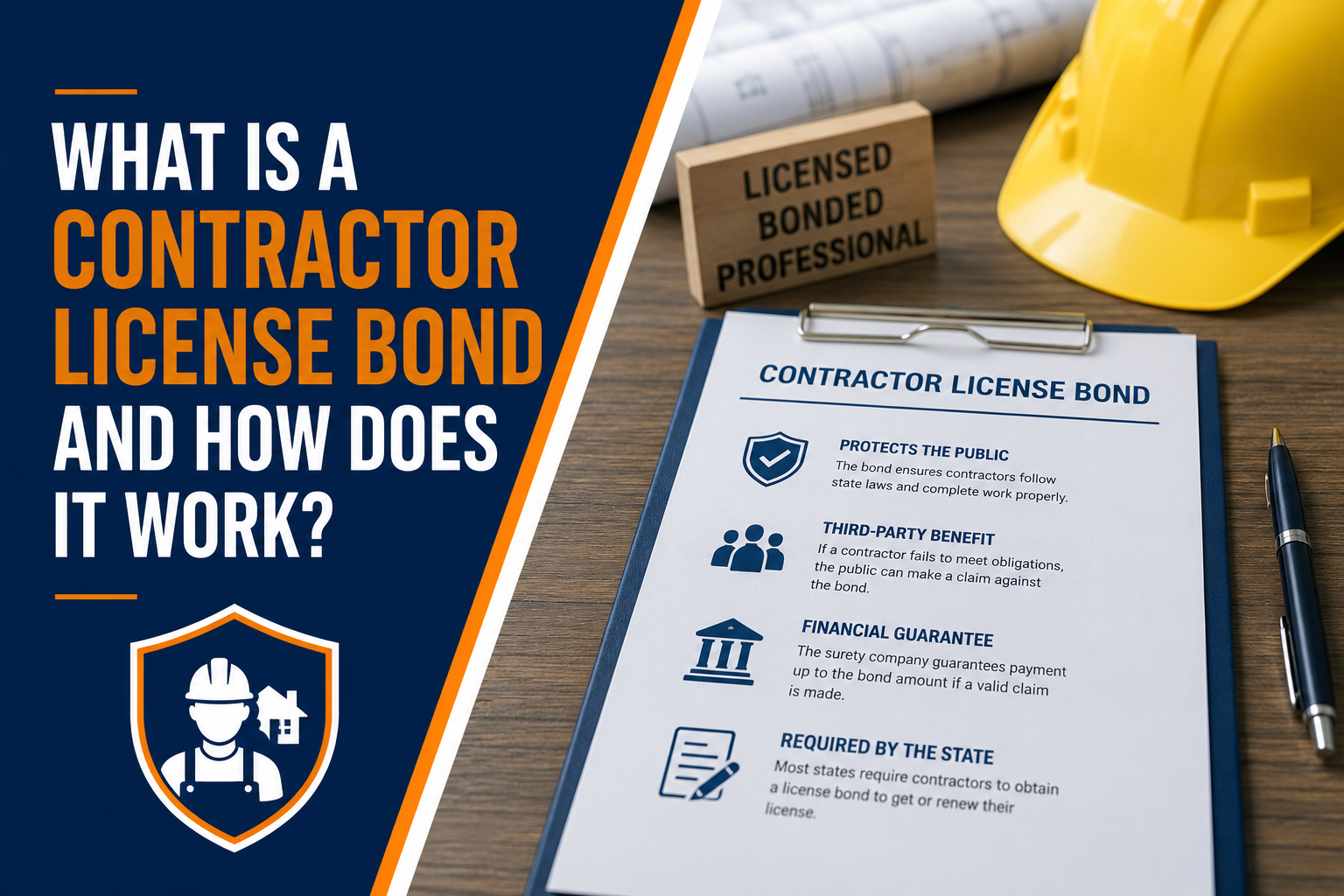
What Is a Contractor License Bond and How Does It Work?
A contractor license bond is a financial guarantee that helps protect customers, workers, suppliers, and government agencies when a contractor violates certain licensing laws.
Many states and local governments require contractors to obtain a bond before receiving or renewing a license. The contractor pays a premium to a surety company. In return, the surety issues the required bond to the licensing authority.
A license bond is not the same as contractor liability insurance. Insurance protects the contractor against covered losses. A license bond primarily protects other parties from specific misconduct or unpaid obligations.
If the surety pays a valid bond claim, the contractor may have to reimburse the surety. Therefore, a bond does not transfer risk in the same way as an insurance policy.
Contractor License Bonds at a Glance
| Question | General answer |
|---|---|
| What is it? | A guarantee that the contractor will follow certain laws and licensing rules |
| Who requires it? | A state, county, city, or licensing board |
| Who does it protect? | Customers, workers, suppliers, and other eligible claimants |
| Does it protect the contractor? | Not in the same way as insurance |
| Who issues it? | A licensed surety company |
| Is the bond amount the contractor’s premium? | No; the contractor pays only the quoted premium |
| Must the contractor repay claims? | Often, under the surety’s indemnity agreement |
| Does it cover every customer dispute? | No; only qualifying claims under the bond and applicable law |
| Does it replace general liability insurance? | No |
| Is the required amount the same nationwide? | No; requirements vary by location and license type |
The bond form and applicable law control each claim. Therefore, contractors should review the rules for every place where they seek a license.
What Is a Contractor License Bond?
A contractor license bond is a type of surety bond required for licensing or registration.
It guarantees that the contractor, known as the principal, will meet certain legal obligations. If the contractor fails to do so, an eligible claimant may seek payment from the bond.
The California Department of Insurance defines a surety bond as an agreement under which the surety answers to the obligee for the principal’s nonperformance. (insurance.ca.gov)
License bonds belong to the commercial surety category. They differ from contract bonds used on individual construction projects.
The Three Parties to a License Bond
A contractor license bond involves three parties.
The Principal
The principal is the contractor or contracting business that must obtain the bond.
The contractor promises to follow the laws, regulations, and obligations listed in the bond.
The Obligee
The obligee is the government agency that requires the bond.
Examples include:
- State contractor licensing boards
- City licensing departments
- County agencies
- State labor departments
- Trade-specific licensing authorities
The obligee does not usually receive every bond payment. Instead, the bond supports the contractor’s compliance with the licensing law.
The Surety
The surety is the company that issues the bond.
The surety may investigate claims and pay valid losses up to the available bond amount. However, the contractor may remain financially responsible to the surety.
How Does a Contractor License Bond Work?
The process generally follows six steps.
1. The Licensing Authority Sets the Requirement
A state or local agency decides which contractors need bonds.
The agency may also determine:
- Required bond amount
- Approved bond form
- Eligible surety companies
- Filing method
- Cancellation notice
- Renewal requirements
- Types of claims the bond covers
Requirements can differ by trade, annual revenue, business structure, and license classification.
2. The Contractor Applies for the Bond
The contractor applies through a surety company or licensed bond producer.
The application may request:
- Legal business name
- Business structure
- Contractor license number
- Bond amount
- Type of work
- Owner information
- Credit information
- Claims or license history
The surety then decides whether to issue the bond and sets the premium.
3. The Contractor Pays the Premium
The contractor does not normally deposit the full bond amount.
Instead, the contractor pays a premium for the bond. The premium is the price charged by the surety for issuing the guarantee.
For example, a contractor required to post a $25,000 bond does not necessarily pay $25,000. The contractor pays the surety’s quoted premium.
The price can depend on:
- Required bond amount
- Personal or business credit
- License history
- Prior bond claims
- Financial condition
- Years in business
- Surety underwriting rules
4. The Bond Is Filed
The contractor or surety files the bond with the licensing authority.
The information must usually match the licensing records exactly. California, for example, requires the business name and license number on the bond to match the Contractors State License Board’s records. Its standard contractor license bond amount is currently $25,000. (cslb.ca.gov)
The authority may not issue or renew the license until it accepts the bond.
5. An Eligible Person Files a Claim
A customer, worker, supplier, or another eligible party may file a claim after an alleged violation.
The claimant may need to provide:
- Construction contract
- Payment records
- Written communications
- Photographs
- Repair estimates
- Invoices
- Court documents
- Evidence of unpaid wages or materials
The correct process depends on state law. In some states, the claimant contacts the surety directly. In others, the claimant may need to file a lawsuit.
6. The Surety Investigates the Claim
The surety reviews the facts and bond terms.
It may:
- Deny the claim
- Request more information
- Negotiate a resolution
- Pay a valid claim
- Require a court judgment before payment
A licensing complaint and a bond claim may also follow different processes.
California’s CSLB investigates complaints against licensed contractors. However, consumers must submit bond claims to the surety that issued the bond. The CSLB does not process those claims for the surety. (cslb.ca.gov)
What Does a Contractor License Bond Cover?
Coverage depends on the bond form and licensing law.
A contractor license bond may respond to certain losses involving:
- Fraud or misrepresentation
- Abandonment of a project
- Failure to follow licensing laws
- Improper or negligent work
- Unpaid wages
- Unpaid suppliers
- Unpaid subcontractors
- Certain tax obligations
- Contract violations recognized by the bond statute
However, the bond does not guarantee customer satisfaction. It also does not cover every disagreement over price, quality, timing, or contract interpretation.
Washington’s contractor bond can support certain claims involving contract breaches, negligent work, unpaid labor, unpaid materials, and specified government obligations. Still, eligible claimants must follow the state’s legal process. (lni.wa.gov)
What Does a Contractor License Bond Not Cover?
License bonds have strict limits.
They generally do not replace insurance for:
- Customer injuries
- Accidental property damage
- Vehicle accidents
- Employee workplace injuries
- Stolen contractor tools
- Damage to contractor equipment
- Professional mistakes
- Cyber incidents
- Pollution losses
They may also exclude claims that do not fall within the licensing law.
For example, a customer may dislike the final paint color. That dispute would not automatically create a valid bond claim.
In addition, claims filed after the applicable deadline may fail. Contractors and customers should review the claim period in the relevant state.
Is a Contractor License Bond the Same as Insurance?
No. This distinction is essential.
Insurance Protects the Insured Contractor
General liability insurance may defend the contractor against covered claims. It may also pay qualifying settlements or judgments.
The contractor usually does not repay the insurer after a covered claim. The deductible and policy terms still apply.
A Bond Protects Other Parties
A license bond guarantees the contractor’s performance of specific legal obligations.
The contractor commonly signs an indemnity agreement with the surety. As a result, the surety may seek reimbursement after paying a valid claim.
Surety filings reviewed by the California Department of Insurance note that surety bonds contain indemnification provisions. Those provisions can require the principal to provide reimbursement or collateral. (insurance.ca.gov)
Therefore, contractors should not treat a bond as a substitute for insurance.
License Bond vs. General Liability Insurance
| License bond | General liability insurance |
|---|---|
| Often required for licensing | Often required by clients or contracts |
| Protects eligible third parties | Protects the insured business against covered claims |
| Covers specific legal obligations | Covers certain bodily injury and property damage claims |
| Contractor may repay the surety | Insured usually does not repay covered claim payments |
| Uses a bond amount | Uses policy limits |
| May become depleted by claims | Limits may also be reduced by claims, depending on the policy |
| Does not cover every accident | Designed for covered liability accidents |
Many contractors need both.
For example, a state may require a license bond. A customer may also require $1 million in general liability coverage.
How Much Is a Contractor License Bond?
The required amount varies widely.
California Example
California requires a $25,000 contractor license bond for licensed contractors. The state may also require additional bonds for certain business structures or disciplinary situations. (cslb.ca.gov)
Arizona Example
Arizona bond amounts depend on the license type and expected gross volume. Current requirements range from $4,250 to $100,000 across the listed classifications and volume levels. (roc.az.gov)
Washington Example
Washington requires registered general contractors to carry a $30,000 bond. Specialty contractors generally need a $15,000 bond under requirements that took effect in July 2024. (lni.wa.gov)
These examples do not create a national rule. Contractors must check the exact agency that regulates their trade and location.
Is the Bond Amount Available for Every Claim?
No. The bond amount is usually the maximum amount available under the bond, subject to state law.
Several claimants may compete for limited funds. Earlier claims can reduce the remaining amount.
Arizona explains that a contractor’s bond may be subject to claims until the available amount is exhausted. The state recommends checking whether the bond has already been reduced or depleted. (roc.az.gov)
Therefore, a $25,000 bond does not promise $25,000 to every customer. It may provide only one shared pool of available protection.
How Does Someone Make a Bond Claim?
The procedure differs by state.
California
A claimant generally identifies the surety through the contractor’s license record. The claimant then contacts that surety and submits supporting documents.
The CSLB advises claimants to include the contract, payment records, communications, and evidence of the alleged violation. (cslb.ca.gov)
Arizona
A claimant may submit a written claim to the surety. Some sureties may require court action before paying.
Arizona also advises consumers to determine whether the contractor posted a surety bond, cash bond, or another approved security. (roc.az.gov)
Washington
Washington generally requires a person seeking bond funds to file a lawsuit. The claimant must name the contractor and bond company and obtain a qualifying judgment. (lni.wa.gov)
These differences make state-specific research essential.
What Happens After a Bond Claim Is Paid?
A paid claim can create serious consequences for the contractor.
The surety may:
- Seek reimbursement
- Demand collateral
- Cancel or decline to renew the bond
- Increase future bond costs
- Refuse future applications
- Report the payment to the licensing authority
The contractor may also need to restore the full required bond amount.
In California, a bond payment or judgment that reduces the required amount can lead to a license suspension. A cancelled bond can also place the license at risk. (cslb.ca.gov)
Therefore, contractors should respond promptly to all claim notices.
How Long Does a Contractor License Bond Last?
Many license bonds are continuous until cancelled. Still, the contractor must pay the required renewal premium.
The surety can generally cancel the bond by giving the required notice. The notice period depends on the bond and applicable law.
If the bond expires or is cancelled, the licensing authority may suspend the contractor’s license. The contractor may need a replacement bond before continuing work.
Contractors should track:
- Renewal date
- Premium due date
- Bond number
- Surety contact information
- License expiration
- Cancellation notices
A bond should never lapse during active licensed work.
License Bond vs. Performance and Payment Bonds
These bonds serve different purposes.
Contractor License Bond
A license bond supports compliance with licensing laws. It usually applies across the contractor’s licensed operations.
Performance Bond
A performance bond guarantees that the contractor will perform a specific contract.
Payment Bond
A payment bond guarantees payment to qualifying subcontractors, workers, and suppliers on a specific project.
Public and private project owners may require performance and payment bonds. The SBA explains that surety bonds help small businesses qualify for contracts by assuring customers that required work will be completed. (sba.gov)
A contractor may need a license bond to operate legally and separate contract bonds for one project.
How to Get a Contractor License Bond
The process usually involves the following steps:
- Confirm the required bond with the licensing authority.
- Identify the correct legal business name.
- Gather the license application or license number.
- Apply through a licensed surety provider.
- Review the premium and indemnity agreement.
- Sign the bond documents.
- File the bond as directed.
- Verify that the agency accepted it.
- Keep copies of the bond and payment records.
- Track renewals and cancellation notices.
The bond information must be accurate. Even a small business-name mismatch can delay a license.
Frequently Asked Questions
Is a contractor license bond required in every state?
No. Requirements vary by state, city, county, trade, and license type.
Does a license bond protect the contractor?
Its main purpose is to protect eligible third parties. The contractor may still benefit by meeting licensing requirements and gaining customer trust.
Does the contractor pay the full bond amount?
Usually not. The contractor generally pays a premium to obtain the bond.
Must the contractor repay a paid claim?
Often, yes. The surety may seek reimbursement under the indemnity agreement.
Can a customer file any complaint against the bond?
A customer can submit a claim, but the surety pays only valid claims covered by the bond and applicable law.
Does a bond cover accidental property damage?
Usually not in the same way as general liability insurance. Contractors need separate liability coverage for qualifying accidents.
What happens if the bond is cancelled?
The contractor’s license or registration may be suspended unless a replacement bond becomes effective on time.
Can several people claim against one bond?
Yes. However, the bond amount may be shared and can become exhausted.
Conclusion
A contractor license bond is a financial guarantee required by many licensing authorities.
It assures the government and eligible claimants that the contractor will follow specific laws and meet certain obligations. If the contractor fails, a claimant may seek payment from the bond.
However, the bond is not liability insurance. It does not protect the contractor against every accident or lawsuit. In addition, the contractor may have to repay the surety after a valid claim.
Before applying, contractors should verify the required bond amount, approved form, filing method, and renewal rules. They should also understand the indemnity agreement and claim process.
A complete contractor insurance program may include both a license bond and several insurance policies. Each product solves a different problem.