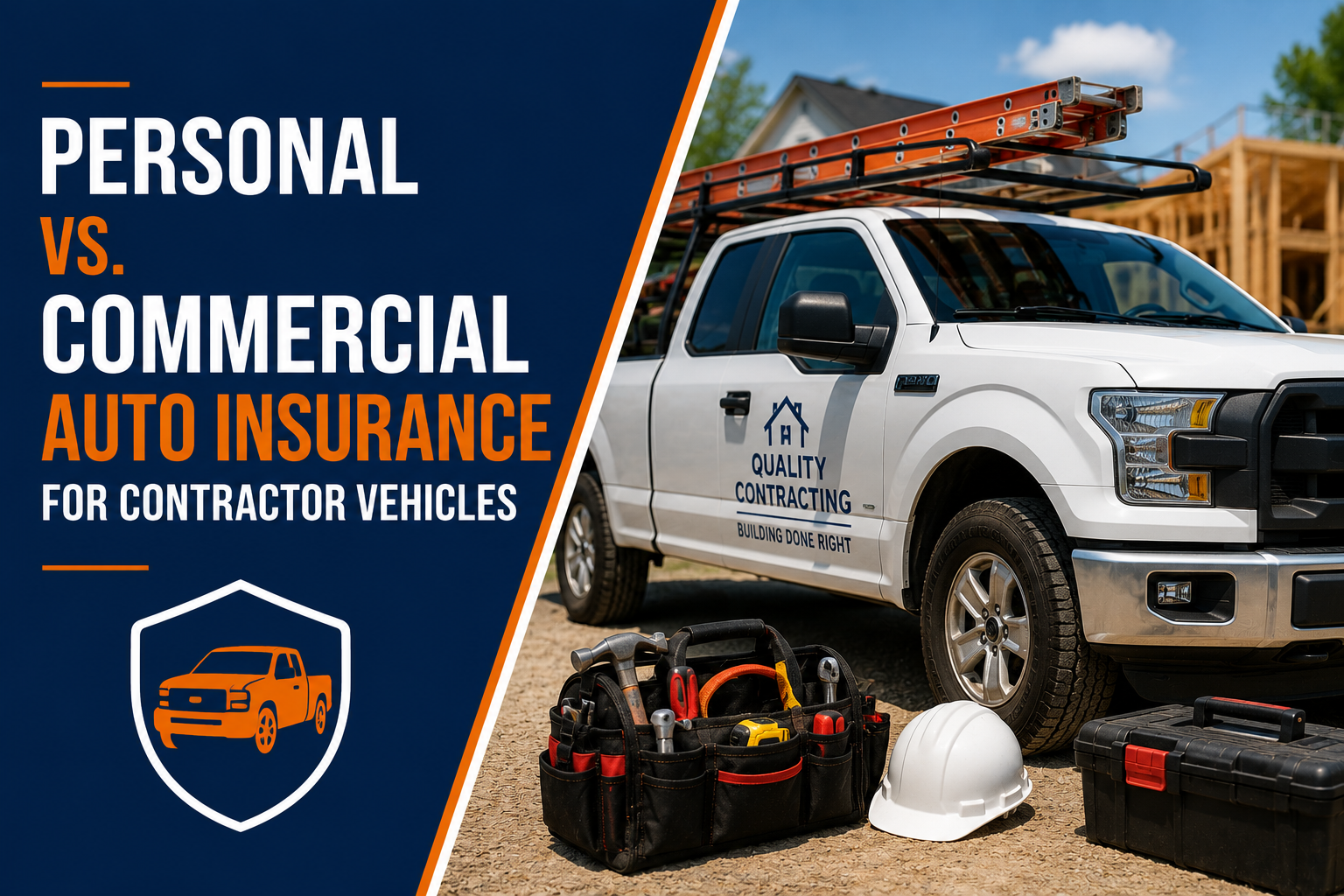
Personal vs. Commercial Auto Insurance for Contractor Vehicles
Contractors usually need commercial auto insurance when they regularly use a car, van, pickup, or truck for business.
A personal auto policy is mainly designed for private driving. It may allow limited business use, but it may not cover daily service calls, tool transport, employee driving, or commercial deliveries.
Commercial auto insurance is built for those risks. It can protect business-owned vehicles and provide coverage for hired or employee-owned vehicles when the policy includes those options.
The NAIC states that personal auto insurance usually does not cover vehicles used for work. It also notes that business auto policies may offer higher limits and broader protection for commercial activities.
Personal vs. Commercial Auto Insurance at a Glance
| Feature | Personal auto insurance | Commercial auto insurance |
|---|---|---|
| Main purpose | Private and household driving | Business-related vehicle use |
| Typical policyholder | Individual or family | Business, owner, or both |
| Regular jobsite travel | May be restricted | Commonly covered |
| Carrying tools and materials | May create a coverage issue | Expected contractor use |
| Employee drivers | Often unsuitable | Can include approved employees |
| Business-owned vehicles | Usually not the right fit | Designed for them |
| Hired vehicles | Limited or uncertain | Hired auto can be added |
| Employee-owned vehicles | Does not protect the business | Non-owned auto can be added |
| Liability limits | Often lower | Higher limits are often available |
| Vehicle modifications | May be limited | Can be reported and insured |
| Tools inside the vehicle | Usually not covered | Usually still need separate tools coverage |
| Personal use | Main purpose | May be allowed when disclosed |
Both policies may offer liability, collision, comprehensive, and uninsured motorist coverage. However, the policy must match the vehicle’s actual use.
What Is Personal Auto Insurance?
Personal auto insurance covers vehicles used mainly for private purposes.
Common uses include:
- Commuting to one regular workplace
- Shopping
- Family transportation
- Personal travel
- Social and recreational driving
A personal policy may also permit some incidental business use. For example, it might allow an occasional trip to the bank or office supply store.
However, coverage varies by insurer and policy form. Texas regulators warn that some personal policies cover limited paid business driving, while others do not. They recommend telling the insurer about business use because an undisclosed claim could be denied.
What Is Commercial Auto Insurance?
Commercial auto insurance covers vehicles used in business operations.
It may protect:
- Business-owned cars
- Contractor vans
- Service pickups
- Utility trucks
- Work trailers
- Rented vehicles
- Employee-owned vehicles used for work
A commercial policy can also cover several drivers and vehicles under one insurance program.
California’s commercial insurance guide explains that business auto policies can apply to owned, hired, and non-owned autos. The selected covered-auto symbols determine which vehicles receive each type of protection.
When Does a Contractor Need Commercial Auto Insurance?
Commercial coverage is usually the safer choice when the vehicle plays an active role in the business.
The following situations often point toward a commercial policy.
The Business Owns the Vehicle
A vehicle titled to an LLC, corporation, or partnership should generally be insured under a policy that recognizes that business.
The named insured should match the entity that owns the vehicle and faces the liability risk.
A mismatch can create problems. For example, a contractor may title a van to an LLC but insure it only under a personal policy in the owner’s name.
The Vehicle Is Used for Daily Service Calls
Regular travel between customers is different from a normal commute.
A contractor may drive to:
- Several homes each day
- Multiple construction sites
- Suppliers and warehouses
- Emergency service calls
- Property inspections
- Estimates and consultations
That pattern creates a clear business exposure.
The Vehicle Carries Tools or Materials
A contractor vehicle may carry:
- Power tools
- Ladders
- Testing equipment
- Plumbing supplies
- HVAC components
- Electrical materials
- Paint or chemicals
- Customer property
This use is more commercial than ordinary personal driving.
However, commercial auto insurance usually does not cover removable tools inside the vehicle. Contractors normally need tools and equipment or inland marine insurance for those items.
Employees Drive the Vehicle
A personal policy is rarely the best option when employees regularly use the vehicle.
Commercial auto insurance can list approved drivers and protect the business against covered liability claims.
Contractors should disclose every regular driver. They should also review motor vehicle records and create written driving rules.
The Vehicle Tows a Trailer
Contractors often tow:
- Equipment trailers
- Landscaping trailers
- Dump trailers
- Tool trailers
- Utility trailers
The insurer needs to know the trailer’s weight, value, ownership, and use.
Liability coverage and physical damage coverage may apply differently. Therefore, the trailer may need its own listing or endorsement.
The Vehicle Has Commercial Branding
A company logo does not automatically determine coverage. Still, it is a strong sign that the vehicle serves a business purpose.
Branding may also make the vehicle a more visible target for tool theft.
Is Driving to a Jobsite the Same as Commuting?
Not always.
A simple drive from home to one regular workplace may look like an ordinary commute. However, contractor travel often involves several business activities.
Examples include:
- Visiting multiple jobsites
- Carrying expensive tools
- Picking up materials
- Transporting employees
- Making deliveries
- Responding to customer calls
Because policies define business use differently, contractors should describe their normal driving routine to the insurer.
Do not ask only whether “commuting” is covered. Explain how many stops occur and what the vehicle carries.
Can a Sole Proprietor Use Personal Auto Insurance?
Possibly, but being self-employed does not automatically make a personal policy suitable.
Consider two examples.
A freelance consultant occasionally drives a sedan to meet a client. A plumber uses a cargo van for six service calls each day.
Both are sole proprietors. However, their auto risks are very different.
A sole proprietor should tell the insurer:
- How often the vehicle is used for work
- How many business miles it travels
- Whether tools or materials are carried
- Whether employees drive it
- Whether it tows a trailer
- Whether it has commercial modifications
The insurer can then decide whether personal coverage, a business-use classification, or commercial auto is appropriate.
Key Coverage Differences
Personal and commercial policies may use similar coverage names. Still, the scope and limits can differ.
Liability Coverage
Liability insurance pays qualifying claims when the insured driver injures someone or damages another person’s property.
Commercial auto policies often provide higher limits because business vehicles can create greater exposure.
A serious accident may involve:
- Several injured people
- Expensive vehicles
- Commercial property
- Lost income claims
- A lawsuit against the company
State minimum limits may satisfy the law. However, they may not provide enough protection for an established contractor.
Collision Coverage
Collision coverage may repair or replace the insured vehicle after:
- A crash with another vehicle
- An impact with a building
- A rollover
- A collision with another object
This coverage usually includes a deductible.
A contractor should consider whether the business could continue without the vehicle. If not, collision coverage may be important.
Comprehensive Coverage
Comprehensive coverage applies to many non-collision losses.
Examples may include:
- Theft of the vehicle
- Vandalism
- Fire
- Hail
- Broken glass
- Falling objects
- Animal strikes
The NAIC explains that comprehensive insurance commonly addresses theft and other non-collision damage.
However, comprehensive coverage for the vehicle usually does not include portable contractor tools.
Uninsured and Underinsured Motorist Coverage
This coverage may help when another driver has no insurance or not enough insurance.
Depending on state law, it may cover:
- Bodily injury
- Medical expenses
- Lost income
- Hit-and-run accidents
- Vehicle damage
Availability and requirements vary by state. Contractors should review the options before rejecting this coverage.
Hired Auto Coverage
Hired auto coverage protects the business when it rents or leases certain vehicles.
A contractor may need a rental when:
- A work van is being repaired
- A large project requires another truck
- The business travels out of town
- A short-term job needs a special vehicle
Hired auto liability may cover claims caused to other people. Physical damage to the rented vehicle may require separate protection.
Before declining a rental company’s damage waiver, ask whether the policy covers:
- Damage to the rental
- Theft
- Loss of use
- Administrative charges
- Towing
- Diminished value
Non-Owned Auto Coverage
Non-owned auto liability protects the business when an employee uses a personal vehicle for work.
For example, an employee might:
- Pick up supplies
- Drive to a jobsite
- Visit a customer
- Deliver documents
- Handle an emergency call
The employee’s personal policy may respond first. However, the contractor’s business may also be sued.
Non-owned auto coverage can protect the company in that situation. It generally does not repair the employee’s personal vehicle.
What Happens if Tools Are Stolen From the Vehicle?
Neither a personal nor commercial auto policy should be expected to cover all removable tools.
A van break-in may involve two policies:
- Comprehensive auto insurance may cover the damaged window or door.
- Tools and equipment insurance may cover the stolen tools.
Portable contractor property is often insured through inland marine coverage.
The NAIC advises small businesses to consider commercial vehicle coverage for business transportation. It also recommends reviewing separate property protection for business equipment.
Contractors should confirm:
- The maximum tools limit per vehicle
- Overnight parking requirements
- Locked-vehicle conditions
- Forced-entry requirements
- Per-item limits
- Replacement cost valuation
What About Custom Vehicle Equipment?
Many contractors add specialized equipment to their vehicles.
Examples include:
- Ladder racks
- Built-in shelving
- Partitions
- Tool drawers
- Service bodies
- Lift gates
- Mounted generators
- Refrigeration units
These upgrades can add significant value.
Contractors should provide the insurer with invoices, photographs, and replacement costs. Otherwise, a claim may value the vehicle as a standard model without the professional upfit.
Can a Commercial Vehicle Be Used Personally?
Yes, many commercial policies allow some personal use.
However, the contractor must disclose that use.
Important questions include:
- Does the owner drive the van home?
- Can family members drive it?
- Is weekend use allowed?
- Does another personal vehicle exist?
- Are personal errands permitted?
The insurer should confirm which drivers and activities are covered.
How Much Does Commercial Auto Insurance Cost?
Commercial auto insurance often costs more than personal insurance.
Several factors can affect the premium:
- Vehicle type
- Business use
- Annual mileage
- Driver records
- Number of vehicles
- Operating area
- Liability limits
- Deductibles
- Claims history
- Trailer use
- Vehicle value
- Trade or industry
The NAIC identifies driving history, mileage, location, vehicle type, limits, and deductibles as common auto rating factors.
The lowest premium is not always the best choice. A cheaper policy can become costly when it does not match the contractor’s real operations.
Risks of Using the Wrong Policy
Using personal insurance for a commercial exposure may lead to serious problems.
Possible consequences include:
- Claim denial
- Policy cancellation
- Nonrenewal
- Premium adjustment
- Uninsured vehicle damage
- Personal responsibility for a lawsuit
- Coverage disputes involving the business entity
Texas regulators specifically warn that failing to disclose business driving could lead to a denied claim.
Contractors should never hide business use to obtain a lower rate.
Questions to Ask Before Choosing a Policy
Ask the insurance agent:
- Does this policy cover my normal contractor activities?
- Is the correct business named on the policy?
- Are all regular drivers covered?
- Can employees drive the vehicle?
- Are hired vehicles included?
- Are employee-owned vehicles covered?
- Does the policy allow personal use?
- Are trailers covered?
- Are custom vehicle upgrades included?
- What liability limit is appropriate?
- Does the policy cover tools inside the vehicle?
- Do I need separate inland marine insurance?
The SBA recommends comparing coverage terms and working with a licensed commercial insurance professional.
Frequently Asked Questions
Can a contractor use personal auto insurance?
Possibly, if the insurer accepts the actual business use. Regular service calls and tool transport often require commercial coverage.
Does a vehicle need commercial insurance because it has a logo?
Not automatically. However, the logo may indicate regular business use that should be disclosed.
Can employees drive a personally insured vehicle?
Regular employee driving can create a coverage problem. A commercial policy is usually better suited for that exposure.
Does commercial auto cover tools?
Usually not. Portable tools generally need tools and equipment or inland marine insurance.
Does commercial auto cover personal use?
It may. The owner should disclose personal use and all potential drivers.
What covers an employee’s personal vehicle?
The employee’s policy may apply first. Non-owned auto liability may protect the contractor’s business.
Is commercial auto legally required?
Vehicle owners must follow state financial responsibility laws. Whether a personal or commercial policy is appropriate depends on ownership, use, and policy terms.
Can a contractor switch from personal to commercial insurance?
Yes. The contractor should avoid a gap between the old and new policies.
Conclusion
Personal auto insurance may work for limited business use when the insurer approves it.
However, contractors usually need commercial auto insurance when they travel between jobsites, carry tools, transport materials, tow trailers, or allow employees to drive.
The correct policy should match the vehicle’s ownership and real daily use.
Contractors should also review hired auto, non-owned auto, custom equipment, and tools coverage. Commercial auto insurance does not solve every vehicle-related risk.
Before choosing a policy, provide the insurer with a full description of the vehicle, drivers, mileage, cargo, and operations. This approach reduces coverage gaps and helps protect both the contractor and the business.
Editorial review: This guide was researched and reviewed by the Coverage Editorial Team using government agencies, insurance regulators, licensing authorities, policy documentation, and current industry pricing sources.