Does Contractor Insurance Cover Tools Left at a Jobsite Overnight?
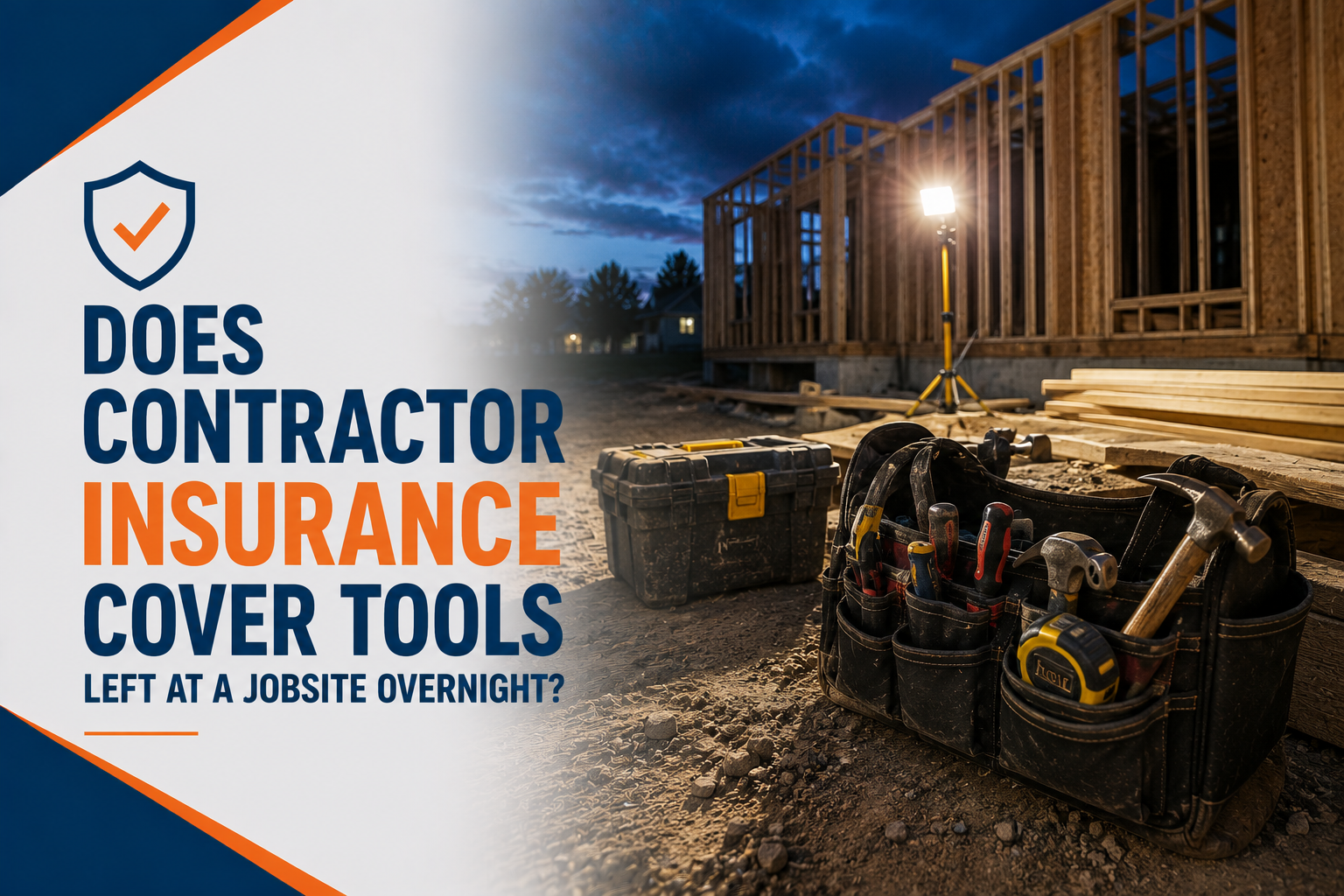
Contractor insurance may cover tools left at a jobsite overnight, but coverage is not automatic. The tools generally need to be insured under a contractors’ tools and equipment policy, equipment floater, or another type of inland marine insurance.
Commercial general liability does not ordinarily cover theft of the contractor’s own tools. A standard commercial property policy or business owner’s policy may protect equipment at the contractor’s main location, but off-premises property can have lower limits or require an endorsement. Builder’s risk insurance usually focuses on the structure under construction and project materials, so contractors should not assume it covers their removable tools.
The outcome of an overnight theft claim depends on the policy’s covered locations, theft provisions, security requirements, deductibles, valuation method, and exclusions. Contractors who routinely leave equipment at customer properties should confirm in writing that their coverage applies to unattended jobsites after working hours.
Quick Answer
Tools left at a jobsite overnight may be covered when:
- The contractor carries tools and equipment or inland marine insurance.
- Theft is a covered cause of loss.
- The jobsite falls within the policy’s coverage territory.
- The tools qualify as insured property.
- The contractor followed any storage and security requirements.
- The loss exceeds the deductible.
- The contractor can prove ownership and value.
- The theft is reported promptly to law enforcement and the insurer.
Coverage may be limited or denied when tools are left unsecured, the property is not scheduled or otherwise insured, the loss is unexplained, or a jobsite-specific sublimit applies.
Which Insurance Covers Tools at a Jobsite?
Portable tools are usually best protected through inland marine insurance rather than standard premises-based property insurance.
The California Department of Insurance describes inland marine as a broad category of property insurance for movable property and unusual risks. Commercial inland marine coverage can include equipment floaters and builder’s risk policies, although those are separate forms designed for different property. The Texas Department of Insurance similarly identifies contractor equipment and property in transit as examples of property commonly insured through inland marine coverage.
Contractors’ Tools and Equipment Insurance
Contractors’ tools and equipment coverage may protect portable property such as:
- Power tools
- Hand tools
- Testing equipment
- Portable generators
- Compressors
- Ladders
- Landscaping equipment
- Surveying devices
- Small machinery
- Toolboxes and storage cases
Depending on the policy, coverage may follow the property while it is:
- At the contractor’s shop
- Inside a work vehicle
- In transit
- At a temporary jobsite
- Stored at a customer’s property
The policy may be called an equipment floater, contractors’ equipment policy, small-tools endorsement, or inland marine policy. The name alone does not determine the coverage, so contractors should review the declarations, coverage form, endorsements, and exclusions.
Commercial Property Insurance
Commercial property insurance generally protects a business location and the property stored there, including equipment, inventory, furniture, and fixtures. Inland marine coverage may be needed when equipment travels or remains away from the insured premises.
A commercial property policy might provide some off-premises coverage, but the available amount may be much lower than the main business personal property limit.
For example, a contractor could have $100,000 of equipment coverage at a workshop but only a limited amount available for tools left at an unscheduled jobsite. The exact limits must be verified in the policy.
Business Owner’s Policy
A business owner’s policy, commonly called a BOP, generally combines commercial property, general liability, and business interruption coverage. Its property section may insure tools and equipment at the listed business location.
However, a BOP should not automatically be expected to provide full protection for tools moved between jobsites. Contractors may need an inland marine endorsement or separate equipment floater.
Builder’s Risk Insurance
Builder’s risk can cover property involved in construction, installation, remodeling, or repair. It commonly focuses on:
- The structure under construction
- Building materials
- Fixtures awaiting installation
- Supplies intended to become part of the project
- Certain property in transit or temporary storage
Regulatory descriptions treat builder’s risk and equipment floaters as separate categories of inland marine insurance. Contractors should therefore not assume that a builder’s risk policy covering a house, renovation, or project materials also covers removable drills, saws, ladders, and hand tools.
The builder’s risk policy should be reviewed to determine whose property is insured and whether contractors’ tools or equipment are included, excluded, or covered only through an endorsement.
General Liability Insurance
Commercial general liability insurance protects against qualifying third-party bodily injury and property damage claims. It is not intended to insure the contractor’s own property against theft.
If a tool injures a customer, general liability may become relevant. If someone steals that tool, the contractor generally needs property or inland marine coverage.
When Are Tools Left Overnight More Likely to Be Covered?
An overnight theft claim is more likely to qualify when the contractor has arranged coverage specifically for portable equipment and complied with the policy’s conditions.
The Jobsite Is a Covered Location
Some policies broadly cover equipment wherever the contractor works within the coverage territory. Others require locations to be listed or reported.
Ask whether coverage applies at:
- Residential customer properties
- Commercial buildings
- Outdoor construction sites
- Vacant properties
- Unoccupied buildings
- Storage containers
- Temporary warehouses
- Projects in another state
A contractor that begins a large project or stores unusually valuable equipment at one site may need to notify the insurer.
Theft Is a Covered Cause of Loss
Some policies cover a broad range of direct physical losses unless excluded. Others cover only listed causes of loss.
Confirm whether the policy covers:
- Theft
- Burglary
- Vandalism
- Fire
- Water damage
- Wind or storm damage
- Accidental damage
- Vehicle collision while transporting tools
Commercial property insurance can protect business property against covered events such as theft or physical damage, but the specific policy determines which causes of loss apply.
The Tools Are Properly Secured
Policies may impose conditions or restrictions when equipment is left unattended.
Relevant questions include:
- Must the building be locked?
- Must tools be stored inside an enclosed structure?
- Is an open construction site acceptable?
- Must equipment be kept in a locked container?
- Is fencing required?
- Must there be visible evidence of forced entry?
- Does coverage change when the property is vacant?
- Are tools covered when left outdoors?
A contractor should not rely on a verbal statement that “theft is covered.” The insurer should explain how the policy treats overnight storage at an unattended jobsite.
The Tools Qualify as Covered Property
The named insured must generally own the property or have an insurable interest in it.
Different rules may apply to:
- Business-owned tools
- Employee-owned tools
- Rented equipment
- Leased machinery
- Borrowed tools
- Property belonging to another subcontractor
- Materials supplied by the customer
Employee tools and rented equipment may require separate limits or endorsements.
Common Reasons an Overnight Tool Claim May Be Limited
Unsecured or Open Jobsites
Tools left in an unlocked building, open yard, unfinished structure, or unsecured area may not satisfy policy conditions.
Even when the policy does not contain an absolute security requirement, the insurer may investigate whether the circumstances meet the definition of theft and whether any exclusion applies.
Unexplained or Mysterious Disappearance
The contractor may discover that a tool is missing without knowing when, where, or how it disappeared.
A loss described only as “the tools were gone in the morning” may be treated differently from a documented break-in with damaged locks, surveillance footage, witness information, or a police report.
The policy may distinguish theft from unexplained disappearance, inventory shortage, or property that cannot be accounted for.
Employee Theft
Theft committed by an employee may be excluded from a standard tools policy or handled under commercial crime insurance.
The Texas Department of Insurance lists employee theft separately from inland marine and other property protections, demonstrating why contractors should not assume every theft is insured under one policy.
Unscheduled High-Value Equipment
A policy may provide blanket coverage for ordinary tools while requiring expensive items to be individually scheduled.
Items that may need special attention include:
- Thermal imaging cameras
- Pipe inspection cameras
- Surveying instruments
- Specialty diagnostic equipment
- Large generators
- Skid steers
- Mini excavators
- Expensive landscaping machinery
The schedule may include the manufacturer, model, serial number, insured value, and ownership information.
Per-Item and Jobsite Sublimits
The policy may have:
- An overall equipment limit
- A maximum per unscheduled item
- A theft sublimit
- A jobsite sublimit
- A limit for employee-owned tools
- A rented-equipment limit
- A newly acquired equipment limit
A $50,000 policy limit does not necessarily mean the insurer will pay $50,000 for every overnight theft.
How an Overnight Tool Claim May Be Calculated
Suppose a plumbing contractor leaves tools inside a locked storage container at a renovation site. Thieves force the container open and steal equipment with a documented replacement cost of $18,000.
The contractor has:
- $30,000 tools and equipment limit
- $1,000 deductible
- $5,000 maximum for any one unscheduled item
- Replacement cost coverage, subject to policy conditions
If all the equipment qualifies for coverage and no individual tool exceeds the per-item cap, the calculation could be:
| Claim calculation | Amount |
|---|---|
| Covered replacement cost | $18,000 |
| Deductible | $1,000 |
| Potential insurer payment | $17,000 |
The result could be lower when depreciation, a sublimit, inadequate documentation, or an exclusion applies.
Replacement Cost vs. Actual Cash Value
The policy may value stolen tools using replacement cost or actual cash value.
Replacement Cost
Replacement cost generally reflects the cost of purchasing a new item of similar type and quality. The policy may initially pay a depreciated amount and reimburse additional costs after the tool is replaced.
Actual Cash Value
Actual cash value generally accounts for depreciation based on the item’s age, condition, and useful life.
A five-year-old saw that costs $1,200 to replace might have an actual cash value substantially below $1,200. Contractors should know which method applies before selecting limits.
What to Do When Tools Are Stolen From a Jobsite
1. Protect the Scene
Do not disturb damaged locks, doors, containers, fencing, or other evidence unless necessary to make the property safe.
2. Contact Law Enforcement
Report the theft and obtain the incident or police report number.
Provide:
- Jobsite address
- Approximate time of the theft
- Description of missing property
- Serial numbers
- Photographs
- Surveillance footage
- Witness details
3. Notify the Customer or General Contractor
Explain the incident factually. Determine whether the theft affected project security, materials belonging to others, or the construction schedule.
4. Contact the Insurance Company Promptly
Report the loss to the insurer or agent according to the policy’s notice requirements. Commercial insurance policies generally require timely claim reporting.
5. Prepare an Inventory
For each stolen item, record:
- Description
- Brand
- Model
- Serial number
- Purchase date
- Purchase price
- Replacement cost
- Ownership
- Receipt or invoice
The NAIC recommends maintaining records, photographs, and inventories of business property because documentation helps establish ownership and claim value.
6. Preserve Supporting Evidence
Keep:
- Police report
- Photographs of forced entry
- Security footage
- Jobsite access records
- Tool assignment records
- Purchase receipts
- Accounting records
- Rental agreements
- Customer contract
- Witness statements
How to Protect Tools Left Overnight
Contractors can reduce both theft risk and claim uncertainty by creating a formal equipment-security procedure.
Consider:
- Removing the most valuable tools each night
- Using locked steel storage containers
- Securing containers to prevent removal
- Installing alarms and motion-activated cameras
- Using GPS trackers on expensive equipment
- Adding visible business identification
- Recording serial numbers
- Maintaining daily tool checklists
- Restricting jobsite access
- Improving lighting and fencing
- Assigning responsibility for locking the site
The NAIC identifies alarms, GPS devices, inventories, and other anti-theft measures as useful business risk-management tools.
Questions to Ask Before Leaving Tools Overnight
Ask the insurance agent:
- Does my policy cover theft from an unattended jobsite?
- Must the tools be stored inside a locked building or container?
- Is forced entry required?
- Are outdoor tools covered?
- Is there an overnight-storage exclusion?
- What is the maximum limit at one jobsite?
- Is there a per-item limit?
- Are employee-owned tools covered?
- Are rented and borrowed tools covered?
- Does the policy pay replacement cost or actual cash value?
- Must high-value items be scheduled?
- What documents are required after a theft?
Obtain the answers in writing or ask the agent to identify the relevant policy sections.
Frequently Asked Questions
Does general liability cover tools stolen from a jobsite?
No, not ordinarily. General liability addresses qualifying claims made by third parties, not theft of the contractor’s own equipment.
Does inland marine cover tools left overnight?
It may. Coverage depends on the locations, causes of loss, security conditions, limits, and exclusions stated in the policy.
Are tools covered at an open construction site?
Possibly, but open or unsecured sites can create coverage problems. Confirm whether the policy requires locked storage, fencing, or evidence of forced entry.
Does builder’s risk cover contractor tools?
Not automatically. Builder’s risk usually focuses on the project and construction materials. Contractor equipment may require separate inland marine coverage.
Are employee-owned tools covered?
Only when the policy includes them. Employee tools may have a separate or lower limit.
Are rented tools covered?
They may be covered when rented equipment is included and the applicable limit is sufficient.
Is a police report required?
The policy may require prompt notice to law enforcement after theft. A police report also supports the timing, location, and circumstances of the claim.
Will insurance pay the full cost of new tools?
That depends on the valuation method, deductible, limits, per-item caps, and proof of ownership.
Conclusion
Contractor insurance can cover tools left at a jobsite overnight, but the contractor usually needs tools and equipment or inland marine coverage designed for portable property.
Commercial general liability does not ordinarily insure stolen tools, and a standard commercial property policy may provide only limited protection away from the main business premises. Builder’s risk should not be assumed to cover removable contractor equipment.
Before leaving tools overnight, confirm that the jobsite is a covered location, theft is insured, security requirements are satisfied, and limits reflect the total value stored at one site. Pay close attention to unattended-property restrictions, per-item limits, employee tools, rented equipment, and valuation methods.
Maintain a current inventory with serial numbers, receipts, and photographs. If a theft occurs, protect the scene, contact law enforcement, notify the insurer promptly, and preserve all supporting evidence.
Editorial review: This guide was researched and reviewed by the Coverage Editorial Team using government agencies, insurance regulators, licensing authorities, policy documentation, and current industry pricing sources.