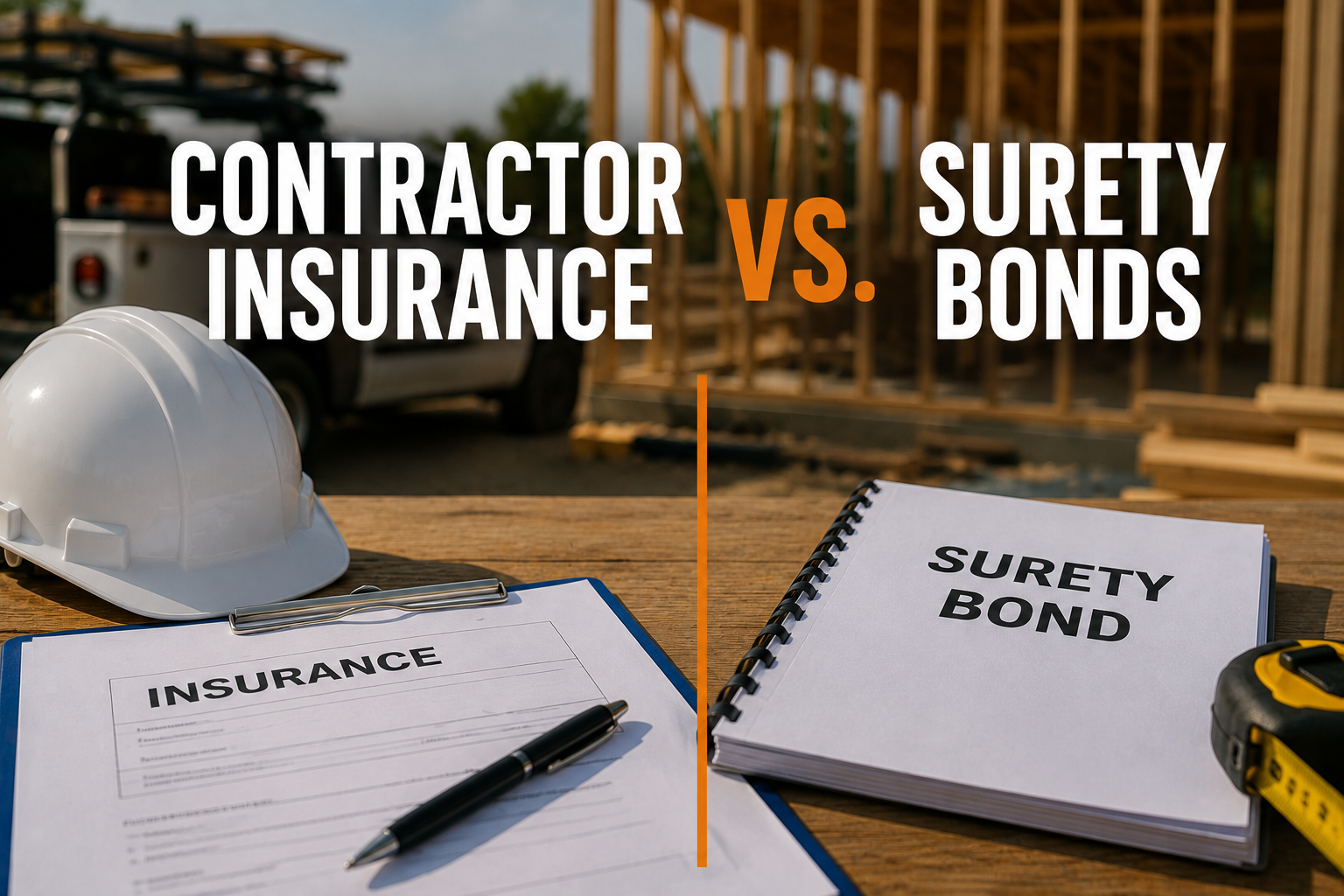
Contractor Insurance vs. Surety Bonds: Key Differences
Contractor insurance and surety bonds both reduce financial risk. However, they protect different parties and respond to different problems.
Contractor insurance protects the contractor against covered accidents, lawsuits, property losses, and other business risks. Examples include general liability, commercial auto, workers’ compensation, and tools coverage.
A surety bond guarantees that the contractor will meet a specific legal or contractual obligation. Depending on the bond, it may protect a licensing authority, project owner, customer, subcontractor, worker, or supplier.
The biggest difference is simple: insurance usually transfers covered risk away from the contractor. A bond guarantees the contractor’s obligation to someone else. If the surety pays a valid claim, the contractor may have to repay the surety.
Therefore, many contractors need both insurance and bonds. One does not replace the other.
Contractor Insurance vs. Surety Bonds at a Glance
| Feature | Contractor insurance | Surety bond |
|---|---|---|
| Main purpose | Protects against covered business losses | Guarantees a legal or contractual obligation |
| Main protected party | The insured contractor | The obligee and eligible claimants |
| Number of parties | Usually insurer and insured | Principal, obligee, and surety |
| Common claims | Injury, property damage, theft, auto accidents | License violations, nonperformance, or unpaid labor and materials |
| Repayment after a claim | Usually not required for a covered claim | Contractor may need to reimburse the surety |
| Legal defense | Often included for covered liability claims | Not the same broad defense protection |
| Coverage amount | Policy limit | Bond amount or penal sum |
| Cost paid by contractor | Insurance premium | Bond premium |
| Underwriting focus | Expected insured losses and business risk | Credit, financial strength, capacity, and character |
| Common requirement | Clients, landlords, lenders, or state law | Licensing agencies and project owners |
| Protects contractor tools | Tools insurance may | No |
| Guarantees project completion | Usually no | A performance bond may |
The policy and bond forms control the final result. Contractors should review both documents before relying on either product.
What Is Contractor Insurance?
Contractor insurance is a group of policies designed to protect a contracting business.
A policy may cover qualifying losses involving:
- Customer injuries
- Accidental property damage
- Employee injuries
- Vehicle accidents
- Stolen tools
- Damaged equipment
- Professional errors
- Cyber incidents
- Pollution events
Commercial liability insurance primarily addresses a business’s liability for bodily injury or property damage caused to third parties. Other policies protect vehicles, employees, buildings, and business property.
Insurance does not cover every loss. Each policy contains limits, exclusions, deductibles, and conditions.
For example, general liability may cover resulting water damage to a customer’s home. However, it may not pay to redo the contractor’s defective work.
What Is a Surety Bond?
A surety bond is a guarantee that a contractor will meet a specific obligation.
The bond may require the contractor to:
- Follow licensing laws
- Enter a contract after winning a bid
- Complete a bonded project
- Pay subcontractors and suppliers
- Meet permit requirements
- Correct certain legal violations
The U.S. Small Business Administration separates surety bonds into contract and commercial bonds. Contract bonds support obligations under a specific contract. Commercial bonds support compliance with laws and regulations.
Surety bonds resemble credit more than ordinary insurance. The surety backs the contractor’s promise but usually expects the contractor to perform without causing a loss. Federal Treasury guidance describes a surety bond as a promise to fulfill an obligation after default and compares it with an extension of credit.
The Three Parties to a Surety Bond
A surety bond involves three parties.
The Principal
The principal is the contractor that must obtain the bond.
The contractor promises to follow the law or complete the bonded obligation.
The Obligee
The obligee requires the bond.
The obligee may be:
- A state licensing board
- A city or county
- A project owner
- A government agency
- A general contractor
The Surety
The surety issues the bond.
If the contractor defaults, the surety investigates the claim. It may pay a valid claim up to the available bond amount.
Oregon’s Water Resources Department describes a surety bond as a three-party agreement between the principal, obligee, and surety company.
Key Difference 1: Who Receives Protection?
Contractor insurance primarily protects the insured business.
For example, general liability may defend the contractor after a customer files a covered property damage lawsuit. Commercial auto may protect the business after a work-vehicle accident.
A surety bond mainly protects the obligee and other eligible claimants.
For example:
- A license bond may protect consumers.
- A performance bond protects the project owner.
- A payment bond protects qualifying subcontractors and suppliers.
- A bid bond protects the owner if the selected contractor refuses the contract.
Oregon’s Construction Contractors Board explains that liability insurance reimburses third parties for covered injury or property damage. In contrast, its contractor bond can pay a final order when the contractor fails to do so.
Key Difference 2: Risk Transfer vs. Financial Guarantee
Insurance transfers certain risks to the insurer.
The contractor pays a premium. In return, the insurer agrees to handle covered losses under the policy.
A surety bond does not transfer the contractor’s obligation in the same way. Instead, the surety guarantees that obligation to the obligee.
If the surety pays because of the contractor’s default, it may seek reimbursement from the contractor. The contractor often agrees to this duty through an indemnity agreement.
Therefore, a contractor should not view a bond claim as a normal insured loss. A paid claim can become a debt owed to the surety.
Key Difference 3: How Claims Work
An insurance claim begins after a covered event or allegation.
For example:
- A contractor damages a customer’s floor.
- The customer demands payment.
- The contractor reports the incident.
- The insurer investigates coverage.
- The insurer may defend and settle the covered claim.
A bond claim follows a different process.
For example:
- A contractor allegedly violates a bonded obligation.
- The customer or obligee submits a claim.
- The surety investigates the alleged default.
- The contractor can provide records and defenses.
- The surety decides whether the claim is valid.
- The surety may pay or take another permitted action.
The claimant must satisfy the bond’s terms and applicable law. A complaint against a contractor does not automatically become a valid bond claim.
Key Difference 4: Who Reimburses the Company?
A contractor usually does not repay an insurance company for a covered liability claim.
The contractor may still pay:
- The deductible
- Amounts above the policy limit
- Excluded losses
- Uninsured expenses
A bond works differently.
If the surety pays a valid claim, the contractor may have to reimburse:
- The claim payment
- Investigation costs
- Legal expenses
- Consultant fees
- Other covered surety losses
This repayment duty is one reason sureties closely review the contractor’s finances before issuing larger bonds.
Key Difference 5: Underwriting Standards
Insurance underwriting focuses on the chance and expected cost of covered losses.
An insurer may review:
- Type of contracting work
- Payroll
- Revenue
- Vehicles
- Employees
- Prior claims
- Tools and property
- Operating locations
- Requested limits
Surety underwriting focuses more heavily on whether the contractor can meet the guaranteed obligation.
For contract bonds, the surety may review:
- Credit history
- Financial statements
- Cash flow
- Working capital
- Previous projects
- Management experience
- Current backlog
- Project size
- Contract terms
The SBA states that applicants for its Surety Bond Guarantee Program must satisfy credit, capacity, and character requirements.
Key Difference 6: Policy Limits vs. Bond Amounts
Insurance policies use coverage limits.
A general liability policy may include separate limits for:
- Each occurrence
- General aggregate
- Completed operations
- Personal and advertising injury
A bond uses a bond amount, also called the penal sum.
That amount is generally the surety’s maximum obligation under the bond. However, several claims may share the same available amount.
A $25,000 license bond does not provide $25,000 to every customer. Prior claims may reduce the remaining funds.
For contract bonds, the required amount may reflect the project’s contract value. Current federal rules generally require performance and payment bonds for covered construction contracts above the applicable threshold. FAR provisions often set each bond at 100% of the original contract price.
Key Difference 7: Legal Defense
Liability insurance commonly includes legal defense for covered lawsuits.
The insurer may appoint an attorney and pay qualifying defense costs. This benefit can apply even when the contractor disputes the allegations.
A surety bond is not a general legal defense policy.
The surety investigates its own potential obligation. However, the contractor may still need separate legal representation to defend the underlying dispute.
Therefore, a bond should not be treated as a substitute for general liability insurance.
Key Difference 8: Duration and Scope
Insurance usually covers a defined policy period.
The contractor renews the policy each year. Claims may depend on when the incident occurred or when the claim was made.
A surety bond may be tied to:
- A contractor license
- One construction contract
- One permit
- One bid
- An ongoing legal requirement
A license bond may remain continuous until cancelled. A performance bond generally remains connected to one project and its bonded obligations.
Contractors must track both insurance renewals and bond status. A lapse can violate a contract or suspend a license.
Common Types of Contractor Insurance
General Liability Insurance
General liability may cover qualifying third-party injury and property damage claims.
It may also provide legal defense.
Workers’ Compensation
Workers’ compensation may cover eligible employee injuries and illnesses caused by work.
Requirements vary by state and business structure.
Commercial Auto Insurance
Commercial auto protects business vehicles and certain auto liability risks.
It usually does not cover portable tools inside the vehicle.
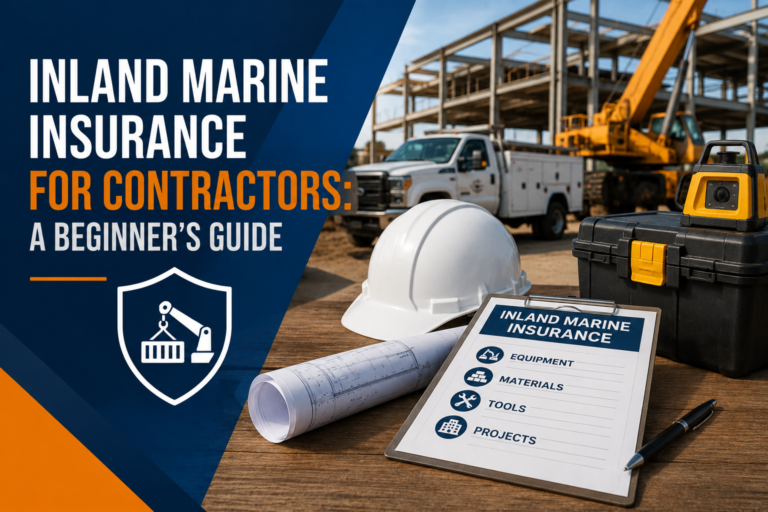
Tools and Equipment Insurance
This coverage may protect portable contractor property against theft, fire, vandalism, and other covered losses.
Insurers often provide it through inland marine coverage.
Professional Liability
Professional liability may cover claims involving design, consulting, or professional mistakes.
Commercial Umbrella
An umbrella can provide additional liability limits above qualifying underlying policies.
Common Types of Contractor Surety Bonds
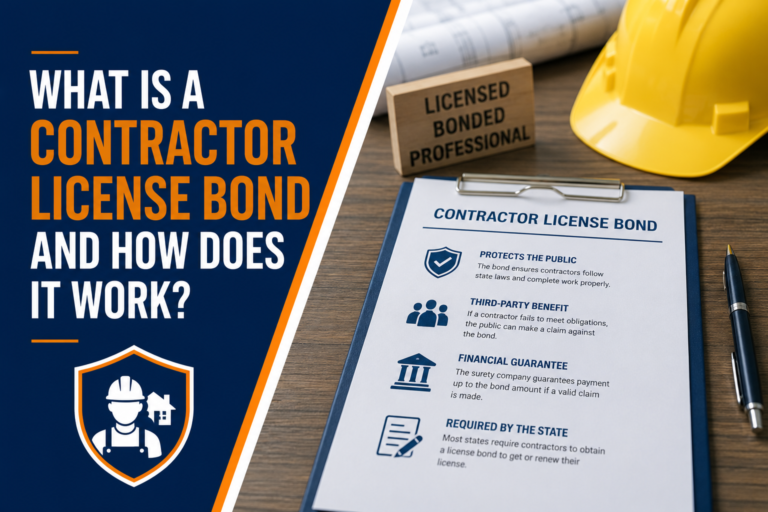
Contractor License Bond
A licensing authority may require this bond before issuing or renewing a contractor license.
It supports compliance with licensing laws. For example, California currently requires licensed contractors to maintain a $25,000 contractor license bond.
Requirements vary by state, city, trade, and license type.
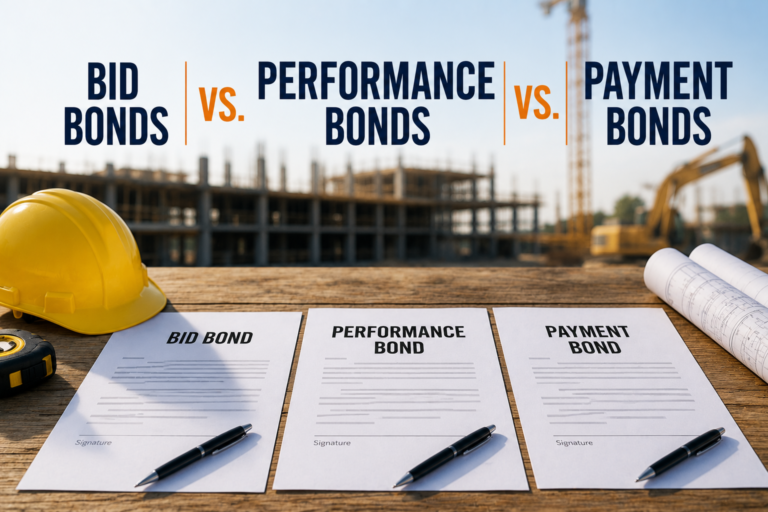
Bid Bond
A bid bond supports the contractor’s bid.
It may protect the project owner if the selected bidder refuses to enter the contract or provide required final bonds.
Performance Bond
A performance bond guarantees the contractor’s performance of a specific contract.
The SBA explains that performance bonds support full completion of the bonded contract.
Payment Bond
A payment bond protects qualifying subcontractors, workers, and suppliers when the bonded contractor fails to pay them.
The SBA states that payment bonds ensure payment to suppliers and subcontractors.
Ancillary Bond
An ancillary bond guarantees another contract requirement.
For example, it may support maintenance duties that fall outside the main performance or payment bonds.
Claim Example: Accidental Property Damage
A plumbing contractor breaks a pipe during a renovation. Water damages the customer’s flooring and cabinets.
General liability insurance may cover the resulting property damage. It may also provide a defense if the customer sues.
A license or performance bond would not automatically handle that accident. The bond would apply only if the facts meet its specific conditions.
Claim Example: Contractor Abandons a Project
A bonded contractor stops work before completing a project.
The project owner may submit a performance bond claim. The surety will investigate the default and the owner’s compliance with the bonded contract.
General liability insurance usually does not guarantee project completion. Therefore, it would not replace a performance bond.
Claim Example: Subcontractors Are Not Paid
A general contractor completes a bonded project but fails to pay subcontractors.
Eligible subcontractors or suppliers may file claims under the payment bond.
General liability insurance does not ordinarily pay unpaid invoices. A payment bond exists for that separate risk.
Federal acquisition rules use payment bonds to protect suppliers of labor and materials on covered federal construction contracts.
Do Contractors Need Both Insurance and Bonds?
Many contractors need both.
A state may require:
- A contractor license bond
- General liability insurance
- Workers’ compensation
A project owner may also require:
- Performance bond
- Payment bond
- Commercial auto insurance
- Umbrella insurance
- Additional insured status
Oregon provides a clear example. Licensed contractors must maintain liability insurance and a surety bond because each requirement protects against a different risk.
The contractor should review licensing rules and every client contract before starting work.
How to Verify Insurance and Bonds
Customers and general contractors should verify both separately.
Verify Insurance
Request:
- Certificate of insurance
- Policy dates
- Coverage limits
- Required endorsements
- Insurance company information
Then, confirm the documents with the issuing agency.
Verify the Bond
Check:
- Contractor’s legal name
- Bond number
- Surety company
- Bond amount
- Effective date
- Current status
- Project or license covered
State licensing websites may offer online verification. Washington, for example, advises consumers to check whether a contractor has active registration, bonding, and liability insurance.
A certificate of insurance does not prove that a contractor has a valid bond. Likewise, a bond does not prove that liability insurance exists.
Frequently Asked Questions
Is a surety bond a type of insurance?
Surety companies often operate within the insurance industry. However, a bond functions differently from standard contractor insurance.
Does general liability replace a contractor bond?
No. General liability covers qualifying accidents and lawsuits. A bond guarantees specific legal or contractual obligations.
Does a contractor repay an insurance claim?
Usually not for a covered claim. However, the contractor remains responsible for deductibles, excluded losses, and amounts above the limit.
Does a contractor repay a bond claim?
Often, yes. The surety may seek reimbursement under the indemnity agreement.
Does a license bond cover bodily injury?
Not like general liability insurance. License bonds address obligations defined by licensing law and the bond form.
Does a performance bond cover property damage?
Its main purpose is to guarantee contract performance. It does not replace liability coverage for accidental property damage.
Can one company provide both insurance and bonds?
Yes. Some insurers and agencies offer both products. However, the bond and insurance remain separate contracts.
Which one costs more?
Costs depend on the policy, bond amount, business risk, credit, project size, and underwriting. Contractors should compare the protections rather than premiums alone.
Conclusion
Contractor insurance and surety bonds solve different problems.
Insurance protects the contractor against covered accidents, lawsuits, injuries, property losses, and other business risks. Surety bonds guarantee that the contractor will meet specific legal or contractual obligations.
The financial structure is also different. An insurer generally absorbs a covered claim after the deductible. A surety may require the contractor to repay a bond loss.
Contractors should never replace one product with the other. Instead, they should identify every licensing, contractual, and operational requirement.
A complete risk plan may include general liability, workers’ compensation, commercial auto, tools coverage, a license bond, and project-specific performance and payment bonds.
Editorial review: This guide was researched and reviewed by the Coverage Editorial Team using government agencies, insurance regulators, licensing authorities, policy documentation, and current industry pricing sources.