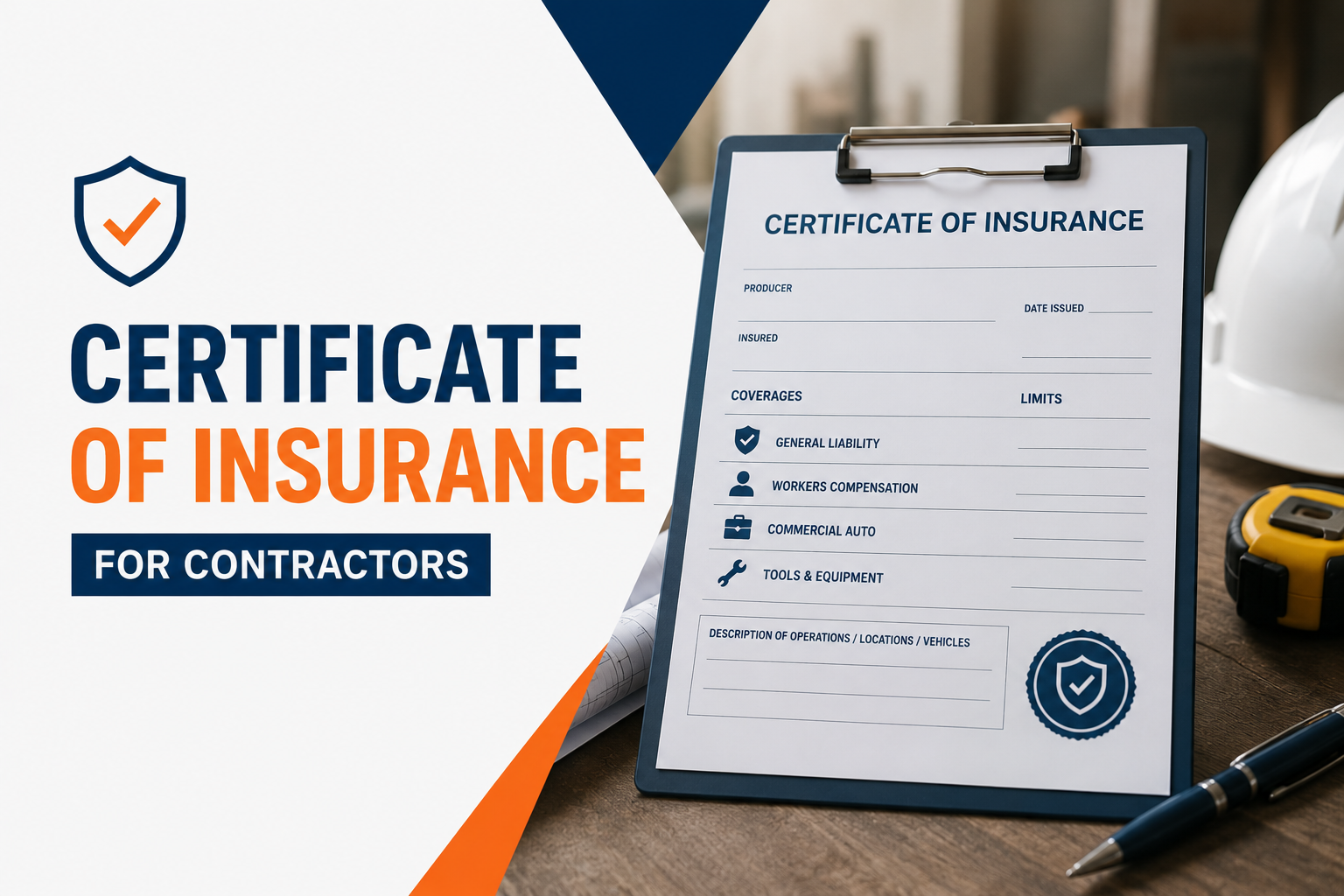
What Is a Certificate of Insurance for Contractors?
A certificate of insurance for contractors is a document that summarizes the business insurance policies a contractor had in place when the certificate was issued. Customers, general contractors, property managers, landlords, and government agencies commonly request one before allowing work to begin.
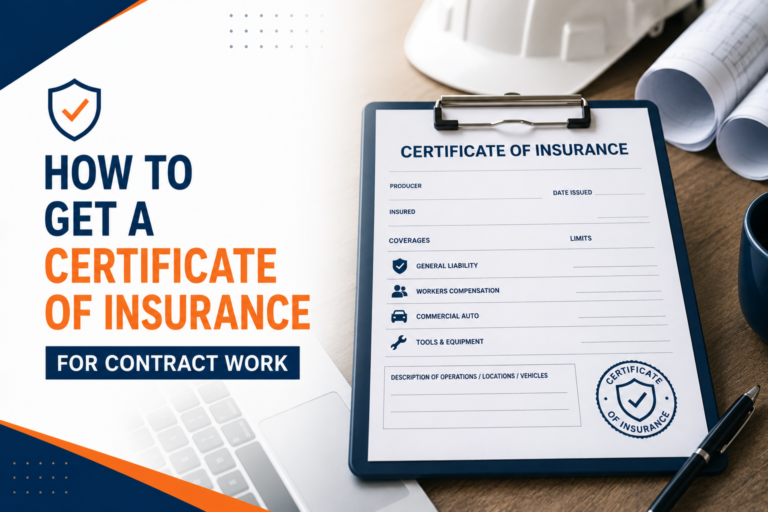
Often abbreviated as a COI, the certificate may show the contractor’s general liability, commercial auto, workers’ compensation, umbrella, or other commercial insurance. It typically identifies the insured business, insurance companies, policy numbers, coverage limits, and policy effective and expiration dates.
A certificate of insurance provides convenient evidence of coverage, but it is not the insurance policy itself. It does not automatically guarantee that a particular accident will be covered, make the certificate holder an additional insured, or change the terms of the contractor’s policy.
Understanding what a COI proves—and what it does not prove—can help contractors avoid project delays and help customers verify that they are hiring an appropriately insured business.
What Does a Certificate of Insurance Show?
A contractor COI provides a summary of selected insurance information on one document.
Depending on the contractor’s policies, it may show:
- Contractor’s legal business name
- Business address
- Insurance agent or broker
- Insurance company names
- Policy numbers
- Coverage types
- Policy effective dates
- Policy expiration dates
- Liability limits
- Certificate holder
- Description of operations
- Certain additional insured references
The California Department of Insurance recommends that consumers request a contractor’s certificate of insurance and check the insurance company name, policy number, and coverage limits. It also advises contacting the insurance company directly when verification is needed.
A COI gives the recipient a quick way to confirm that listed policies existed on the date the certificate was prepared. However, the actual insurance contract—including its coverage forms, exclusions, conditions, and endorsements—controls whether a claim is covered.
What Insurance Policies Can Appear on a Contractor COI?
A certificate may summarize several types of contractor insurance.
| Insurance coverage | What it generally addresses |
|---|---|
| General liability | Third-party bodily injury and property damage |
| Commercial auto | Liability involving vehicles used for business |
| Workers’ compensation | Qualifying employee work-related injuries and illnesses |
| Employers’ liability | Certain employee injury claims outside standard workers’ compensation benefits |
| Commercial umbrella | Additional limits above qualifying underlying policies |
| Professional liability | Claims involving professional errors, advice, or services |
| Other specialized coverage | Policies such as pollution liability or builder’s risk |
The commonly used ACORD certificate of liability insurance form includes sections for general liability, automobile liability, umbrella or excess liability, and workers’ compensation and employers’ liability. ACORD develops standardized insurance forms used throughout the industry.
Not every policy will necessarily appear on the same certificate. Professional liability, builder’s risk, tools and equipment, or other specialized policies may require separate documentation.
Why Do Contractors Need Certificates of Insurance?
A contractor may need a COI to prove that the business satisfies legal, licensing, leasing, or contractual insurance requirements.
Certificates are commonly requested by:
- Homeowners
- General contractors
- Commercial customers
- Property managers
- Municipalities
- Government agencies
- Landlords
- Lenders
- Project owners
A general contractor may require a subcontractor to submit a certificate before entering the job site. A commercial landlord may request one before allowing a contractor to work inside a leased building. A homeowner may ask for proof of general liability and workers’ compensation coverage before signing a remodeling agreement.
Business insurance can protect against unexpected costs involving accidents, property damage, and lawsuits. The SBA recommends assessing business risks, working with a licensed insurance professional, comparing policy terms, and reviewing coverage as the business changes.
A current COI can also make a contractor appear more professional and prepared. It shows that the contractor has taken steps to manage business risks rather than expecting the customer to rely only on verbal assurances.
Who Issues a Certificate of Insurance?
A certificate is typically issued by the contractor’s insurance agent, broker, or insurance company.
The contractor generally contacts the insurance professional and provides:
- Certificate holder’s legal name
- Certificate holder’s address
- Project name or number
- Contract insurance requirements
- Requested coverage limits
- Additional insured requirements
- Required endorsements
- Deadline for delivery
Contractors should not create, edit, or alter their own certificates. Changing policy limits, expiration dates, additional insured wording, or other insurance information can result in serious contractual, legal, and insurance consequences.
When a customer asks for a COI, the contractor should forward the complete request to the insurance agent. The agent can determine whether the existing policies satisfy the request or whether changes and endorsements are necessary.
What Is the Certificate Holder?
The certificate holder is the person or organization receiving the certificate.
It may be:
- The homeowner
- General contractor
- Property owner
- Property management company
- Municipality
- Lender
- Commercial client
Being listed as the certificate holder generally means the party receives evidence of the contractor’s insurance. It does not automatically provide that party with coverage under the policy.
This distinction is important because customers sometimes believe that having their name in the certificate holder box makes them insured. It does not.
Certificate Holder vs. Additional Insured
A certificate holder and an additional insured are not the same.
Certificate Holder
A certificate holder receives evidence that the contractor has certain insurance policies. This status alone does not normally provide coverage under the contractor’s policy.
Additional Insured
An additional insured is a person or organization granted certain protection under another party’s liability policy through the policy language or an endorsement.
A project owner or general contractor may request additional insured status for liability arising from the contractor’s work. The scope of that protection depends on the endorsement and policy terms.
The NAIC explains that an endorsement changes the underlying insurance contract by adding, deleting, excluding, or otherwise modifying coverage. An endorsement becomes part of the policy and takes precedence when it changes the original terms.
A COI may indicate that the certificate holder is an additional insured, but the policy or endorsement must actually provide that status. New York insurance regulators have specifically stated that a certificate cannot identify an organization as an additional insured unless the referenced policy includes it as one.
Contractors should obtain and retain the actual additional insured endorsement when a contract requires it.
Does a Certificate of Insurance Change the Policy?
No. A standard certificate does not normally amend, extend, or alter the coverage provided by the insurance policy.
It summarizes information but does not replace:
- Policy declarations
- Coverage forms
- Definitions
- Conditions
- Exclusions
- Endorsements
- Deductibles
- Coverage limits
Texas-approved certificate language states that a certificate is issued as information only, does not grant rights to the certificate holder, and does not amend or extend the policy’s coverage.
This means a certificate cannot create coverage that the contractor did not purchase. For example, typing “additional insured” or “30-day cancellation notice” into a description box does not necessarily create those rights if the policy and endorsements do not support them.
The actual policy remains the controlling contract between the insured and the insurance company.
Does a COI Guarantee That a Claim Will Be Covered?
No. A certificate shows selected policy information, but it does not guarantee payment for a future claim.
A claim may still be denied or limited because:
- The incident falls outside the policy period.
- The contractor performed an excluded operation.
- The claim does not satisfy the policy’s coverage requirements.
- The applicable limit has been exhausted.
- The contractor failed to comply with policy conditions.
- The damaged work falls under a workmanship exclusion.
- The activity was not disclosed to the insurer.
- A required endorsement was never issued.
For example, a COI may show $1 million in general liability coverage. That does not mean every $1 million claim will be paid. The insurer must investigate the incident and apply the policy’s terms.
A certificate should therefore be treated as evidence of insurance—not as a guarantee of coverage.
Will the Certificate Holder Receive Cancellation Notice?
Not necessarily.
Many certificate forms state that cancellation notice will be provided according to the policy provisions. The recipient should not assume that the insurance company must provide 10, 30, or 60 days’ notice merely because that wording was requested on the certificate.
ACORD explains that cancellation-notice rights generally depend on the policy, endorsement, or applicable legal requirement rather than the certificate alone.
Texas insurance regulators similarly explain that a certificate may include cancellation or material-change notice information only when the policy, an endorsement, or applicable law grants that right. A certificate cannot independently alter or expand policy obligations.
A customer that requires cancellation notice should request the appropriate endorsement and verify that the insurer issued it.
How Does a Contractor Request a COI?
The process is usually straightforward:
- Obtain the customer’s exact legal name and address.
- Review the contract’s insurance requirements.
- Send the request to the insurance agent or broker.
- Identify any required additional insured endorsements.
- Provide the project name, address, and deadline.
- Review the completed certificate for accuracy.
- Send it to the requesting party.
- Keep a copy with the project records.
Many insurers or agencies provide certificates without an additional charge, although policy changes and endorsements may affect the premium.
Contractors should avoid waiting until the morning a project begins. Requests involving higher limits, umbrella insurance, waivers of subrogation, or completed operations endorsements may require additional underwriting.
How Should a Customer Verify a Contractor’s COI?
A homeowner or business hiring a contractor should review the certificate carefully.
Check that:
- The insured name matches the contractor’s contract.
- The policy dates include the project period.
- The insurance company is clearly identified.
- General liability limits satisfy the contract.
- Workers’ compensation is shown when required.
- Commercial auto coverage is listed when relevant.
- Additional insured status is supported by an endorsement.
- The certificate does not appear altered.
- The contractor’s trade is covered by the policy.
The California Department of Insurance advises consumers to contact the listed insurance company directly when verifying the information on a contractor’s certificate.
The NAIC also provides tools for checking insurer licensing, complaint information, and financial data, and it directs consumers to their state insurance departments for assistance.
For larger projects, the customer may request copies of relevant endorsements rather than relying solely on the certificate.
Common Certificate of Insurance Mistakes
Using the Wrong Business Name
The insured name should match the entity performing and contracting for the work. A certificate issued to an individual may not properly identify work contracted through an LLC.
Confusing the Certificate Holder With an Additional Insured
Listing a customer in the certificate holder box does not grant additional insured protection.
Allowing the Certificate to Expire
A certificate may be valid when the project begins but show a policy that expires before the work is completed. Updated proof should be requested after renewal.
Assuming All Operations Are Covered
A certificate may show general liability coverage without revealing exclusions for roofing, demolition, excavation, residential construction, or other activities.
Relying on Description-Box Wording
Statements typed into the description of operations cannot create rights or coverage that are absent from the policy.
Failing to Verify Subcontractor Certificates
General contractors should collect COIs and required endorsements from subcontractors before work begins and track expiration dates throughout the project.
Altering the Document
Contractors should never change certificate dates, limits, policy numbers, or wording. Any correction must come from the issuing agent or insurer.
Frequently Asked Questions
Is a certificate of insurance the same as an insurance policy?
No. A COI summarizes selected information from one or more policies. The complete policy determines the actual coverage.
How much does a certificate of insurance cost?
Insurance agents commonly issue certificates as part of servicing a commercial policy. However, adding coverage, increasing limits, or requesting endorsements may increase the premium.
How long is a contractor COI valid?
The certificate reflects the policy dates listed on the document. It does not remain current after the underlying policy expires, is canceled, or changes.
Can a contractor start work without a COI?
Possibly, but the customer, license, lease, or contract may require proof of insurance before work begins. Starting without it could violate the agreement.
Does a COI prove workers’ compensation coverage?
It may show workers’ compensation policy information. The recipient should verify that the policy is active and applies to the contractor’s workers and operations.
Does a certificate make a homeowner an additional insured?
No. Additional insured status must be provided by the policy or an endorsement.
Can a customer call the insurer to verify a COI?
Yes. Customers may contact the insurance company or issuing agency using independently verified contact information.
Should contractors collect COIs from subcontractors?
Yes. Contractors should collect certificates and required endorsements before subcontracted work begins and retain them with project records.
Conclusion
A certificate of insurance allows contractors to provide customers, general contractors, landlords, and project owners with a convenient summary of active business insurance.
It can show general liability, commercial auto, workers’ compensation, umbrella, and other coverage, along with policy dates and limits. However, a COI is not the policy, does not guarantee claim payment, and does not automatically make the certificate holder an additional insured.
Contractors should request certificates through their licensed insurance agent, verify that the insured name and limits are correct, and provide any endorsements required by the contract. Customers should review the document, confirm that coverage remains active, and verify important information directly with the issuing agency or insurer.
Treat the COI as the beginning of insurance verification—not the complete answer. For projects with significant risk, review the relevant policy endorsements before work starts.
Editorial review: This guide was researched and reviewed by the Coverage Editorial Team using government agencies, insurance regulators, licensing authorities, policy documentation, and current industry pricing sources.