What Does “Additional Insured” Mean for Contractors?
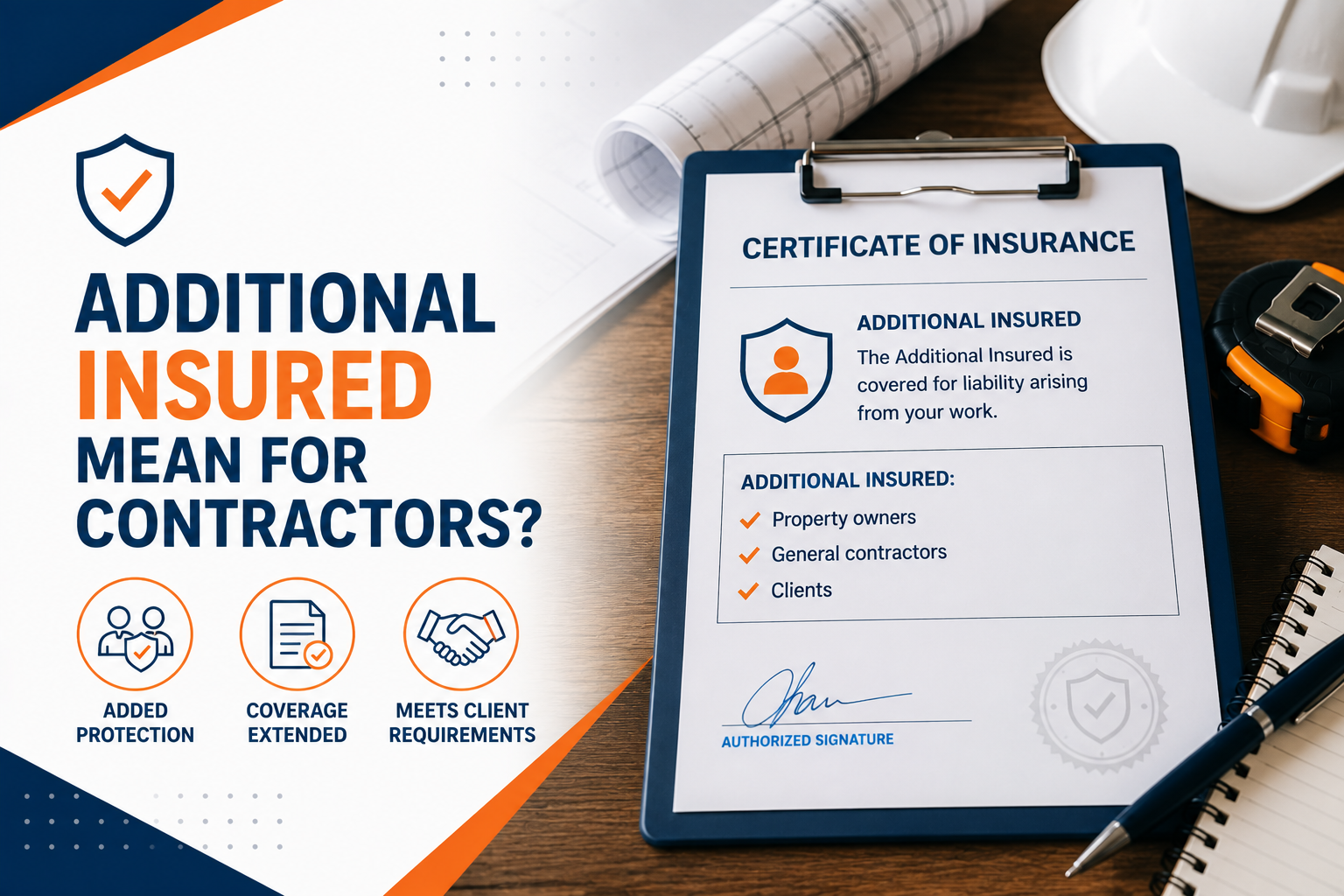
“Additional insured” means that another person or organization receives limited protection under a contractor’s liability insurance policy. The protection usually applies only to claims connected to the contractor’s work, operations, or completed project.
A general contractor may require a subcontractor to add the general contractor as an additional insured. A property owner may ask a remodeling company to do the same. Government agencies, landlords, developers, and commercial customers often include this requirement in their contracts.
Additional insured status can give the requesting party access to the contractor’s insurance when both parties are named in a covered lawsuit. However, it does not give the additional insured every right available to the policyholder. Coverage depends on the endorsement, contract, claim, policy limits, and exclusions.
What Is an Additional Insured?
An additional insured is a person or organization added to another party’s insurance policy for a specific liability exposure.
In a contractor relationship:
- The contractor is usually the named insured.
- The customer, property owner, or general contractor becomes the additional insured.
- The insurer provides limited coverage according to an endorsement.
- Coverage usually applies only to liability connected to the named insured’s work.
For example, a general contractor hires a plumbing subcontractor. The subcontractor causes a leak that damages the building. The property owner sues both companies.
If the general contractor is properly listed as an additional insured on the plumber’s general liability policy, the plumber’s insurer may defend the general contractor against qualifying allegations related to the plumbing work.
An endorsement changes, adds, removes, or limits provisions in an insurance policy. Therefore, the actual additional insured endorsement—not the contract or certificate alone—determines the coverage available.
Why Do Contractors Need Additional Insured Coverage?
Construction projects involve several businesses working at the same location. An accident caused by one contractor can lead to claims against the property owner, developer, general contractor, and subcontractors.
A general contractor may be sued because it:
- Hired the subcontractor
- Controlled part of the jobsite
- Supervised the project
- Had contractual responsibility for safety
- Was responsible for delivering the completed work
Additional insured coverage helps transfer some of that risk back to the contractor whose work created the exposure.
For example, an electrical subcontractor leaves materials in a hallway. A visitor trips and sues both the electrician and the general contractor. Additional insured coverage may allow the electrician’s policy to respond for the general contractor when the endorsement covers the claim.
Who Commonly Requests Additional Insured Status?
The requesting party is often the person or organization above the contractor in the project’s contractual chain.
Common examples include:
- Property owners
- General contractors
- Construction managers
- Developers
- Landlords
- Municipalities
- Government agencies
- Commercial customers
- Lenders
- Homeowners associations
A general contractor may also require every subcontractor to provide additional insured coverage before entering the jobsite.
Public contracts often require both a certificate of insurance and a copy of the additional insured endorsement. That distinction matters because the certificate summarizes coverage, while the endorsement changes who receives protection under the policy.
What Does Additional Insured Coverage Protect?
Additional insured coverage may protect the requesting party against certain third-party claims connected to the named insured’s acts, omissions, or work.
Depending on the endorsement, it may address:
- Bodily injury claims
- Property damage claims
- Personal and advertising injury
- Legal defense expenses
- Settlements
- Court judgments
- Claims arising from ongoing operations
- Claims arising from completed operations
Suppose a roofing subcontractor damages a neighboring property while replacing a roof. The property owner sues both the roofer and the general contractor. If the endorsement applies, the roofer’s liability policy may defend the general contractor against the qualifying claim.
Coverage is not unlimited. Modern additional insured endorsements commonly restrict protection to the extent allowed by law and to the coverage required by the written contract. They also do not increase the policy’s total limits.
What Additional Insured Coverage Does Not Do
Adding another party as an additional insured does not give that party complete access to every section of the contractor’s policy.
It usually does not:
- Cover unrelated activities of the additional insured
- Protect the additional insured for every act of its own negligence
- Increase the contractor’s policy limits
- Cover claims excluded by the policy
- Replace professional liability insurance
- Replace workers’ compensation
- Guarantee coverage for completed operations
- Make the additional insured the policy owner
- Give the additional insured control over policy changes
- Cover work outside the endorsement’s scope
For example, if a property owner causes an accident that has no connection to the contractor’s work, the contractor’s additional insured endorsement may not apply.
Likewise, adding a general contractor as an additional insured does not remove exclusions involving pollution, professional services, residential construction, roofing, excavation, or other restricted operations.
Additional Insured vs. Named Insured
The named insured is the person or business listed as the primary policyholder. This party purchases the policy and assumes the main obligations under it.
The named insured generally has broader rights, including the ability to:
- Request policy changes
- Add or remove coverage
- Receive policy documents
- Pay premiums
- Cancel the policy
- Report claims
- Add other insured parties
An additional insured receives more limited protection. Its rights depend on the endorsement and its relationship to the named insured’s work.
| Feature | Named Insured | Additional Insured |
|---|---|---|
| Purchases the policy | Yes | No |
| Pays the premium | Usually | Usually not |
| Controls the policy | Yes | No |
| Receives broad policy protection | Yes | Limited |
| Must be connected to covered operations | Not in the same way | Usually |
| Can cancel the policy | Usually | No |
| Shares policy limits | Yes | Yes |
The two parties generally share the same available limits. Adding an additional insured does not create a separate liability limit for that party.
Additional Insured vs. Certificate Holder
An additional insured and a certificate holder are not the same.
A certificate holder receives a certificate showing that the contractor had certain insurance on the date the certificate was issued. Certificate holder status alone does not provide coverage under the policy.
An additional insured receives protection through the policy or an endorsement.
| Status | What It Provides |
|---|---|
| Certificate holder | Evidence that insurance exists |
| Additional insured | Limited coverage under the policy |
| Named insured | Primary rights and coverage under the policy |
A certificate may show an “additional insured” box or include wording in the description section. However, that wording does not replace a required endorsement.
Official certificate instructions warn that when additional insured status is required, the policy must be endorsed. A statement on the certificate alone does not grant those rights.
Ongoing Operations vs. Completed Operations
Contractors should pay close attention to whether the endorsement covers ongoing operations, completed operations, or both.
Ongoing Operations Coverage
Ongoing operations coverage applies while the contractor is actively performing the work.
Examples include:
- A customer trips over materials during construction.
- A subcontractor damages existing property while working.
- A falling tool injures a visitor before the project is finished.
- Water enters the building during an active roofing project.
An ongoing operations endorsement may stop providing additional insured status once the contractor’s work is complete.
Completed Operations Coverage
Completed operations coverage applies to qualifying injury or damage that occurs after the contractor finishes the work.
Examples include:
- A repaired pipe leaks several weeks later.
- Faulty wiring causes a fire after occupancy.
- A railing detaches after project completion.
- A roof installation leads to later water damage.
A separate completed operations endorsement may be needed. Sonoma County’s insurance guidance states that an endorsement written only for ongoing operations does not provide completed operations protection.
For construction projects, contracts often require both forms because serious claims can arise long after crews leave the jobsite.
Scheduled vs. Blanket Additional Insured Endorsements
A scheduled endorsement lists the additional insured by name. The insurer or agent must usually issue a new endorsement for each party.
A blanket endorsement automatically provides additional insured status when the named insured agrees to do so in a written contract.
Scheduled Endorsement
A scheduled endorsement may be appropriate when:
- The contract names one specific customer.
- The insurer requires individual approval.
- The customer wants its legal name shown on the endorsement.
- The project has customized insurance requirements.
Blanket Endorsement
A blanket endorsement may be more efficient for a contractor that signs many contracts.
However, blanket coverage normally applies only when the written agreement meets the endorsement’s conditions. A verbal promise or purchase order may not be enough.
Some blanket endorsements cover only the party that signed the contract with the contractor. They may not automatically include the property owner, lender, parent company, affiliates, or other parties listed elsewhere in the agreement. Official government guidance on commonly used endorsements highlights these differences.
What Does Primary and Noncontributory Mean?
A contract may require additional insured coverage on a primary and noncontributory basis.
Primary means the contractor’s policy responds before the additional insured’s own insurance for a covered claim.
Noncontributory means the contractor’s insurer will not seek contribution from the additional insured’s policy for that claim.
This wording can affect which insurer responds first. However, additional insured status does not automatically guarantee primary and noncontributory treatment. A separate endorsement or qualifying policy provision may be necessary.
Contractors should send the exact contract language to their insurance agent. The agent can confirm whether the policy and endorsement satisfy the requirement.
Is a Waiver of Subrogation the Same Thing?
No. Additional insured status and a waiver of subrogation perform different functions.
Additional insured coverage may provide defense and liability protection to another party.
A waiver of subrogation limits the insurer’s ability to recover claim payments from the party named in the waiver.
A contract may require both:
- Additional insured status
- Primary and noncontributory coverage
- Waiver of subrogation
The certificate alone does not create a waiver. Certain policies require a separate endorsement.
How Does a Contractor Add an Additional Insured?
The contractor should follow these steps:
- Read the insurance section of the contract. Identify every party that must be included.
- Send the full language to the insurance agent. Do not send only the first page or a certificate request.
- Confirm ongoing and completed operations requirements. Many construction contracts require both.
- Verify the legal names. The contract, certificate, and endorsement should use accurate business names.
- Request the endorsement. Ask for a copy, not only the certificate.
- Check primary and noncontributory wording. Confirm whether the policy includes the required provision.
- Check the waiver of subrogation requirement. Arrange a separate endorsement when necessary.
- Deliver documents before work starts. Waiting may delay access to the project.
- Keep copies with the contract. Retain the certificate and endorsements for future claims.
The New Hampshire Insurance Department advises customers to retain both the certificate and any endorsements that grant additional insured status.
Does It Cost Money to Add an Additional Insured?
It may.
Some insurers include blanket additional insured coverage in the policy premium. Others charge for each scheduled endorsement. Fees can also depend on the trade, contract, project, number of parties, completed operations requirements, and requested wording.
More complex requests may cost more, especially when a contract requires:
- Several additional insured parties
- Completed operations coverage
- Primary and noncontributory wording
- Waivers of subrogation
- Higher liability limits
- Project-specific aggregate limits
- Coverage maintained for several years
The contractor should obtain the cost before signing the agreement. Some insurance requirements may be unavailable under the existing policy.
Common Additional Insured Mistakes
Relying Only on the Certificate
A certificate does not replace an endorsement. Ask for both documents.
Adding the Wrong Business Name
An incorrect legal name can create delays and disputes. Use the exact name shown in the contract.
Providing Only Ongoing Operations Coverage
The customer may remain unprotected against claims that occur after project completion.
Assuming Blanket Coverage Includes Everyone
A blanket endorsement may cover only parties that have a direct written agreement with the named insured.
Ignoring Policy Exclusions
Additional insured status does not remove exclusions for restricted trades, locations, or operations.
Waiting Until the Project Begins
The insurer may need time to approve the request. Arrange coverage before employees or subcontractors enter the jobsite.
Frequently Asked Questions
Does Additional Insured Status Protect the Contractor?
The endorsement primarily extends certain coverage to another party. The contractor remains the named insured and continues to receive protection under the policy.
Can a Homeowner Be an Additional Insured?
Possibly. However, additional insured requirements are more common in commercial and subcontracting relationships. The insurer must approve or automatically cover the homeowner under the applicable endorsement.
Does Additional Insured Status Increase Policy Limits?
No. The named insured and additional insured generally share the policy’s existing limits.
Can Several Parties Be Additional Insureds?
Yes. A contract may require coverage for the owner, general contractor, developer, construction manager, lender, and related entities. The contractor must confirm that the endorsement includes each required party.
Does Additional Insured Coverage Apply After the Job Ends?
Only when the endorsement includes completed operations coverage. An ongoing operations endorsement may end when the contractor finishes its work.
Can a Certificate Holder File a Claim?
Certificate holder status alone does not make the holder insured. The ability to seek coverage depends on the policy and endorsement.
Does Additional Insured Status Cover the Other Party’s Negligence?
It depends on the endorsement, applicable law, contract, and facts of the claim. Coverage is often limited to liability connected to the named insured’s acts or work.
Conclusion
Additional insured status gives a property owner, general contractor, or other party limited protection under a contractor’s liability insurance. It is commonly required because several businesses can be sued after the same construction accident.
However, a certificate of insurance alone is not enough. The contractor must review the actual endorsement and confirm whether it covers ongoing operations, completed operations, and every party named in the contract.
Before signing an agreement, send the complete insurance requirements to a licensed commercial insurance professional. Verify the legal names, policy limits, endorsements, exclusions, and required wording. Careful review can prevent rejected certificates, project delays, and costly coverage disputes.
Editorial review: This guide was researched and reviewed by the Coverage Editorial Team using government agencies, insurance regulators, licensing authorities, policy documentation, and current industry pricing sources.