What Does Contractor General Liability Insurance Not Cover?
Contractor general liability insurance provides important protection against third-party bodily injury, property damage, personal and advertising injury, and certain claims involving completed work. However, it does not cover every accident, financial loss, or business problem a contractor may experience.
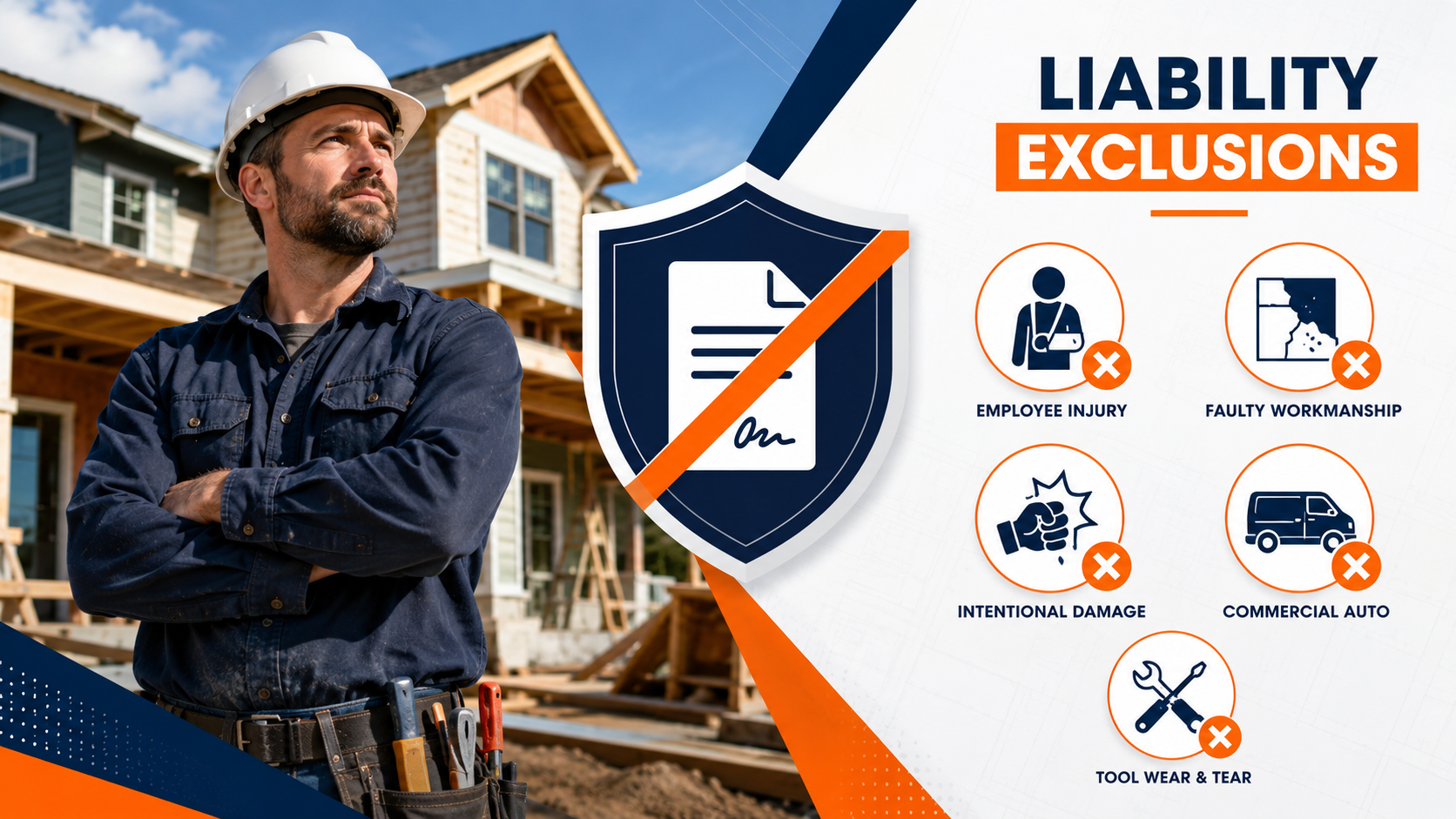
General liability insurance usually does not cover employee injuries, commercial vehicle accidents, stolen tools, damage to the contractor’s own property, professional mistakes, intentional acts, most pollution incidents, or the basic cost of correcting defective workmanship. Separate policies or endorsements are often required for these exposures.
The exact exclusions depend on the insurance company, policy form, contractor classification, endorsements, and type of work performed. Contractors should therefore review the complete policy rather than assuming that every liability claim is covered.
Contractor General Liability Exclusions at a Glance
| Loss or claim | Usually covered by general liability? | Coverage that may be needed |
|---|---|---|
| Employee injury | No | Workers’ compensation |
| Work vehicle accident | No | Commercial auto insurance |
| Stolen or damaged tools | No | Tools and equipment insurance |
| Damage to your own business property | No | Commercial property insurance |
| Professional advice or design error | No | Professional liability insurance |
| Cost of correcting defective work | Usually no | Contractor warranty, reserve funds, or specialized coverage |
| Resulting damage from defective work | Possibly | General liability, subject to exclusions |
| Intentional injury or damage | No | Generally uninsurable |
| Pollution or contamination | Commonly excluded | Contractors pollution liability |
| Cyberattack or data breach | No | Cyber liability insurance |
| Employment discrimination claim | No | Employment practices liability insurance |
| Missed deadline or contract dispute | Usually no | Professional liability or contractual risk management |
| Damage above the policy limit | No | Commercial umbrella or excess liability |
| Normal wear and tear | No | Maintenance or equipment coverage |
These are common limitations, not guarantees. Policy wording controls whether a particular claim is covered.
1. Employee Injuries and Occupational Illnesses
General liability insurance is primarily designed to cover injuries suffered by customers, visitors, vendors, and other third parties. It generally excludes injuries to the contractor’s employees arising from their employment.
For example, general liability would not normally cover an employee who:
- Falls from a ladder
- Cuts a hand while using a power tool
- Injures a back while lifting materials
- Develops an occupational illness
- Is struck by equipment at a job site
Workers’ compensation insurance is designed for these incidents. It may provide medical treatment, rehabilitation, partial wage replacement, disability benefits, and death benefits after a qualifying work-related injury or illness. Workers’ compensation requirements are primarily regulated at the state level, so the rules depend on where the contractor operates.
A contractor should not assume that calling a worker an independent subcontractor eliminates all workers’ compensation obligations. Classification depends on applicable law and the actual working relationship.
2. Commercial Vehicle Accidents
Contractor general liability insurance normally excludes liability arising from the ownership, maintenance, or use of automobiles.
That means a general liability policy will not usually pay when a contractor causes an accident while:
- Driving to a customer’s property
- Transporting tools or materials
- Making a delivery
- Towing a work trailer
- Driving between job sites
- Operating a business-owned van or truck
Commercial auto insurance is generally needed for vehicles used in business operations. The National Association of Insurance Commissioners explains that personal auto insurance usually does not cover vehicles used for work and that commercial policies may provide higher limits and additional protection for business vehicles, employee-operated vehicles, large trucks, rentals, and vehicles carrying goods.
General liability may still cover certain incidents involving equipment classified as mobile equipment rather than an automobile, but the distinction can be technical. Contractors operating forklifts, excavators, lifts, or other machinery should confirm how each item is classified.
3. Damage to Your Own Tools and Equipment
General liability protects against certain damage to property belonging to other people. It does not normally insure the contractor’s own tools, equipment, materials, or machinery.
It generally will not replace:
- Stolen power tools
- Damaged ladders
- Lost testing equipment
- A vandalized work trailer
- Machinery destroyed in a fire
- Materials stolen from a job site
Tools and equipment insurance—often written as inland marine or contractor’s equipment coverage—is usually required for portable property that moves between locations.
Commercial property insurance may protect equipment, inventory, computers, furniture, and other business property kept at a listed office, workshop, or storage location. A business owner’s policy may combine commercial property protection with general liability and business interruption coverage.
Contractors should review restrictions involving unattended job sites, unlocked vehicles, overnight storage, unexplained disappearance, and equipment rented from others.
4. Damage to Property You Own, Rent, or Control
General liability insurance is not intended to function as property insurance for buildings or spaces controlled by the contractor.
Claims may be excluded or limited when damage affects property that the contractor:
- Owns
- Rents
- Occupies
- Borrows
- Physically controls
- Is directly working on
For example, a contractor’s general liability policy may not fully cover damage to a workshop owned by the business. Commercial property insurance would normally be the more appropriate policy.
Coverage can also become complicated when the damaged property was in the contractor’s “care, custody, or control.” Suppose a contractor temporarily takes possession of a customer’s appliance for repair and damages it. The policy may treat that differently from accidental damage to another part of the customer’s home.
Some policies provide limited coverage for damage to rented premises, but the limit, causes of loss, and conditions should be reviewed carefully.
5. Professional Errors, Advice, and Design Mistakes
General liability insurance is mainly intended for bodily injury and tangible property damage. It does not usually cover claims based solely on professional advice, designs, inspections, recommendations, or technical services.
Professional liability insurance, also known as errors and omissions insurance, may be needed when a contractor provides:
- Architectural or engineering services
- Construction consulting
- Project management
- Home inspections
- Technical designs
- Plans or specifications
- Cost estimates
- Energy audits
- Installation recommendations
For example, a construction consultant might recommend an unsuitable material that causes the client a financial loss without causing physical property damage. That claim may fall outside general liability coverage.
The U.S. Small Business Administration distinguishes professional liability from general liability and identifies it as coverage for service businesses facing claims involving errors, negligence, or malpractice.
Some contractors need both policies because physical job-site accidents and professional service claims involve different exposures.
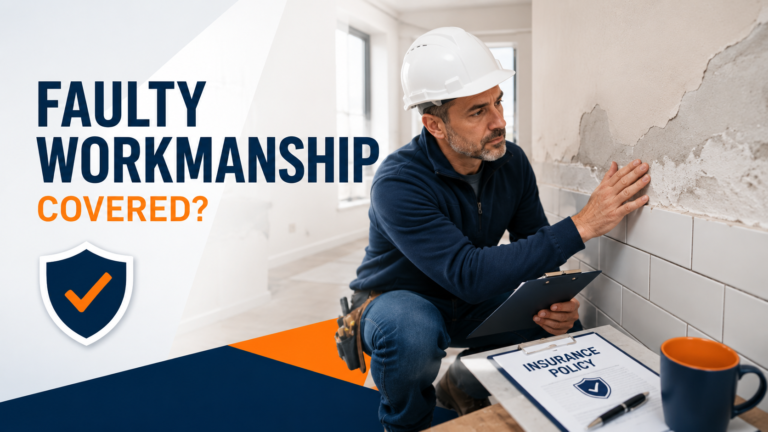
6. The Cost of Correcting Defective Workmanship
General liability insurance is not a performance guarantee or maintenance contract. It generally does not pay the basic cost of removing, repairing, replacing, or completing a contractor’s defective work.
Consider a plumber who improperly installs a pipe connection:
- The cost of correcting the faulty connection itself may be excluded.
- Water damage to flooring, walls, or furniture may potentially qualify as resulting property damage.
Similarly, if a roofer installs shingles incorrectly, the policy may not pay to replace the defective roof installation. However, it may potentially respond if water later damages unrelated interior property.
The distinction between defective work and resulting damage is one of the most important—and complicated—areas of contractor liability insurance. Coverage can change depending on:
- Whether the project was completed
- Whether a subcontractor performed the work
- Which part of the property was damaged
- Whether an endorsement changes the standard exclusions
- Whether the damage occurred during or after operations
Contractors should ask specifically about the “your work,” “your product,” impaired property, and property-being-worked-on exclusions.
7. Contractual Guarantees and Business Disputes
General liability does not cover every obligation a contractor accepts in a contract.
It will not normally pay simply because a contractor:
- Misses a completion deadline
- Exceeds the project budget
- Fails to meet a performance guarantee
- Loses a bid deposit
- Must refund a dissatisfied customer
- Owes liquidated damages
- Fails to complete the project
- Is involved in a payment dispute
Certain liabilities assumed under qualifying insured contracts may be covered, but contractual liability provisions contain exceptions and detailed definitions.
Before signing an agreement, contractors should review indemnification clauses, insurance requirements, warranties, additional insured provisions, and responsibility for delays. Accepting broader liability in a contract does not guarantee that the insurance policy will cover it.
8. Intentional, Dishonest, or Criminal Acts
General liability insurance is designed for accidental events. It generally excludes bodily injury or property damage that the insured expected or intended.
Examples include:
- Deliberately damaging customer property
- Intentionally injuring another person
- Committing fraud
- Stealing customer property
- Knowingly making false statements
- Performing illegal work
- Concealing known damage
Insurance may still defend another insured who did not participate in an intentional act, depending on the policy and circumstances. However, contractors should never expect insurance to protect deliberate misconduct.
Punitive damages may also be excluded or uninsurable under the law of certain states.
9. Pollution and Environmental Damage
Standard general liability policies commonly exclude or restrict pollution-related losses.
Potential contractor pollution exposures include:
- Mold
- Asbestos
- Lead paint
- Fuel spills
- Chemical releases
- Refrigerant leaks
- Contaminated soil
- Silica dust
- Wastewater
- Hazardous material removal
The NAIC explains that environmental insurance covers losses arising from unexpected releases of pollutants that are typically excluded from general liability and property policies. Potential covered losses under environmental insurance may include bodily injury, property damage, cleanup costs, and business interruption.
Contractors performing remediation, excavation, demolition, HVAC work, environmental testing, or hazardous material handling should consider contractors pollution liability insurance.
10. Cyberattacks and Data Breaches
General liability insurance does not normally provide comprehensive protection for data breaches, ransomware, fraudulent transfers, or other cyber incidents.
A contractor may store:
- Customer addresses
- Payment information
- Employee records
- Building plans
- Contracts and estimates
- Account passwords
- Tax documents
Cyber liability insurance may help cover customer notifications, data recovery, legal expenses, business interruption, incident response, and certain third-party claims, depending on the policy.
The Federal Trade Commission recommends that small businesses evaluate whether cyber insurance is appropriate and compare first-party and third-party coverage with an insurance professional.
General liability policies may also contain exclusions involving electronic data, confidential information, or certain privacy-related incidents.
11. Employment-Related Claims
General liability does not typically cover claims brought by employees alleging workplace misconduct.
Common examples include:
- Discrimination
- Wrongful termination
- Harassment
- Retaliation
- Failure to promote
- Improper hiring practices
- Employment-related defamation
- Invasion of employee privacy
Employment practices liability insurance, commonly called EPLI, is designed for many of these exposures.
Workers’ compensation and EPLI serve different purposes. Workers’ compensation addresses work-related physical injuries and illnesses, while EPLI addresses allegations involving employment decisions and workplace conduct.
12. Business Income Lost After an Interruption
General liability does not normally replace income merely because a contractor cannot operate after a fire, storm, theft, or other disruption.
Business interruption insurance may help replace eligible lost income and continuing operating expenses when operations are suspended because of covered physical damage. This coverage is frequently included in a business owner’s policy along with general liability and commercial property insurance.
Business interruption coverage still has conditions. It may require direct physical loss from a covered cause and may include waiting periods, limits, and exclusions.
13. Claims Above the Policy Limits
A claim can fall within the policy’s coverage and still leave the contractor with unpaid expenses if the loss exceeds the available limit.
A general liability policy may include:
- Each occurrence limit
- General aggregate limit
- Products-completed operations aggregate
- Personal and advertising injury limit
- Medical payments limit
- Damage to rented premises limit
Once the applicable limit is exhausted, the contractor may be responsible for the remaining amount.
Commercial umbrella or excess liability insurance can provide additional limits above qualifying underlying policies. Contractors working on high-value projects or contracts requiring larger limits should consider this additional protection.
14. Undisclosed or Excluded Contracting Operations
A contractor policy is priced and issued according to the work disclosed in the application. The policy may exclude activities the insurer did not agree to cover.
Potentially restricted operations include:
- Roofing
- Demolition
- Excavation
- Structural work
- Work above certain heights
- Welding or hot work
- Swimming pool construction
- Asbestos or mold remediation
- Work involving heavy machinery
- Projects above a stated value
- Residential developments or condominiums
A contractor insured as a painter should not assume the policy covers roofing or structural remodeling performed occasionally.
Failing to describe operations accurately can result in incorrect premiums, audit charges, claim disputes, or cancellation.
How Contractors Can Avoid General Liability Coverage Gaps
Before purchasing or renewing coverage, contractors should:
- Describe every service they perform.
- Disclose subcontractor use and annual subcontractor costs.
- Confirm coverage for completed operations.
- Review exclusions for work at heights, roofing, demolition, and excavation.
- Check requirements for certificates and additional insured endorsements.
- Insure vehicles under an appropriate commercial auto policy.
- Protect tools through property or inland marine coverage.
- Purchase workers’ compensation when required.
- Consider professional, cyber, pollution, and umbrella coverage.
- Review new contracts with an insurance professional before signing.
The least expensive policy is not necessarily the best option. A policy has limited value if it excludes the contractor’s primary services.
Frequently Asked Questions
Does contractor general liability cover faulty workmanship?
It generally does not pay to correct the defective work itself. It may cover resulting bodily injury or damage to other property, depending on the circumstances and policy exclusions.
Does general liability cover stolen tools?
No. Tools and equipment insurance or inland marine coverage is generally needed for theft or damage involving portable tools.
Does general liability cover employee injuries?
No. Employee injuries and occupational illnesses are typically handled through workers’ compensation insurance.
Does general liability cover damage to a work vehicle?
No. Commercial auto insurance is normally required for liability and physical damage involving work vehicles.
Does general liability cover subcontractor mistakes?
Possibly, but coverage is not automatic. Policies may restrict subcontracted work or require subcontractors to maintain their own insurance.
Does general liability cover professional negligence?
Usually not when the claim arises solely from professional advice, designs, inspections, or consulting services. Professional liability insurance may be required.
Does general liability cover mold or asbestos claims?
Many pollution-related claims are excluded or limited. Contractors handling mold, asbestos, lead, chemicals, or contaminated materials may need pollution liability coverage.
Does general liability cover work already completed?
Products-completed operations coverage may apply to certain bodily injury or property damage claims arising after work is finished. It does not automatically cover the cost of correcting the contractor’s defective work.
Conclusion
Contractor general liability insurance provides valuable protection, but it is only one part of a complete business insurance program.
It generally does not cover employee injuries, vehicle accidents, stolen tools, professional errors, intentional acts, cyber incidents, most pollution claims, contractual performance disputes, or the cost of correcting defective work. Coverage can also be limited by policy limits, contractor classifications, and endorsements excluding specific operations.
Review the policy before beginning a project rather than waiting until a claim occurs. Make sure the insurer knows exactly what work you perform, where you work, which equipment you use, and whether you hire subcontractors.
A carefully structured insurance program can combine general liability with workers’ compensation, commercial auto, tools and equipment, professional liability, cyber insurance, pollution liability, and umbrella coverage. The objective is not simply to obtain a certificate of insurance—it is to protect the business against the losses most likely to threaten its future.
Editorial review: This guide was researched and reviewed by the Coverage Editorial Team using government agencies, insurance regulators, licensing authorities, policy documentation, and current industry pricing sources.