
What Does General Liability Insurance Cover for Contractors?
General liability insurance helps protect contractors from some of the most common claims that can arise while working at a customer’s home, business, or job site. It typically covers third-party bodily injury, accidental damage to someone else’s property, personal and advertising injury, and certain claims related to completed work.
It may also pay legal defense costs when a contractor is sued over a covered incident—even when the contractor believes the claim is unfounded.
For example, general liability insurance may respond if a homeowner trips over your equipment, you accidentally damage a customer’s flooring, or completed work later causes covered property damage. However, it generally does not cover employee injuries, commercial vehicle accidents, professional mistakes, stolen tools, intentional damage, or every cost associated with defective workmanship.
Understanding these distinctions is important because a contractor general liability policy is broad, but it is not designed to cover every business risk.
What Is General Liability Insurance for Contractors?
General liability insurance, sometimes called commercial general liability or CGL insurance, protects a contracting business against certain claims made by customers, property owners, vendors, and other third parties.
The U.S. Small Business Administration describes general liability insurance as protection against financial losses resulting from bodily injury, property damage, medical expenses, libel, slander, legal defense, settlements, and judgments.
Contractors commonly purchase this coverage because their work frequently involves:
- Entering customer properties
- Using tools and machinery around other people
- Working near valuable structures and belongings
- Creating temporary job-site hazards
- Installing, repairing, or modifying building systems
- Performing work that could cause damage after completion
General liability insurance may be purchased as a standalone policy or included in a business owner’s policy. A business owner’s policy, or BOP, usually combines general liability with commercial property and business interruption coverage.
General Liability Coverage at a Glance
| Type of claim | Usually covered? | Example |
|---|---|---|
| Third-party bodily injury | Often | A customer trips over your extension cord |
| Third-party property damage | Often | You accidentally damage a homeowner’s floor |
| Medical payments | Often, within a separate limit | A visitor needs treatment after a job-site fall |
| Personal and advertising injury | Often | A competitor alleges advertising-related defamation |
| Products-completed operations | Often | Completed installation causes later property damage |
| Legal defense for covered claims | Often | A customer sues over an alleged covered accident |
| Employee injuries | Generally not | An employee falls from a ladder |
| Commercial auto accidents | Generally not | Your work van causes a collision |
| Professional errors | Generally not | Your design recommendation causes financial loss |
| Your own tools and equipment | Generally not | Tools are stolen from your trailer |
| Intentional damage | Generally not | Property is deliberately damaged |
| Pollution incidents | Commonly excluded or limited | Chemical contamination occurs at a job site |
Coverage always depends on the policy’s wording, limits, exclusions, endorsements, and the circumstances of the claim.
1. Third-Party Bodily Injury
Bodily injury coverage applies when someone who is not your employee alleges that your business caused a physical injury.
Covered third parties may include:
- Customers
- Homeowners
- Tenants
- Visitors
- Delivery workers
- Vendors
- Pedestrians
- Other people at the job site
A commercial general liability policy commonly addresses bodily injury claims for which the business is legally responsible.
Contractor Bodily Injury Example
A remodeling contractor leaves a stack of materials near a customer’s doorway. A visitor trips over the materials, falls, and breaks an arm.
The contractor’s general liability insurance may help pay covered expenses such as:
- The injured person’s medical costs
- The injured person’s lost income
- Legal defense expenses
- A negotiated settlement
- A court judgment, up to the applicable policy limit
Coverage is not guaranteed simply because an injury happened at the job site. The insurer will investigate how the accident occurred, who may be responsible, and whether an exclusion applies.
2. Accidental Damage to Customer Property
Property damage coverage is one of the most important parts of general liability insurance for plumbers, electricians, painters, HVAC technicians, carpenters, landscapers, and other contractors.
It may apply when your work accidentally damages property belonging to another person or business.
Examples include:
- A plumber damages a customer’s cabinetry while accessing a pipe.
- A painter spills paint on hardwood flooring.
- An HVAC contractor damages a ceiling while moving equipment.
- A landscaper breaks a customer’s window with flying debris.
- An electrician accidentally damages an appliance during installation.
- A carpenter damages a customer’s wall while moving materials.
Liability insurance generally protects the business when its actions or failure to act cause covered bodily injury or property damage to someone else.
Property Damage vs. Damage to Your Own Property
General liability insurance is primarily designed for damage to other people’s property. It generally does not pay to replace your own tools, equipment, materials, vehicle, or business property.
Contractors may need separate policies such as:
- Tools and equipment insurance
- Inland marine insurance
- Commercial property insurance
- Builder’s risk insurance
- Commercial auto physical damage coverage
For example, if you drop a tool and damage a customer’s countertop, general liability may apply. If the tool itself is also destroyed, the cost of replacing your tool would normally require separate property coverage.
3. Products-Completed Operations Coverage
A contractor’s liability does not necessarily end when the job is finished.
Products-completed operations coverage can apply when completed work later causes covered bodily injury or property damage. The Insurance Information Institute defines completed operations coverage as protection for bodily injury or property damage caused by a completed project or job.
Completed Operations Example
An electrician completes a wiring installation. Several weeks later, an alleged installation error causes a fire that damages other parts of the customer’s home.
Depending on the policy, the cause of the loss, and applicable exclusions, completed operations coverage may help address the resulting property damage claim and legal defense.
Other potential examples include:
- Improper plumbing work causes later water damage.
- An installed cabinet falls and injures someone.
- A repaired railing fails after the project is completed.
- Roofing work allows water to enter and damage the building’s interior.
- An installed fixture becomes detached and damages customer property.
Completed operations coverage is particularly important for contractors because claims may be reported months or years after a project ends.
Contractors should confirm that their policy includes completed operations protection and review how long they must maintain coverage after completing a project.
4. Medical Payments Coverage
General liability insurance often includes medical payments coverage for minor injuries suffered by third parties.
This portion of the policy may pay reasonable medical expenses regardless of whether the contractor is ultimately found legally liable, subject to the policy’s conditions and medical payments limit.
Covered expenses may include:
- Ambulance services
- Emergency room treatment
- X-rays
- Doctor visits
- Certain immediate medical care
Medical payments coverage is usually subject to a lower limit than the primary bodily injury liability limit. It is intended to address relatively minor incidents and may help resolve a claim before it becomes a lawsuit.
However, it generally does not cover injuries to the contractor, business owners, or employees.
5. Personal and Advertising Injury
General liability insurance is not limited to physical accidents. It may also cover certain non-physical injuries connected to business communications and advertising.
Personal and advertising injury coverage may address allegations involving:
- Libel
- Slander
- Certain privacy violations
- False arrest or detention
- Wrongful eviction
- Misappropriation of advertising ideas
- Certain copyright infringement in advertising
The SBA and NAIC identify libel and slander among the types of claims that general liability insurance may cover.
Advertising Injury Example
A contractor publishes an advertisement that makes a damaging statement about a competitor. The competitor alleges that the statement is false and harmed its reputation.
The contractor’s general liability policy may provide a defense if the allegation qualifies as a covered personal or advertising injury and no exclusion applies.
Policies often exclude claims arising from knowingly false statements, deliberate violations of another party’s rights, or certain online and media activities. Contractors should not assume that every marketing dispute is covered.
6. Legal Defense Costs
One of the most valuable features of general liability insurance is coverage for legal defense.
A contractor may need an attorney even when the accusation is exaggerated, inaccurate, or ultimately dismissed. Legal costs can accumulate long before a court determines who was responsible.
For a covered claim, the policy may pay for:
- Attorney fees
- Court filing costs
- Investigation expenses
- Expert witnesses
- Negotiated settlements
- Covered judgments
The Insurance Information Institute explains that business liability exposure includes not only damages but also attorney fees and other costs involved in defending the business against a liability claim.
Contractors should review whether defense costs are paid inside or outside the policy’s liability limits. When defense expenses reduce the available limit, a long lawsuit can leave less money available for a settlement or judgment.
Does General Liability Cover Faulty Workmanship?
General liability insurance is not a warranty for the quality of your work.
It generally does not pay simply because a customer is dissatisfied or because your work must be removed, corrected, or completed again. However, it may cover resulting bodily injury or damage to other property caused by allegedly defective work.
Faulty Workmanship Example
Suppose a plumber incorrectly installs a pipe connection.
- The cost of reopening the wall and correcting the faulty connection may not be covered.
- Water damage to the customer’s flooring, furniture, or other parts of the building may potentially be covered.
This distinction is often summarized as the difference between the contractor’s defective work itself and resulting damage caused by that work.
Coverage becomes more complicated when subcontractors performed the defective work, when the damage involves the contractor’s completed project, or when policy endorsements change the standard exclusions. Contractors should have their insurance agent explain how the policy addresses “your work,” “your product,” and subcontracted work.
What General Liability Insurance Does Not Cover
General liability insurance has important limitations. Contractors often need several policies to build complete protection.
Employee Injuries
General liability typically does not cover injuries sustained by employees while working.
Workers’ compensation insurance is designed to cover qualifying employee work-related injuries and occupational illnesses.
Commercial Vehicle Accidents
A general liability policy normally excludes bodily injury or property damage arising from the use of business vehicles.
Contractors who drive to job sites, carry materials, tow trailers, or operate business-owned vehicles may need commercial auto insurance. The NAIC notes that personal auto insurance usually does not cover vehicles used for work and that business auto policies can include higher limits and additional commercial protections.
Professional Mistakes
General liability does not usually cover claims based solely on professional advice, designs, inspections, estimates, or recommendations.
Professional liability insurance, also known as errors and omissions insurance, may be necessary for:
- Architects
- Engineers
- Designers
- Home inspectors
- Construction consultants
- Project managers
- Contractors providing technical recommendations
Damage to Your Own Tools
General liability does not typically pay when your tools or equipment are stolen, lost, or damaged.
Tools and equipment insurance or inland marine coverage may be needed to protect portable business property.
Intentional Acts
Policies generally exclude injury or damage that the insured expected or intended.
Insurance is designed for accidental and unexpected events—not deliberate damage, fraud, or knowingly harmful conduct.
Pollution and Contamination
Standard general liability policies commonly exclude many pollution-related losses. The NAIC states that general liability and property policies exclude most losses connected to pollution, with limited exceptions.
Contractors working with chemicals, fuel, asbestos, mold, lead, refrigerants, contaminated soil, or wastewater may need contractors pollution liability insurance.
Contractual Disputes
General liability does not automatically cover every obligation accepted in a contract.
Claims involving unpaid work, missed deadlines, warranties, liquidated damages, or failure to complete a project may fall outside general liability coverage. Certain liabilities assumed under an insured contract may be covered, but the details depend on the policy.
Does General Liability Cover Subcontractors?
Coverage for subcontractor-related claims depends heavily on the policy.
Some contractor policies cover liability arising from subcontracted work, while others contain restrictions or exclusions. An insurer may require subcontractors to:
- Carry their own general liability insurance
- Maintain specific policy limits
- Provide certificates of insurance
- Name the contractor as an additional insured
- Sign written subcontractor agreements
- Maintain workers’ compensation coverage
Using uninsured subcontractors can also affect premiums during an insurance audit.
Contractors should never assume that subcontractors are automatically covered. The policy should be reviewed before subcontracted work begins.
Understanding General Liability Policy Limits
A contractor general liability policy commonly contains several separate limits.
Each Occurrence Limit
The most the insurer will pay for one covered occurrence, subject to the policy terms.
General Aggregate Limit
The most the insurer will pay for covered claims during the policy period, excluding claims subject to a separate aggregate.
Products-Completed Operations Aggregate
The maximum available for covered claims arising from products or completed work.
Medical Payments Limit
The maximum available for qualifying medical expenses for each injured person.
A contract may require minimum limits before a contractor can begin work. Larger projects may also require commercial umbrella insurance to provide additional liability limits above the underlying general liability policy.
How Contractors Can Avoid Coverage Gaps
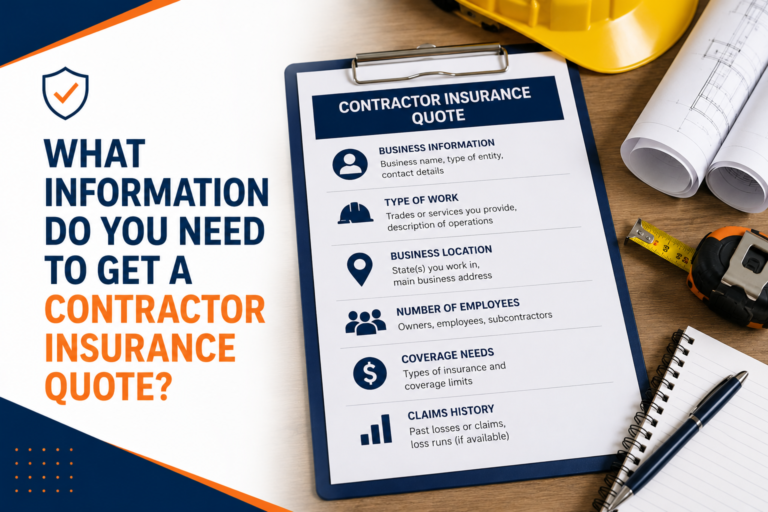
Before purchasing a policy, provide the insurer with a complete and accurate description of your work.
Tell the agent or broker about:
- Every service you perform
- Maximum project values
- Residential and commercial work
- Subcontractor use
- Work performed at height
- Excavation or demolition
- Roofing operations
- Welding or hot work
- States where you operate
- Completed operations exposure
Do not select a policy based only on price. A low-cost policy may exclude the exact activity that creates your greatest risk.
Review the declarations, classifications, endorsements, exclusions, deductible, and coverage limits. You should also confirm whether customers can be added as additional insureds and whether completed operations additional insured coverage is available when required.
Frequently Asked Questions
Does general liability cover damage caused by a contractor?
It may cover accidental damage to a customer’s property or other third-party property. Coverage depends on how the damage happened and whether exclusions involving your work, your product, or property under your control apply.
Does general liability cover a contractor’s mistakes?
It may cover bodily injury or property damage resulting from certain mistakes, but it generally does not pay merely to correct poor workmanship. Professional mistakes involving advice, design, or consulting may require professional liability insurance.
Does general liability cover stolen tools?
No, general liability typically does not cover the contractor’s own stolen tools. Tools and equipment insurance or inland marine coverage is usually needed.
Does general liability cover subcontractors?
Sometimes, but not automatically. The policy may restrict subcontracted work or require subcontractors to maintain their own insurance. Review the policy before hiring them.
Does general liability cover damage after the job is completed?
Products-completed operations coverage may cover qualifying bodily injury or property damage that occurs after the work has been completed.
Does general liability cover employee injuries?
No. Employee work-related injuries are generally handled through workers’ compensation insurance rather than general liability.
Does general liability cover a work van?
No. Vehicle accidents and physical damage to a work van generally require commercial auto insurance.
Is general liability insurance required for contractors?
There is no single federal requirement applying to every contractor. However, state licensing rules, municipalities, landlords, general contractors, and customer agreements may require it.
Conclusion
General liability insurance protects contractors against several of the most common risks of working around customers and their property.
It can help cover third-party bodily injury, accidental property damage, medical payments, personal and advertising injury, completed operations claims, and legal defense expenses. However, it does not replace workers’ compensation, commercial auto, professional liability, tools and equipment coverage, or pollution liability insurance.
Before purchasing a policy, review the exact services you provide, the types of properties where you work, your use of subcontractors, and the insurance requirements in your contracts. Ask a licensed insurance professional to explain exclusions involving faulty workmanship, completed operations, property in your care, and subcontracted work.
The right policy should do more than produce a certificate of insurance. It should address the real accidents and claims that could threaten your contracting business.
Editorial review: This guide was researched and reviewed by the Coverage Editorial Team using government agencies, insurance regulators, licensing authorities, policy documentation, and current industry pricing sources.