What Insurance Does a Pool Service Business Need?
A pool service business works around water, electricity, pumps, gas heaters, slippery surfaces, and potentially dangerous chemicals. A technician could accidentally damage a pool liner, cause a chemical reaction, leave a valve incorrectly positioned, or create a leak that damages a customer’s property. Even a routine cleaning visit can lead to an injury claim if someone trips over a hose or slips on a wet surface.
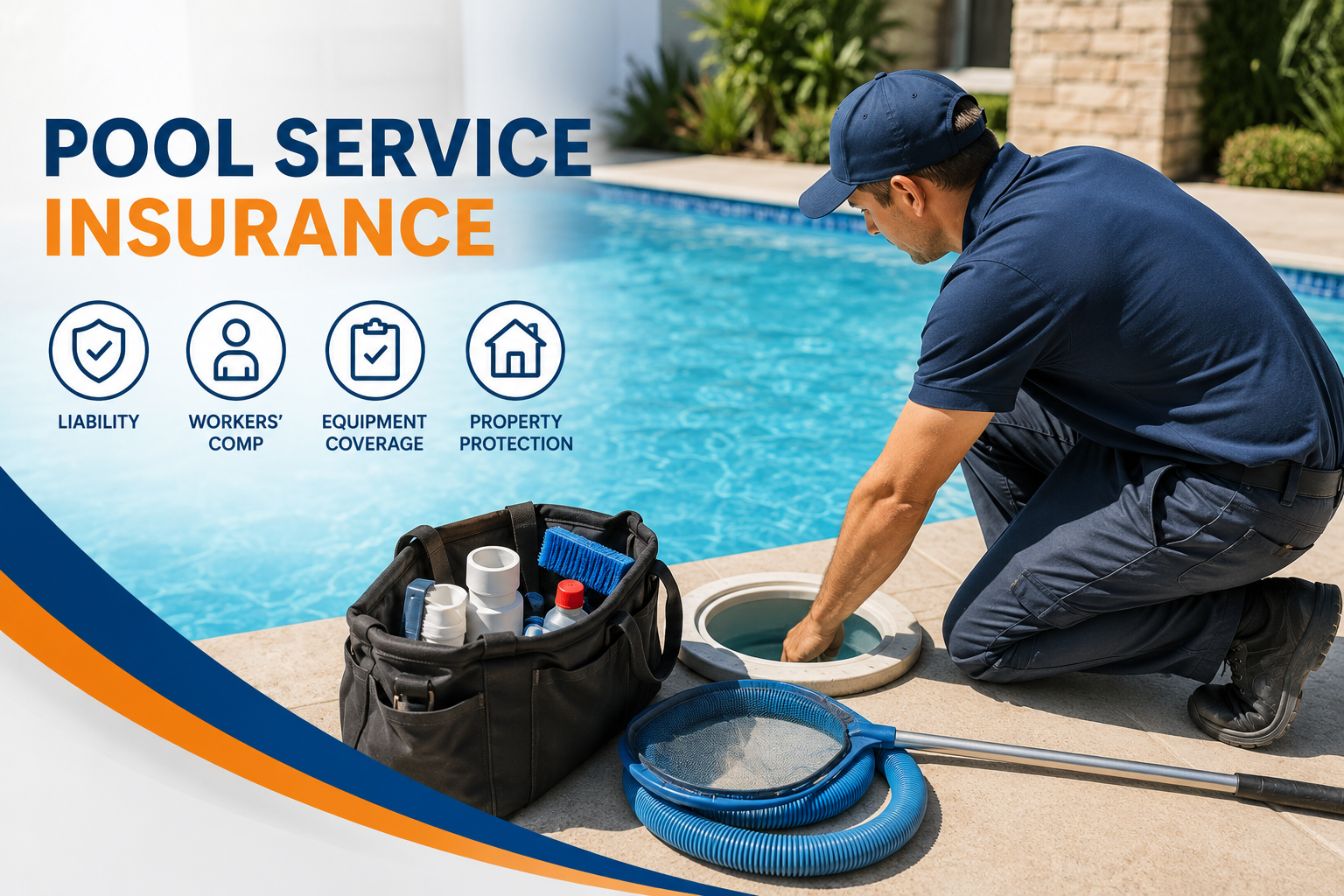
For most pool service businesses, general liability insurance is the essential starting point. Companies with employees may also need workers’ compensation, while mobile pool technicians should consider commercial auto and tools and equipment coverage.
Businesses that store, transport, or apply chlorine, acids, and other pool chemicals should carefully evaluate pollution liability and chemical-related exclusions. Additional coverage may be necessary for equipment installation, pool opening and closing, leak detection, electrical work, gas heaters, commercial pools, or major repairs.
What Insurance Does a Pool Service Company Need?
The appropriate insurance package depends on the company’s services, employees, vehicles, equipment, chemical use, and customer contracts.
| Insurance Coverage | What It May Cover | Who Typically Needs It |
|---|---|---|
| General liability insurance | Customer injuries, accidental property damage, and covered lawsuits | Nearly every pool service business |
| Completed operations coverage | Injury or property damage discovered after work is completed | Businesses repairing or installing pool equipment |
| Workers’ compensation | Employee work-related injuries and occupational illnesses | Companies with employees, when required |
| Commercial auto insurance | Accidents involving business-owned or commercially used vehicles | Mobile pool service companies |
| Tools and equipment insurance | Theft or damage involving portable service equipment | Technicians transporting valuable tools |
| Pollution liability insurance | Certain chemical spills, contamination, fumes, and cleanup claims | Companies handling pool chemicals |
| Commercial property insurance | Chemicals, inventory, tools, and office property at a fixed location | Businesses with offices, warehouses, or storage facilities |
| Installation floater | Pumps, filters, heaters, and other materials awaiting installation | Contractors supplying pool equipment |
| Business owner’s policy | General liability, commercial property, and business income coverage | Eligible small pool service businesses |
| Professional liability insurance | Certain claims involving water testing, recommendations, or technical errors | Businesses providing inspections, consulting, or written reports |
| Commercial umbrella insurance | Liability claims exceeding underlying policy limits | Growing companies or businesses serving large properties |
| Surety or license bond | Financial guarantee required by a regulator or customer | Contractors subject to licensing or bonding requirements |
General Liability Insurance for Pool Service Businesses
General liability insurance is usually the foundation of a pool service company’s insurance package. It may cover certain third-party bodily injury, property damage, personal injury, advertising injury, and related legal defense expenses.
The U.S. Small Business Administration describes general liability insurance as coverage for certain financial losses involving bodily injury, property damage, medical expenses, lawsuits, settlements, and judgments.
Common Pool Service Liability Claims
General liability insurance may respond when:
- A customer slips on a wet pool deck.
- A visitor trips over a hose, vacuum line, or tool case.
- A technician damages pool tile or coping.
- A dropped tool cracks a deck surface.
- Incorrect valve operation causes water damage.
- A service visit damages landscaping or outdoor furniture.
- A technician breaks a pool cover or enclosure.
- Water from a repair damages a neighboring structure.
- A customer alleges that chemical exposure caused bodily injury.
- Equipment left near the pool injures a visitor.
- A service vehicle or cart damages the customer’s property.
General liability may also provide legal defense when a customer files a covered lawsuit. Defense expenses can include attorney fees, investigations, expert opinions, and court costs, even when the pool company believes it was not responsible.
What General Liability Insurance May Not Cover
General liability insurance does not cover every pool service loss. Common exclusions or limitations may involve:
- Employee injuries
- Injuries suffered by the business owner
- Commercial vehicle accidents
- Damage to the company’s own equipment
- Intentional property damage
- The cost of repeating defective work
- Certain pollution or chemical contamination claims
- Professional errors that cause only financial loss
- Damage to property in the company’s care, custody, or control
- Services that were not disclosed to the insurer
A pool service company should accurately describe every operation when applying for insurance. Basic cleaning and chemical balancing may create different risks from pool resurfacing, heater installation, electrical repair, diving board work, leak detection, acid washing, or pool construction.
Completed Operations Coverage
Some of the most expensive pool service claims can occur after the technician has completed the work and left the property.
Examples include:
- An incorrectly installed pump connection begins leaking.
- A repaired filter later fails and damages nearby equipment.
- A heater installation causes a fire or carbon monoxide incident.
- An improperly positioned valve causes a pool to drain.
- A repaired plumbing connection causes underground water damage.
- Pool equipment malfunctions and damages the customer’s property.
- Incorrect winterization allows pipes or equipment to freeze and crack.
Products-completed operations coverage is commonly included within commercial general liability insurance. It may cover certain bodily injury or property damage arising from completed work, subject to the policy’s terms, exclusions, and limits.
However, insurance generally distinguishes between defective work itself and separate damage resulting from that work. A policy may not pay simply because a pump was installed incorrectly and must be reinstalled. It may respond if the faulty installation causes separate covered water or fire damage.
Pool contractors should confirm that completed operations coverage applies to every repair and installation service they perform.
Pollution and Pool Chemical Liability Insurance
Pool service technicians commonly handle chlorine, bromine, muriatic acid, sodium bisulfate, algaecides, stabilizers, and other chemicals. These substances can create serious injury, property damage, and environmental risks when they are mixed, contaminated, spilled, or stored improperly.
The EPA warns that pool chemical incidents can cause fires, toxic vapor releases, and personnel injuries. Water entering chemical containers, incompatible products being stored together, or contamination of handling equipment can create dangerous reactions.
A standard general liability policy may contain a pollution exclusion that restricts coverage for chemical releases. Contractors pollution liability or a specialized pool service endorsement may address certain claims involving:
- Chlorine or acid spills
- Toxic vapor releases
- Chemical contamination
- Damage to landscaping or neighboring property
- Improper chemical disposal
- Soil or water contamination
- Emergency cleanup expenses
- Transportation of pool chemicals
- Bodily injury caused by covered chemical exposure
Coverage varies significantly. Some policies address only sudden and accidental incidents, while others may include gradual pollution, transportation, storage, or completed operations.
Pool service companies should confirm that their actual chemicals, application methods, storage practices, and service locations are covered.
Chemical Storage and Employee Safety
Pool chemicals should be stored in clean, dry, ventilated areas and protected from water, heat, incompatible substances, and contamination. The EPA advises closing containers properly, protecting damaged packaging, and storing chemicals away from leaks, doors, windows, and other possible sources of water.
The CDC recommends allowing only trained workers to handle pool chemicals, documenting chemical safety practices, posting instructions in storage and pump areas, and following an emergency response plan after a spill.
Businesses with employees who handle hazardous chemicals may also need:
- A written hazard communication program
- Properly labeled containers
- Accessible safety data sheets
- Employee chemical-safety training
- Appropriate personal protective equipment
- Written spill and emergency procedures
OSHA requires employers with hazardous chemicals to make information about chemical identities and hazards available and understandable to workers.
Insurance does not replace employee training, product-label compliance, safe storage, or emergency planning.
Workers’ Compensation Insurance
Workers’ compensation may provide medical treatment, partial wage replacement, disability benefits, rehabilitation, and death benefits when an employee experiences a covered work-related injury or occupational illness.
Pool technicians may face injuries involving:
- Chemical burns and respiratory exposure
- Slips and falls
- Electrical shock
- Back injuries from lifting pumps or chemical containers
- Cuts from broken equipment
- Heat illness
- Vehicle accidents between appointments
- Eye injuries
- Falls into pools or equipment areas
- Repetitive-motion injuries
Workers’ compensation for most private-sector businesses is administered through individual state systems. Employee thresholds, owner exemptions, benefits, and penalties therefore vary by jurisdiction.
Does a Solo Pool Technician Need Workers’ Comp?
A sole proprietor without employees may qualify for an exemption in some states. However, the owner may still be permitted to elect workers’ compensation coverage for themselves.
General liability insurance normally does not pay the business owner’s medical bills or replace income after a work-related injury. A self-employed pool technician may compare workers’ compensation with occupational accident, disability, and health insurance.
Proof of workers’ compensation may also be required by a commercial customer, property manager, homeowners association, or general contractor even when the owner qualifies for a legal exemption.
Employees vs. Independent Contractors
Calling a pool technician an independent contractor does not automatically establish the correct classification.
The IRS evaluates the entire working relationship, including behavioral control, financial control, and the relationship between the parties. A written contract alone is not sufficient to determine whether someone is an employee or an independent contractor.
A technician may be more likely to be considered an employee when the pool company:
- Assigns the technician’s daily route
- Sets the work schedule
- Supplies vehicles, chemicals, and tools
- Determines service procedures
- Establishes customer prices
- Provides ongoing supervision
- Pays an hourly or weekly wage
- Maintains a continuing relationship
Misclassification can lead to employment tax liability, workers’ compensation audit charges, wage claims, penalties, and uninsured injury disputes.
Commercial Auto Insurance
Pool service businesses frequently use pickup trucks, vans, trailers, and utility vehicles to transport technicians, chemicals, pumps, filters, hoses, vacuums, and repair parts.
A personal auto policy may restrict or exclude regular business use. The SBA recommends considering commercial coverage when a vehicle is used primarily to visit customers, travel between worksites, carry tools, or make deliveries.
Commercial auto insurance may include:
- Bodily injury liability
- Property damage liability
- Collision coverage
- Comprehensive coverage
- Uninsured or underinsured motorist coverage
- Medical payments or personal injury protection
- Trailer coverage
- Coverage for permanently attached equipment
The insurer should know which vehicles transport chemicals, whether employees take vehicles home, who is permitted to drive, and whether tanks, racks, or service equipment are permanently installed.
Hired and Non-Owned Auto Insurance
Hired auto coverage may protect the company against certain liability involving vehicles rented or temporarily leased for business use.
Non-owned auto coverage may protect the pool service company when an employee uses a personal vehicle for customer visits, estimates, or parts pickup.
This coverage generally protects the business’s liability interest. It does not replace the vehicle owner’s personal insurance or automatically cover physical damage to the employee’s vehicle.
Tools and Equipment Insurance
Pool technicians may carry expensive portable tools and service equipment, including:
- Pool vacuums and robotic cleaners
- Water-testing equipment
- Leak-detection devices
- Pumps and portable filtration equipment
- Pressure-testing tools
- Power tools
- Drain and plumbing equipment
- Extension poles and nets
- Tablets and mobile devices
- Electrical testing equipment
- Portable lighting
- Safety equipment
Tools and equipment insurance, often written as inland marine coverage, may protect portable business property while it is transported, stored in a service vehicle, or used at a customer’s property.
Coverage may apply to theft, fire, vandalism, and certain accidental damage. Policies may contain unattended vehicle exclusions, security requirements, deductibles, and individual item limits.
Maintain an updated equipment inventory with receipts, serial numbers, photographs, and replacement values.
Installation Floater Coverage
Pool service companies that supply pumps, filters, heaters, automation systems, saltwater chlorinators, lights, or covers may be responsible for those materials before installation is complete.
An installation floater may protect equipment while it is:
- Transported to the customer’s property
- Stored temporarily at the jobsite
- Awaiting installation
- Partially installed
- Kept at an off-site storage location
- Damaged by a covered event before completion
This coverage can be particularly important for high-value heaters, control systems, pumps, and commercial pool equipment.
The contractor should confirm when coverage begins and ends, whether theft from an unsecured property is covered, and whether equipment remains protected during transportation.
Business Owner’s Policy
A business owner’s policy, commonly called a BOP, usually combines:
- General liability insurance
- Commercial property insurance
- Business interruption or business income coverage
Commercial property insurance may protect tools, chemical inventory, replacement parts, computers, furniture, and supplies at an insured location. Business income coverage may replace certain lost revenue and continuing expenses when covered property damage interrupts operations.
The SBA notes that businesses with significant physical assets should consider commercial property insurance.
A standard BOP generally does not include workers’ compensation, commercial auto, or broad pollution liability coverage.
Additional Coverage a Pool Service Business May Need
Professional Liability Insurance
Professional liability insurance may be appropriate when the company provides written inspections, water-treatment plans, technical consulting, leak evaluations, or recommendations that could cause a customer financial loss.
Commercial Umbrella Insurance
Commercial umbrella insurance provides additional limits above qualifying underlying policies. It may be useful for businesses servicing luxury homes, apartment complexes, hotels, schools, health clubs, or other commercial facilities.
Commercial Crime Insurance
Pool technicians frequently enter customer yards and equipment areas without continuous supervision. Commercial crime or employee dishonesty coverage may protect the company against certain theft, fraud, or dishonest conduct by employees.
Cyber Insurance
A pool service company may store customer addresses, gate codes, payment information, photographs, service records, and equipment details. Cyber insurance may help with certain data breaches, ransomware incidents, payment fraud, and privacy claims.
Surety and License Bonds
Some states and local governments regulate pool contractors, especially businesses performing construction, structural repairs, electrical connections, plumbing, or gas-heater installations.
A surety bond primarily protects the government agency or customer requiring it. If the surety pays a valid claim, the pool contractor may be required to reimburse the surety.
Insurance Recommendations by Pool Service Type
| Pool Service Activity | Coverage to Consider |
|---|---|
| Solo residential pool cleaner | General liability, tools coverage, commercial auto review, and pollution coverage |
| Company with employees | General liability, workers’ comp, commercial auto, tools coverage, and EPLI |
| Pool equipment repair | General liability, completed operations, tools coverage, and commercial auto |
| Pump, filter, or heater installation | General liability, completed operations, installation floater, and license review |
| Commercial pool maintenance | General liability, pollution liability, workers’ comp, commercial auto, and umbrella insurance |
| Pool opening and winterization | General liability, completed operations, tools coverage, and commercial auto |
| Acid washing or chemical treatment | General liability, pollution liability, workers’ comp, and chemical-storage review |
| Pool renovation or construction | Contractor-specific liability, workers’ comp, commercial auto, builder’s risk, and bonds |
Frequently Asked Questions
Can You Start a Pool Cleaning Business Without Insurance?
A solo pool cleaner may not always be legally required to carry general liability insurance. However, working uninsured exposes personal and business assets to customer injuries, water damage, chemical incidents, vehicle accidents, and equipment theft.
Does Pool Service Insurance Cover Water Damage?
General liability or completed operations coverage may apply when a covered service mistake causes water damage to a customer’s property. Coverage depends on the cause of the loss and the policy’s exclusions.
Does General Liability Cover Incorrect Pool Chemicals?
Possibly, but pollution or chemical exclusions may restrict coverage. A specialized endorsement or pollution liability policy may be necessary for chemical application, spills, fumes, or contamination.
Does Pool Service Insurance Cover a Damaged Pool Liner?
General liability may cover accidental damage to a customer’s pool liner, subject to care, custody, or control exclusions and other policy conditions.
Does Insurance Cover Stolen Pool Equipment?
General liability does not cover the company’s own stolen equipment. Tools and equipment, inland marine, commercial property, or commercial auto coverage may apply depending on where the equipment was stored.
Do Pool Service Subcontractors Need Insurance?
Subcontractors should generally carry their own general liability, commercial auto, pollution liability, and workers’ compensation coverage when applicable. The hiring company should obtain current certificates and verify worker classification.
Does an LLC Replace Pool Service Insurance?
No. An LLC is a legal business structure, while insurance provides financial protection and legal defense for covered claims. Owners may still face liability for personal negligence, regulatory violations, guarantees, and uninsured losses.
Conclusion
Most pool service businesses should begin with general liability insurance, completed operations coverage, commercial auto insurance, and protection for tools and equipment. Companies with employees may also need workers’ compensation.
Because pool technicians handle chlorine, acids, and other reactive substances, businesses should carefully evaluate pollution liability, chemical-storage procedures, employee training, and exclusions within standard liability policies.
Additional coverage may be necessary for pool equipment installation, gas heaters, electrical work, commercial facilities, acid washing, leak detection, renovations, or pool construction.
Before purchasing insurance, provide the insurer with a complete description of every service, chemical, vehicle, employee, tool, and type of customer the business serves. A policy designed for basic residential cleaning may not adequately cover equipment installation, commercial pools, chemical spills, or major repairs.
Editorial review: This guide was researched and reviewed by the Coverage Editorial Team using government agencies, insurance regulators, licensing authorities, policy documentation, and current industry pricing sources.