What Insurance Does a Flooring Installation Business Need?
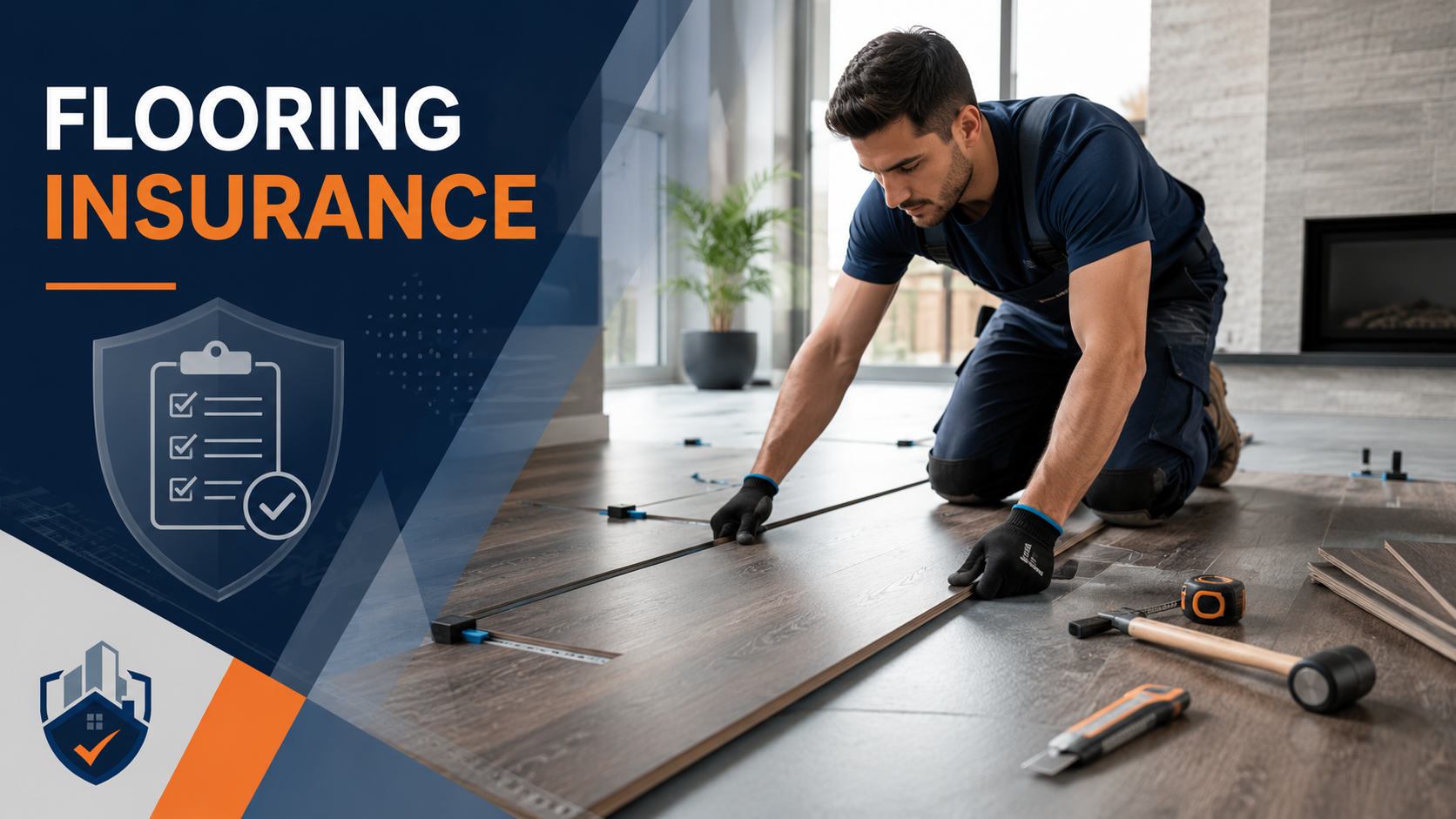
A flooring installation business works inside customers’ homes and commercial properties, often around expensive furniture, finished walls, plumbing, electrical systems, and fragile materials. One incorrect cut, adhesive spill, damaged water line, or improperly installed floor can lead to a costly property damage claim.
Flooring contractors also face risks involving saws, nail guns, floor grinders, heavy materials, chemical adhesives, vehicle accidents, and stolen equipment. Businesses that remove older flooring may encounter asbestos-containing tiles or adhesives, while cutting concrete, stone, or tile can expose workers to respirable crystalline silica.
For most flooring installation businesses, general liability insurance is the essential starting point. Companies with employees may also need workers’ compensation, while mobile contractors should consider commercial auto and tools and equipment coverage.
The appropriate insurance package depends on the flooring materials installed, removal services performed, employees, vehicles, equipment, project sizes, and customer contracts.
What Insurance Does a Flooring Contractor Need?
| Insurance Coverage | What It May Cover | Who Typically Needs It |
|---|---|---|
| General liability insurance | Customer injuries, accidental property damage, and covered lawsuits | Nearly every flooring installation business |
| Completed operations coverage | Injury or damage discovered after installation is finished | Flooring contractors performing installation work |
| Workers’ compensation | Employee work-related injuries and occupational illnesses | Businesses with employees, when required |
| Commercial auto insurance | Accidents involving company vans, trucks, and trailers | Mobile flooring contractors |
| Tools and equipment insurance | Theft or damage involving portable tools and machinery | Contractors transporting valuable equipment |
| Installation floater | Flooring materials while transported, stored, or awaiting installation | Businesses supplying flooring materials |
| Commercial property insurance | Inventory, machinery, furniture, and property at a fixed location | Companies with warehouses, showrooms, or workshops |
| Business owner’s policy | General liability, property, and business income coverage | Eligible small flooring businesses |
| Pollution liability insurance | Certain claims involving adhesives, solvents, dust, chemicals, or contamination | Contractors using coatings, epoxies, or hazardous products |
| Professional liability insurance | Certain design, specification, or consulting errors | Businesses providing flooring design or technical advice |
| Commercial umbrella insurance | Claims exceeding primary liability limits | Growing contractors or businesses working on large projects |
| Surety or license bond | Financial guarantee required by a regulator or contract | Contractors subject to licensing or bonding rules |
General Liability Insurance for Flooring Installers
General liability insurance is usually the foundation of a flooring contractor’s insurance package. It may cover certain third-party bodily injury, property damage, personal injury, advertising injury, and related legal defense expenses.
The U.S. Small Business Administration recommends evaluating insurance based on a company’s particular risks. General liability insurance is intended to address certain losses involving bodily injury, property damage, lawsuits, settlements, and judgments.
Common Flooring Installation Liability Claims
A general liability policy may respond when:
- A customer trips over tools, cords, or loose flooring materials.
- A flooring installer damages a wall, cabinet, or doorway.
- A nail or screw punctures a hidden plumbing line.
- Adhesive spills onto finished customer property.
- A floor grinder damages a neighboring surface.
- A worker breaks a window while carrying flooring materials.
- Dust from the project damages electronics or personal belongings.
- Equipment left in a hallway causes a visitor to fall.
- A flooring installation damages an in-floor heating system.
- A customer alleges that fumes caused bodily injury.
- Materials stored at the property damage the customer’s home.
General liability may also provide legal defense when the company is sued over a covered incident. Defense coverage can be valuable even when the contractor believes the claim is unfounded.
What General Liability Insurance May Not Cover
General liability does not cover every flooring-related loss. Common exclusions or limitations may involve:
- Employee injuries
- Injuries suffered by the business owner
- Commercial vehicle accidents
- Damage to the company’s own tools
- Intentional property damage
- The cost of replacing defective work
- Certain pollution or chemical exposure claims
- Professional errors causing only financial loss
- Damage to property in the contractor’s care, custody, or control
- Services that were not disclosed to the insurer
The flooring company should accurately describe every operation when requesting coverage. Carpet installation, hardwood refinishing, tile work, polished concrete, epoxy coatings, and asbestos-containing flooring removal create substantially different exposures.
Completed Operations Coverage
Some flooring claims do not become apparent until after the contractor has completed the project.
Examples include:
- Hardwood flooring buckles and damages cabinets.
- Tile becomes loose and causes someone to fall.
- An incorrectly installed floor damages an in-floor heating system.
- Moisture trapped beneath flooring causes mold or property damage.
- A poorly secured transition strip creates a tripping hazard.
- Flooring installed over an unsuitable subfloor later causes separate damage.
Products-completed operations coverage is commonly included within a commercial general liability policy. It may cover certain bodily injury or property damage arising from completed work.
However, it generally does not pay solely because the flooring is uneven, installed incorrectly, or must be removed and installed again. Insurance commonly distinguishes between defective workmanship itself and separate resulting damage caused by that work.
Contractors should confirm that completed operations coverage applies to every flooring system they install, including tile, hardwood, laminate, luxury vinyl, carpet, epoxy, and specialty commercial flooring.
Workers’ Compensation Insurance
Workers’ compensation may provide medical care, partial wage replacement, disability benefits, rehabilitation, and death benefits when an employee suffers a covered work-related injury or occupational illness.
Flooring installers may experience:
- Knee, back, and shoulder injuries
- Cuts from knives, saws, and flooring materials
- Nail gun injuries
- Eye injuries from flying debris
- Hearing damage
- Chemical exposure
- Respiratory irritation
- Falls on stairs or uneven surfaces
- Crushing injuries while moving heavy materials
- Vehicle accidents between jobsites
Private-sector workers’ compensation programs are generally administered at the state level. Employee thresholds, owner exemptions, benefits, and penalties therefore vary by jurisdiction.
Does a Solo Flooring Installer Need Workers’ Comp?
A sole proprietor without employees may qualify for an exemption in some states. However, the owner may still be permitted to elect workers’ compensation coverage for themselves.
General liability insurance normally does not pay the owner’s medical bills or replace personal income after a work-related injury. A self-employed flooring installer may compare workers’ compensation with occupational accident, health, and disability insurance.
Proof of workers’ comp may also be required by a general contractor, property manager, commercial customer, or licensing authority even when the owner qualifies for a statutory exemption.
Employees vs. Independent Contractors
Calling an installer an independent contractor does not automatically establish the correct classification.
The IRS evaluates the full working relationship, including behavioral control, financial control, and the relationship between the parties. No single factor automatically determines whether someone is an employee or an independent contractor.
An installer may be more likely to be treated as an employee when the flooring company:
- Assigns the worker’s schedule and projects
- Provides tools, vehicles, and materials
- Determines installation methods
- Pays by the hour or week
- Supervises the work
- Maintains an ongoing relationship
- Prevents the worker from offering services independently
Misclassification can lead to employment tax liabilities, workers’ compensation audit charges, penalties, wage claims, and uninsured injury disputes.
Commercial Auto Insurance
Flooring businesses regularly use vans, pickup trucks, box trucks, and trailers to transport employees, flooring materials, saws, compressors, grinders, adhesives, and installation equipment.
Personal auto policies may restrict regular commercial use. Business auto insurance may provide higher liability limits and additional protection for commercial vehicles, rental vehicles, employee-owned vehicles, and vehicles carrying business goods or equipment.
Commercial auto insurance may include:
- Bodily injury liability
- Property damage liability
- Collision coverage
- Comprehensive coverage
- Uninsured or underinsured motorist coverage
- Medical payments or personal injury protection
- Trailer coverage
- Coverage for permanently attached equipment
The insurer should know which vehicles are used, who drives them, how far crews travel, and whether materials extend beyond or above the normal dimensions of the vehicle.
Hired and Non-Owned Auto Insurance
Hired auto coverage may address certain liability involving rented or temporarily leased vehicles.
Non-owned auto coverage may protect the business when an owner or employee uses a personal vehicle for estimates, material pickup, or transportation between projects.
This coverage generally protects the flooring company’s liability interest. It does not replace the vehicle owner’s personal auto insurance or automatically cover damage to the personal vehicle.
Tools and Equipment Insurance
Flooring contractors may carry expensive portable tools and machinery, including:
- Table saws and miter saws
- Flooring nailers and staplers
- Air compressors
- Tile saws
- Floor sanders and edgers
- Concrete grinders
- Dust-extraction systems
- Moisture meters
- Carpet stretchers
- Floor scrapers
- Generators
- Laser measuring equipment
Tools and equipment insurance, often written as inland marine coverage, may protect portable business property while it is transported, stored in a vehicle, or used at a customer’s location.
Review deductibles, theft restrictions, unattended vehicle exclusions, security requirements, and per-item limits. Large sanders, grinders, and other high-value equipment may need to be listed individually.
Maintain an equipment inventory containing serial numbers, photographs, receipts, and replacement values.
Installation Floater Coverage
Flooring businesses that supply materials may be responsible for hardwood, tile, carpet, vinyl, underlayment, and other products before installation is complete.
An installation floater may cover materials while they are:
- Being transported to the project
- Stored temporarily at the jobsite
- Awaiting installation
- Partially installed
- Located at an off-site storage facility
- Damaged by a covered event before the customer accepts the work
This coverage can be particularly valuable when a contractor supplies custom hardwood, imported tile, premium carpet, or materials purchased specifically for a large commercial project.
The policy should identify when coverage begins and ends, whether theft from an unsecured jobsite is covered, and whether water damage or improper installation is excluded.
Business Owner’s Policy
A business owner’s policy, commonly called a BOP, typically combines:
- General liability insurance
- Commercial property insurance
- Business interruption or business income coverage
The NAIC describes a BOP as a commonly purchased small-business policy that includes general liability, commercial property, and business interruption insurance.
Commercial property coverage may protect flooring inventory, office furniture, computers, showroom contents, and equipment stored at an insured location. Business income coverage may replace certain lost revenue and continuing expenses when covered property damage interrupts operations.
A standard BOP generally does not include workers’ compensation, commercial auto, or complete coverage for equipment traveling between jobsites.
Flooring Dust, Adhesives, and Pollution Liability
Flooring contractors may work with adhesives, epoxies, stains, finishes, solvents, sealers, and other chemicals. Employers with hazardous chemicals in the workplace may be required to maintain labels, safety data sheets, employee training, and an appropriate hazard communication program.
Standard general liability policies may restrict certain pollution-related claims. Contractors pollution liability may be worth considering when the company performs:
- Epoxy floor installation
- Solvent-based hardwood refinishing
- Chemical adhesive removal
- Large commercial coating projects
- Mold-contaminated flooring removal
- Chemical spill cleanup
- Work involving substantial fumes or indoor air concerns
The policy should identify the products used, transportation exposures, waste disposal activities, and whether coverage applies to completed work.
Silica and Asbestos Risks
Cutting tile, grinding concrete, or preparing cement-based subfloors can generate respirable crystalline silica. OSHA’s construction silica standard requires covered employers to limit worker exposure and implement applicable protective measures.
Flooring removal in older buildings may also disturb asbestos-containing vinyl tile, sheet flooring, or mastic. EPA and OSHA provide specific guidance and requirements for work involving asbestos-containing flooring materials. Improper removal can release hazardous fibers and create significant cleanup and liability exposure.
A flooring installer should not assume that an unknown older floor is safe to sand, grind, cut, or remove. Testing and qualified asbestos professionals may be necessary before work begins.
If a flooring project disturbs painted baseboards, trim, or other painted surfaces in a pre-1978 home or child-occupied facility, EPA Renovation, Repair and Painting requirements may also apply.
Additional Insurance a Flooring Company May Need
Professional Liability Insurance
Professional liability may be relevant when the company provides flooring design, moisture evaluations, technical specifications, product recommendations, or written inspection reports.
Commercial Umbrella Insurance
Commercial umbrella insurance provides additional liability limits above qualifying underlying policies. It may be useful for flooring companies working in luxury homes, large commercial properties, schools, healthcare facilities, or multifamily buildings.
Employment Practices Liability Insurance
A growing flooring company may consider employment practices liability insurance for certain employee allegations involving discrimination, harassment, retaliation, or wrongful termination.
Surety and License Bonds
Licensing and bonding requirements vary by state, county, city, and project type. Construction businesses may need contractor licenses, local registrations, or bonds before accepting certain projects.
A surety bond primarily protects the customer or licensing authority. If the surety pays a valid claim, the flooring contractor may be required to reimburse it.
Insurance Recommendations by Flooring Service
| Flooring Business Activity | Coverage to Consider |
|---|---|
| Carpet and vinyl installation | General liability, tools coverage, commercial auto, and installation floater |
| Hardwood installation | General liability, completed operations, tools coverage, and commercial auto |
| Hardwood sanding and refinishing | General liability, equipment coverage, pollution review, and workers’ comp |
| Tile and stone installation | General liability, silica exposure controls, tools coverage, and completed operations |
| Concrete grinding and polishing | General liability, workers’ comp, equipment coverage, and pollution liability review |
| Epoxy floor installation | General liability, pollution liability, commercial auto, and tools coverage |
| Flooring removal in older buildings | General liability, workers’ comp, asbestos evaluation, and pollution coverage |
| Commercial flooring contractor | General liability, workers’ comp, commercial auto, umbrella, and installation floater |
Frequently Asked Questions
Can You Start a Flooring Business Without Insurance?
A solo installer may not always be legally required to carry general liability insurance. However, working uninsured exposes personal and business assets to customer injuries, property damage, vehicle accidents, equipment theft, and lawsuits.
Does Flooring Insurance Cover Installation Mistakes?
Insurance generally does not pay only because the flooring was installed incorrectly and must be replaced. Completed operations coverage may apply when defective work causes separate covered bodily injury or property damage.
Does General Liability Cover Damage to a Customer’s Home?
It may cover accidental damage to walls, cabinets, plumbing, furniture, or other customer property, subject to the policy’s terms, exclusions, and deductible.
Does Flooring Insurance Cover Stolen Tools?
General liability does not cover the contractor’s own stolen tools. Tools and equipment, inland marine, or commercial property insurance may provide protection.
Do Flooring Subcontractors Need Insurance?
Subcontractors should generally carry their own general liability, commercial auto, and workers’ compensation coverage when applicable. The hiring contractor should collect current certificates and verify worker classification.
Does an LLC Replace Flooring Business Insurance?
No. An LLC is a legal business structure, while insurance provides financial protection and legal defense for covered claims. Owners may still face liability for personal negligence, guarantees, regulatory violations, and uninsured losses.
Conclusion
Most flooring installation businesses should begin with general liability insurance, completed operations coverage, commercial auto insurance, and protection for tools and equipment. Companies with employees may also need workers’ compensation, while contractors supplying flooring materials should consider an installation floater.
Additional protection may be necessary for hardwood refinishing, epoxy coatings, concrete grinding, asbestos-containing flooring removal, or large commercial projects.
Before purchasing coverage, give the insurer a complete description of the materials installed, removal services, chemicals, employees, vehicles, equipment, and customer types. A policy designed for basic carpet installation may not adequately cover tile cutting, concrete polishing, chemical coatings, or hazardous flooring removal.
Editorial review: This guide was researched and reviewed by the Coverage Editorial Team using government agencies, insurance regulators, licensing authorities, policy documentation, and current industry pricing sources.