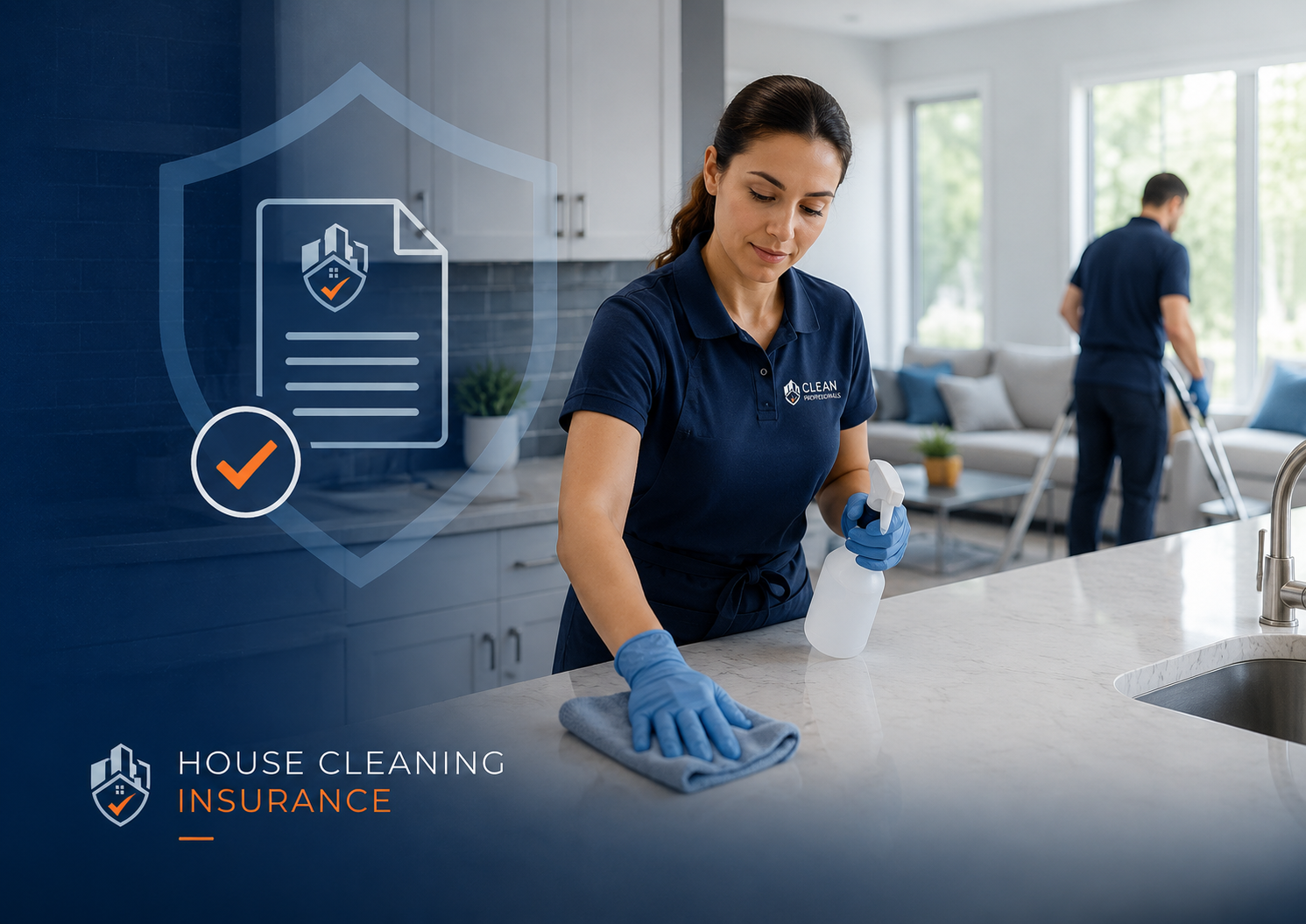
What Insurance Does a House Cleaning Business Need?
A house cleaning business may appear simple to operate: a team, cleaning supplies, reliable transportation, and a schedule of residential clients. However, every visit places the business inside someone else’s home, often around expensive furniture, fragile belongings, pets, children, wet floors, electrical equipment, and potentially hazardous chemicals.
A cleaner could accidentally damage hardwood flooring, knock over an expensive television, lose a customer’s house key, or suffer an injury while lifting furniture. An employee could also be accused of stealing property, even when the accusation is unfounded.
For most residential cleaning companies, general liability insurance is the essential starting point. Businesses with employees may also need workers’ compensation, while companies that drive between clients should consider commercial auto or hired and non-owned auto coverage. A janitorial bond, business property insurance, and other policies may be necessary depending on how the company operates.
What Insurance Does a Residential Cleaning Business Need?
The right insurance package depends on whether the company has employees, owns vehicles, stores equipment, works from home, or performs specialized cleaning services.
| Coverage | What It Protects | Who Typically Needs It |
|---|---|---|
| General liability insurance | Customer injuries, accidental property damage, and related legal expenses | Nearly every house cleaning business |
| Janitorial service bond | Certain customer losses involving employee theft or dishonesty | Businesses entering customers’ homes |
| Workers’ compensation | Employee work-related injuries and occupational illnesses | Cleaning companies with employees, when required |
| Commercial auto insurance | Business-owned vehicles and driving-related liability | Companies that own or lease vehicles |
| Hired and non-owned auto insurance | Business use of rented or employee-owned vehicles | Companies whose cleaners use personal cars |
| Business property insurance | Cleaning equipment, supplies, furniture, and business property | Businesses with valuable equipment or a physical location |
| Inland marine insurance | Equipment and supplies while transported or used away from the business location | Mobile cleaning businesses |
| Commercial umbrella insurance | Liability claims exceeding primary policy limits | Growing businesses or companies with large contracts |
| Cyber insurance | Data breaches, cyberattacks, and certain privacy-related expenses | Businesses storing customer or payment data |
| Employment practices liability | Employee claims involving discrimination, harassment, or wrongful termination | Cleaning businesses with employees |
General Liability Insurance for House Cleaners
General liability insurance is usually the most important policy for a residential cleaning business. It protects against certain third-party bodily injury and property damage claims arising from normal business operations.
The U.S. Small Business Administration describes general liability insurance as coverage for financial losses related to bodily injury, property damage, medical expenses, lawsuits, settlements, and judgments.
Common House Cleaning Liability Claims
Examples of incidents that could lead to a general liability claim include:
- A cleaner spills a chemical that stains a customer’s carpet.
- A vacuum cleaner scratches a hardwood floor.
- An employee knocks over a valuable decoration.
- A customer slips on a recently mopped floor.
- A cleaning cart damages a wall or doorway.
- A visitor trips over an extension cord.
- A customer alleges that cleaning chemicals caused bodily injury.
- An employee accidentally leaves a faucet running and causes water damage.
General liability may also help pay for legal defense if the business is sued over a covered incident. This can be important even when the business believes it did nothing wrong, because attorney fees and court costs can become substantial.
What General Liability May Not Cover
A general liability policy does not cover every problem that can occur inside a customer’s home. Depending on the policy language, exclusions or limitations may apply to:
- Intentional damage
- Employee injuries
- Vehicle accidents
- Employee theft
- Damage to the company’s own equipment
- Poor-quality work that must be repeated
- Pollution or hazardous material cleanup
- Certain property in the business’s care, custody, or control
- Professional mistakes that do not cause bodily injury or property damage
Cleaning business owners should explain their services accurately when applying for coverage. Standard residential cleaning, carpet cleaning, pressure washing, mold remediation, crime-scene cleanup, and hazardous waste removal do not create the same risks.
Does a House Cleaning Business Need to Be Bonded?
Many customers prefer to hire a cleaning company that is both insured and bonded, but insurance and bonding serve different purposes.
A janitorial service bond, sometimes called a cleaning business bond, may provide protection to customers if an employee steals property while performing cleaning services. The exact conditions, exclusions, documentation requirements, and claim process depend on the bond.
A bond can help a cleaning company:
- Build trust with new clients
- Qualify for certain residential or commercial contracts
- Demonstrate that employee dishonesty risks have been considered
- Market the business as bonded and insured
A janitorial bond does not replace general liability insurance. It generally addresses dishonest conduct rather than accidental damage or customer injuries.
Cleaning companies should also distinguish a customer-facing janitorial bond from employee dishonesty or commercial crime insurance. Commercial crime coverage may protect the business itself against certain theft, forgery, fraud, or dishonest acts committed by employees.
The National Association of Insurance Commissioners defines fidelity coverage as a bond or policy addressing an employer’s loss resulting from an employee’s dishonest act.
Workers’ Compensation Insurance
Workers’ compensation insurance can provide medical treatment, partial wage replacement, rehabilitation benefits, and other benefits when an employee suffers a covered work-related injury or occupational illness.
Cleaning employees face several job-related hazards, including:
- Slips and falls
- Back injuries from lifting
- Repetitive-motion injuries
- Chemical burns
- Respiratory irritation
- Cuts from broken glass or sharp objects
- Falls from step stools or ladders
- Vehicle accidents while traveling between clients
OSHA identifies chemical exposure, electrical hazards, ergonomics, falls, bloodborne pathogens, and personal protective equipment as relevant concerns for the cleaning industry.
Cleaning chemicals can cause skin irritation, burns, coughing, asthma symptoms, and other health effects. OSHA also warns that mixing products containing bleach and ammonia can release dangerous gases and cause severe lung damage or death.
Is Workers’ Comp Required for a Cleaning Business?
Workers’ compensation requirements are primarily established at the state level. The number of employees that triggers coverage, available owner exclusions, penalties, and exemptions vary by jurisdiction.
A cleaning company should consult the workers’ compensation agency in every state where its employees work. The U.S. Department of Labor maintains a directory of state workers’ compensation officials.
Even when a small cleaning company is exempt under state law, carrying workers’ comp may still be valuable. Without coverage, the business could become responsible for an injured employee’s medical expenses, lost wages, and related legal claims.
Employees vs. Independent Contractors
Calling a cleaner an independent contractor does not automatically make the classification valid.
The IRS considers behavioral control, financial control, and the nature of the relationship. Relevant factors include who determines how the work is performed, who supplies equipment, how the worker is paid, whether the relationship is ongoing, and whether the services are a key part of the company’s business.
A cleaner may be more likely to be treated as an employee when the company:
- Assigns the cleaner’s schedule
- Determines which customers they serve
- Provides all supplies and equipment
- Requires specific cleaning procedures
- Sets the worker’s pay
- Restricts the worker from serving other clients
- Supervises how the work is performed
Misclassification may result in unpaid insurance premiums, tax liabilities, penalties, wage claims, and workers’ compensation disputes.
Commercial Auto Insurance
House cleaning companies often travel to multiple homes each day while transporting vacuums, chemicals, mops, and other supplies. Personal auto insurance may not adequately cover accidents arising from regular business use.
Commercial auto insurance may provide:
- Bodily injury liability
- Property damage liability
- Collision coverage
- Comprehensive coverage
- Uninsured or underinsured motorist coverage
- Medical payments or personal injury protection where applicable
- Coverage for permanently attached equipment
A vehicle owned or leased by the cleaning company should generally be discussed with a commercial insurance agent. The NAIC notes that commercial auto policies often carry higher liability limits and may include provisions for rented and non-owned vehicles.
Hired and Non-Owned Auto Coverage
A cleaning company may not own any vehicles but still have a business-related auto exposure.
Hired auto coverage addresses certain liability arising from vehicles the business rents or leases temporarily.
Non-owned auto coverage addresses certain liability arising when employees use personal vehicles for business activities, such as driving between clients or picking up supplies.
The employee’s personal policy normally remains important, but the cleaning company could also be named in a lawsuit after an accident. Hired and non-owned auto insurance may be added to a business owner’s policy or purchased as part of another commercial package.
Business Owner’s Policy
A business owner’s policy, commonly called a BOP, combines several coverages into one package. It typically includes:
- General liability insurance
- Commercial property insurance
- Business interruption or business income coverage
The NAIC explains that a BOP can be less expensive for some small businesses than purchasing the included policies separately. However, a standard BOP usually does not include commercial auto, workers’ compensation, health insurance, or professional liability coverage.
A cleaning company may use business property coverage to protect:
- Commercial vacuums
- Carpet-cleaning machines
- Floor-cleaning equipment
- Computers and office furniture
- Cleaning chemicals and supplies
- Uniforms
- Inventory stored at an office or warehouse
Business interruption coverage may replace certain lost income and continuing expenses when the company cannot operate because of a covered property loss.
Does Homeowners Insurance Cover a Home-Based Cleaning Business?
A house cleaning company operated from the owner’s residence should not assume that homeowners or renters insurance covers business equipment and liability.
Personal policies commonly restrict coverage for business property and may exclude business-related liability claims. The NAIC advises home-based business owners to consider a BOP or separate liability, business property, and business interruption coverage.
The owner should tell the insurance agent if cleaning equipment, chemicals, customer records, or business inventory are stored at home.
Inland Marine Insurance for Cleaning Equipment
House cleaning equipment is frequently transported between locations. Commercial property insurance may provide limited protection once equipment leaves the insured premises.
Inland marine insurance can cover movable business property while it is:
- Inside a work vehicle
- Being transported between jobs
- Stored temporarily at another location
- Used at a customer’s home
- In transit for repair
This coverage may be especially useful for businesses that own expensive carpet extractors, steam cleaners, pressure washers, industrial vacuums, or specialized floor-care equipment.
Owners should review whether theft from an unattended vehicle is covered and whether security requirements apply.
Additional Insurance a Cleaning Company May Need
Commercial Umbrella Insurance
Commercial umbrella insurance provides additional liability limits above certain underlying policies. It may be appropriate for a growing cleaning company, a business serving high-value homes, or a contractor required to carry higher limits by a property manager or commercial client.
Cyber Liability Insurance
A cleaning business may store customer addresses, alarm codes, door-access instructions, payment information, employee records, and online booking data.
Cyber insurance may help with certain costs arising from a data breach, ransomware attack, system interruption, or privacy claim. The NAIC notes that most general liability and commercial property policies do not cover cyber risks and that cyber policies are highly customized.
Employment Practices Liability Insurance
Employment practices liability insurance, or EPLI, may protect the business against certain employee allegations involving:
- Discrimination
- Harassment
- Retaliation
- Wrongful termination
- Failure to promote
- Employment-related defamation
This coverage becomes more relevant as a cleaning company adds employees, supervisors, and formal hiring procedures.
Professional Liability Insurance
Professional liability insurance is not always a priority for a basic residential cleaning company. However, it may be considered when the business provides consulting, specialized cleaning recommendations, property management support, or services where a professional mistake could create a financial loss without bodily injury or physical property damage.
Pollution Liability Insurance
Standard cleaning companies may not need a separate pollution policy. Businesses performing mold remediation, biohazard cleaning, crime-scene cleanup, hazardous material removal, or large chemical applications should discuss pollution and environmental liability with a specialized insurance professional.
Insurance Recommendations by Cleaning Business Type
| Business Structure | Coverage to Consider |
|---|---|
| Solo cleaner with no employees | General liability, janitorial bond, business property, and personal or commercial auto review |
| Home-based cleaning company | BOP, general liability, business property, janitorial bond, and auto coverage |
| Company with employees | General liability, workers’ comp, janitorial bond, EPLI, auto, and property coverage |
| Employees using personal vehicles | General liability, workers’ comp, hired and non-owned auto, and janitorial bond |
| Company-owned vans | Commercial auto, general liability, workers’ comp, property, and equipment coverage |
| High-end residential cleaner | Higher liability limits, janitorial bond, umbrella insurance, and careful property-damage coverage |
| Specialized remediation company | General liability, workers’ comp, commercial auto, pollution liability, and specialized professional coverage |
How Much House Cleaning Business Insurance Do You Need?
There is no single policy limit that is correct for every cleaning company. Appropriate limits depend on:
- The value of homes and property being cleaned
- Number of employees
- Annual payroll and revenue
- Type of cleaning services
- Number of daily appointments
- Vehicle ownership and usage
- Value of equipment and supplies
- Claims history
- State requirements
- Customer contract requirements
Many customers, property managers, franchisors, and commercial clients specify minimum insurance limits. The company should review every contract before providing a certificate of insurance or agreeing to additional insured requirements.
How to Buy Cleaning Business Insurance
Before requesting quotes, prepare accurate information about:
- Services offered
- Annual revenue
- Employee payroll
- Number of employees and subcontractors
- States where work is performed
- Business-owned vehicles
- Employee vehicle usage
- Value of tools and equipment
- Previous claims
- Residential and commercial customers
Compare policies based on coverage, exclusions, deductibles, limits, endorsements, and insurer service—not premium alone. The SBA recommends assessing business risks, working with a licensed agent, comparing options, and reassessing coverage as the business grows.
Frequently Asked Questions
Can I Clean Houses Without Business Insurance?
A solo cleaner may not always be legally required to carry general liability insurance, but working uninsured creates significant financial risk. Customers, landlords, property managers, and cleaning platforms may also require proof of coverage.
Is General Liability Insurance Required for a Cleaning Business?
General liability is not universally required by law, but it may be required by a contract, franchise agreement, landlord, or client. It is also one of the most important protections for accidental customer injuries and property damage.
Do Self-Employed House Cleaners Need Workers’ Comp?
A self-employed cleaner without employees may qualify for an exemption, depending on state law and business structure. Some owners can elect to include themselves in workers’ compensation coverage.
Does Cleaning Business Insurance Cover Broken Items?
General liability may cover accidental damage to customer property, subject to policy terms and exclusions. Coverage may be restricted for property considered to be in the cleaner’s care, custody, or control, so the policy should be reviewed carefully.
Does General Liability Cover Employee Theft?
Usually not. A janitorial bond, fidelity bond, or commercial crime policy is designed to address certain theft or employee dishonesty exposures.
Do Independent Cleaning Contractors Need Insurance?
Independent cleaners should generally carry their own general liability and auto coverage. A written contract does not guarantee independent contractor status, and the hiring business should verify certificates and classification requirements.
Can a Cleaning Business Use Personal Auto Insurance?
A personal policy may restrict or exclude regular business use. The owner should disclose how the vehicle is used and ask whether commercial auto or an appropriate business-use endorsement is necessary.
Conclusion
Most house cleaning businesses should begin with general liability insurance because accidental property damage and customer injuries are among their most significant everyday risks. A janitorial bond can strengthen customer trust, while workers’ compensation becomes essential when the company hires employees and state requirements apply.
Cleaning companies that drive between homes, transport valuable equipment, store customer information, or operate from a home office may need additional coverage such as commercial auto, hired and non-owned auto, a business owner’s policy, inland marine insurance, or cyber liability.
Before accepting clients, review your services, employees, vehicles, equipment, and contract requirements with a licensed insurance professional. The right coverage can protect the company’s finances while helping customers feel confident allowing your cleaners into their homes.
Editorial review: This guide was researched and reviewed by the Coverage Editorial Team using government agencies, insurance regulators, licensing authorities, policy documentation, and current industry pricing sources.