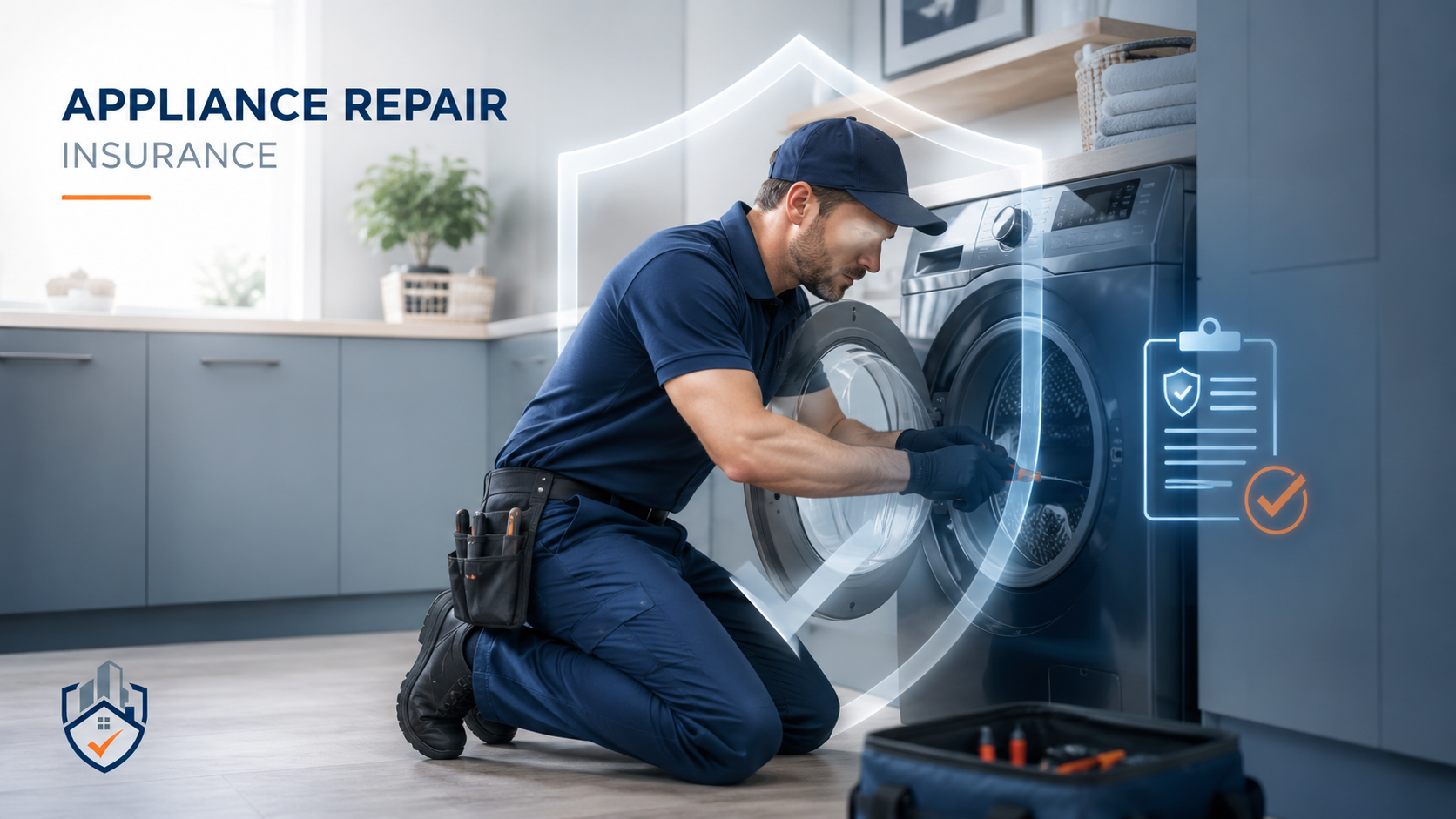
What Insurance Does an Appliance Repair Business Need?
An appliance repair business works with expensive customer property, electrical systems, water connections, gas lines, moving components, and potentially regulated refrigerants. A technician can make one incorrect connection and cause a leak, electrical fire, damaged floor, or appliance failure. Even when the business performs the repair correctly, a customer may still allege that the technician caused damage or created an unsafe condition.
For most appliance repair businesses, general liability insurance is the essential starting point. Mobile technicians may also need commercial auto insurance and tools and equipment coverage, while companies with employees may be required to carry workers’ compensation. Businesses that keep customer appliances at a workshop should consider coverage for customer property in their care.
The right appliance repair business insurance package depends on the services provided, number of technicians, vehicle use, equipment value, business location, and whether the company repairs refrigeration or gas-powered appliances.
What Insurance Does an Appliance Repair Company Need?
An appliance repair company should generally consider the following coverages:
| Insurance Coverage | What It May Cover | Who Typically Needs It |
|---|---|---|
| General liability insurance | Customer injuries, accidental property damage, and covered lawsuits | Nearly every appliance repair business |
| Completed operations coverage | Injury or damage occurring after a completed repair | Businesses performing repairs or installations |
| Workers’ compensation | Employee work-related injuries and occupational illnesses | Companies with employees, when required |
| Commercial auto insurance | Accidents involving company-owned or commercially used vehicles | Mobile repair companies |
| Tools and equipment insurance | Theft or damage involving portable diagnostic equipment and tools | Technicians transporting valuable equipment |
| Commercial property insurance | Tools, inventory, furniture, and equipment at a business location | Businesses with offices, warehouses, or repair shops |
| Customer property coverage | Damage to appliances left in the company’s possession | Repair shops storing customer appliances |
| Business owner’s policy | General liability, property, and business income coverage | Eligible small appliance repair businesses |
| Professional liability insurance | Certain claims involving diagnostic or professional service errors | Businesses providing technical advice or inspections |
| Commercial umbrella insurance | Claims exceeding primary liability limits | Growing companies or contractors with larger accounts |
| Cyber insurance | Data breaches, payment fraud, and privacy incidents | Businesses storing customer and payment information |
| Employment practices liability | Employee allegations involving discrimination or wrongful termination | Companies with employees |
General Liability Insurance for Appliance Repair Businesses
General liability insurance can protect an appliance repair company against certain third-party bodily injury and property damage claims. It may also cover legal defense expenses when the business is sued over a covered incident.
The U.S. Small Business Administration describes general liability insurance as coverage for financial losses involving bodily injury, property damage, medical expenses, lawsuits, settlements, and judgments.
Common Appliance Repair Liability Claims
General liability insurance may respond when:
- A technician scratches a customer’s hardwood floor while moving a refrigerator.
- A washing machine connection leaks and causes water damage.
- A customer trips over a tool case or extension cord.
- A dishwasher repair damages nearby cabinets.
- A technician drops a component and breaks a countertop.
- A visitor is injured by equipment left in a walkway.
- A repair accidentally damages an electrical outlet or wall.
- A customer alleges that fumes, smoke, or another condition caused bodily injury.
- An appliance tips over and damages the customer’s property.
- A technician breaks a valuable item while working inside the home.
The policy may also pay defense costs if the customer’s allegations are incorrect. A lawsuit can require attorneys, technical experts, inspections, and court filings even when the repair company believes it is not responsible.
What General Liability Insurance Does Not Cover
General liability insurance does not cover every appliance repair loss. Common exclusions or limitations may involve:
- Employee injuries
- Injuries suffered by the owner
- Commercial vehicle accidents
- Damage to the company’s own tools
- Intentional damage
- The cost of repeating defective work
- Certain refrigerant, pollution, or hazardous material claims
- Customer property under the company’s care, custody, or control
- Professional errors that cause only financial loss
- Services that were not disclosed to the insurer
An appliance repair company should describe all operations accurately. Repairing washing machines and electric dryers may create different risks from servicing gas ranges, built-in refrigerators, commercial refrigeration systems, or restaurant equipment.
Completed Operations Coverage
An appliance repair claim may occur after the technician has left the customer’s property.
For example:
- A repaired dishwasher later leaks and damages the kitchen floor.
- An improperly connected dryer overheats and causes a fire.
- A refrigerator repair leads to water damage several days later.
- A wall oven becomes unstable after installation.
- A gas appliance allegedly releases carbon monoxide after service.
Products-completed operations coverage is commonly included within general liability insurance, but it remains subject to the policy’s conditions, exclusions, limits, and coverage territory.
It may cover resulting bodily injury or property damage caused by completed work. It generally does not pay only because the repair was unsuccessful or because the company must replace a defective part and perform the same work again.
Appliance repair businesses should confirm that completed operations coverage remains active and that the policy does not exclude the specific equipment or services they provide.
Customer Property in Your Care
Standard general liability policies may restrict coverage for property in the company’s care, custody, or control. This is especially important for appliance repair shops that take refrigerators, washing machines, microwaves, or other equipment away from the customer’s home.
Customer property or bailee coverage may protect appliances while they are:
- Stored at the repair shop
- Being diagnosed
- Awaiting replacement parts
- Transported to or from the customer
- Temporarily held after repairs
- Damaged by fire, theft, or another covered event
The policy should reflect the maximum total value of customer appliances that may be stored at one time. A shop holding several premium refrigerators or commercial appliances may need substantially higher limits than a mobile technician who rarely removes equipment from a home.
Review whether coverage applies during transportation and whether unexplained disappearance, employee theft, flood, or improper repair is excluded.
Workers’ Compensation Insurance
Workers’ compensation provides benefits when a covered employee suffers a work-related injury or occupational illness. Benefits may include medical treatment, partial wage replacement, disability payments, rehabilitation, and death benefits.
Workers’ compensation for most private-sector employees is administered through individual state systems. Coverage thresholds, exemptions, owner elections, and penalties therefore vary by state.
Appliance repair technicians may face injuries involving:
- Electrical shock
- Burns
- Cuts from sharp metal components
- Back injuries from moving heavy appliances
- Repetitive-motion injuries
- Exposure to chemicals or refrigerants
- Falls while using step ladders
- Vehicle accidents between appointments
- Crushing injuries
- Unexpected startup of powered equipment
OSHA states that hazardous energy can include electrical, mechanical, hydraulic, pneumatic, chemical, and thermal energy. Unexpected energization during maintenance can cause electrocution, burns, crushing injuries, cuts, amputations, and fractures.
Does a Solo Appliance Repair Technician Need Workers’ Comp?
A self-employed appliance technician without employees may qualify for an exemption in some states. However, the owner may be permitted to elect coverage for themselves.
Voluntary workers’ compensation can be valuable because general liability insurance does not normally pay the owner’s medical bills or replace income after a work injury.
A solo technician should compare workers’ compensation with occupational accident, health, and disability insurance. Contract requirements may also require workers’ comp even when the business is legally exempt.
Employees vs. Independent Contractors
Calling a technician an independent contractor does not automatically make the classification legally valid.
The IRS considers behavioral control, financial control, and the relationship between the worker and the business. A worker may be more likely to be an employee when the company controls schedules, assigns customers, provides tools and vehicles, determines repair procedures, and maintains an ongoing relationship.
Misclassification can lead to employment tax liability, workers’ compensation audit charges, wage claims, penalties, and uninsured injury disputes.
Commercial Auto Insurance
Mobile appliance repair companies frequently use vans or trucks to transport technicians, replacement parts, hand trucks, diagnostic equipment, and tools.
A personal auto policy may not adequately cover regular business use. The National Association of Insurance Commissioners notes that business auto insurance may provide higher limits and additional protections for commercial vehicles, rental vehicles, employee-owned vehicles, trucks, and vehicles used to transport goods.
Commercial auto insurance may include:
- Bodily injury liability
- Property damage liability
- Collision coverage
- Comprehensive coverage
- Uninsured or underinsured motorist coverage
- Medical payments or personal injury protection
- Coverage for permanently attached equipment
- Rental vehicle coverage
The insurer should know who drives each vehicle, how many service calls are completed, where technicians travel, and whether appliances are transported.
Hired and Non-Owned Auto Insurance
A business can have an auto liability exposure even when it does not own a vehicle.
Hired auto coverage may protect the company against certain liability involving rented or temporarily leased vehicles.
Non-owned auto coverage may apply when owners or employees use personal vehicles for business errands, service calls, or parts pickup.
This coverage generally protects the business’s liability interest. It does not replace the vehicle owner’s personal auto policy or automatically cover damage to the personal vehicle.
Tools and Equipment Insurance
Appliance technicians may carry expensive tools and diagnostic equipment, including:
- Digital multimeters
- Refrigerant recovery equipment
- Vacuum pumps
- Electronic leak detectors
- Combustible gas detectors
- Hand trucks and lifting equipment
- Power tools
- Specialty meters
- Refrigerant scales
- Laptop computers or tablets
- Replacement parts and components
Tools and equipment insurance, often written as inland marine coverage, may protect portable property while it is transported, stored in a vehicle, or used at a customer’s location.
Coverage may apply to theft, fire, vandalism, and certain accidental damage. However, policies may contain unattended vehicle exclusions, security requirements, deductibles, and per-item limits.
Create an inventory containing photographs, serial numbers, receipts, and replacement values. Expensive equipment may need to be listed individually on the policy.
Business Owner’s Policy
A business owner’s policy, commonly called a BOP, combines multiple forms of small-business insurance into one package.
A standard BOP generally includes:
- General liability insurance
- Commercial property insurance
- Business interruption or business income insurance
The NAIC describes a BOP as a commonly purchased small-business policy that combines general liability, business property, and business interruption coverage.
Commercial property coverage may protect repair equipment, replacement parts, computers, furniture, inventory, and supplies located at an insured office or workshop.
Business income coverage may replace certain lost revenue and continuing expenses when operations are interrupted by covered property damage.
A BOP does not usually include workers’ compensation, commercial auto, or complete protection for tools traveling between customer locations.
Refrigerant Work and Pollution Liability
Appliance businesses that repair refrigerators, freezers, ice machines, heat pumps, or other refrigeration equipment may encounter regulated refrigerants.
EPA regulations require technicians who maintain, service, repair, or dispose of equipment that could release regulated refrigerants into the atmosphere to hold the appropriate Section 608 technician certification.
Certification requirements depend on the type of equipment being serviced. Technicians must pass an EPA-approved examination, and the certification does not expire. The EPA’s certification system includes specific categories for different appliance types.
General liability policies may contain pollution or refrigerant exclusions. Pollution liability or an appropriate endorsement may be needed for certain claims involving:
- Refrigerant leaks
- Improper refrigerant handling
- Chemical spills
- Contamination
- Cleanup expenses
- Bodily injury from covered fumes or substances
- Transportation of regulated materials
Insurance does not replace EPA certification, recovery requirements, recordkeeping obligations, or state environmental rules.
Professional Liability Insurance
Professional liability insurance may cover certain claims alleging that technical advice, diagnosis, inspection, or another professional service caused a customer financial loss.
It may be relevant when the business provides:
- Written appliance inspections
- Repair-or-replace recommendations
- Maintenance consulting
- Energy-efficiency assessments
- Warranty inspection services
- Technical reports for property owners
- Advice to landlords or property managers
General liability primarily addresses bodily injury and physical property damage. Professional liability may address claims involving financial harm without a related injury or physical damage.
Additional Insurance an Appliance Repair Business May Need
Commercial Umbrella Insurance
Commercial umbrella insurance provides additional limits above qualifying liability policies. It may be useful for companies with multiple technicians, large commercial accounts, numerous vehicles, or contractual requirements for higher limits.
Cyber Insurance
Appliance repair companies may store customer addresses, access instructions, credit card information, invoices, photographs, and warranty records. Cyber insurance may help with certain data breaches, ransomware incidents, notification expenses, payment fraud, and privacy claims.
Employment Practices Liability Insurance
Employment practices liability insurance may cover certain employee allegations involving discrimination, harassment, retaliation, wrongful termination, and other workplace conduct.
Commercial Crime Insurance
Crime insurance may protect the business against certain losses involving employee theft, forgery, fraud, or stolen company funds. It may also be valuable when technicians regularly enter customers’ homes and handle customer property.
Insurance Recommendations by Business Type
| Business Situation | Coverage to Consider |
|---|---|
| Solo mobile technician | General liability, completed operations, tools coverage, and commercial auto review |
| Repair business with employees | General liability, workers’ comp, commercial auto, tools coverage, and EPLI |
| Shop storing customer appliances | General liability, property insurance, customer property coverage, and business income |
| Refrigerator repair company | General liability, tools coverage, commercial auto, Section 608 compliance, and pollution coverage review |
| Business using personal vehicles | General liability, hired and non-owned auto, and tools coverage |
| Company repairing gas appliances | General liability, completed operations, commercial auto, and higher liability limits |
| Commercial appliance contractor | General liability, workers’ comp, commercial auto, umbrella insurance, and contract-specific endorsements |
| Business selling replacement appliances | General liability, product liability, property, inventory, and commercial auto coverage |
Frequently Asked Questions
Can You Start an Appliance Repair Business Without Insurance?
A solo technician may not always be legally required to carry general liability insurance. However, operating without coverage exposes personal and business assets to property damage claims, customer injuries, vehicle accidents, tool theft, and lawsuits.
Is General Liability Insurance Required for Appliance Repair?
General liability insurance is not universally required by federal law. It may be required by state or local licensing rules, a landlord, a home warranty company, a manufacturer, a commercial customer, or a subcontracting agreement.
Does Appliance Repair Insurance Cover Water Damage?
General liability or completed operations coverage may cover resulting water damage caused by a covered repair error, subject to policy terms. It generally does not cover only the cost of repeating the defective repair.
Does General Liability Cover a Customer’s Appliance?
Coverage may be limited when the appliance is considered to be in the company’s care, custody, or control. Customer property or bailee coverage may be needed when appliances are stored or transported.
Does Appliance Repair Insurance Cover Stolen Tools?
General liability does not cover the company’s stolen tools. Tools and equipment or inland marine insurance may provide coverage, subject to deductibles and theft restrictions.
Do Refrigerator Repair Technicians Need EPA Certification?
Technicians who service, maintain, repair, or dispose of equipment in a way that could release regulated refrigerants generally need the appropriate EPA Section 608 certification.
Does an LLC Replace Business Insurance?
No. An LLC is a legal business structure, while insurance provides financial protection and legal defense for covered claims. The owner may still face liability for personal negligence, guarantees, or uninsured losses.
Conclusion
Most appliance repair businesses should begin with general liability insurance, completed operations coverage, commercial auto protection, and tools and equipment insurance. Companies with employees may also need workers’ compensation, while repair shops storing customer appliances should consider customer property coverage.
Businesses working with refrigerators and other refrigerant-containing equipment must also evaluate EPA certification requirements and potential pollution exclusions. Additional coverage may be needed when the company repairs gas appliances, employs multiple technicians, stores large amounts of inventory, or serves commercial customers.
Before accepting a new type of appliance repair, review the service with a licensed insurance professional. A policy designed for basic household appliance repairs may not adequately cover refrigerant work, gas systems, commercial kitchen equipment, appliance installation, or customer property kept at a repair facility.
Editorial review: This guide was researched and reviewed by the Coverage Editorial Team using government agencies, insurance regulators, licensing authorities, policy documentation, and current industry pricing sources.