
Can You Work as a Contractor Without Insurance?
Yes, you can sometimes work as a contractor without business insurance in the United States. No single federal law requires every self-employed contractor to carry the same insurance policies.
However, being legally allowed to work without insurance does not necessarily mean you can complete every job without it. State licensing rules, commercial auto laws, workers’ compensation requirements, client contracts, property owners, and general contractors may require specific coverage before you can start working.
Even when insurance is optional, operating without it means you may have to pay personally for lawsuits, customer injuries, property damage, stolen tools, vehicle accidents, and other business losses.
For most contractors, the real question is not simply whether they can work without insurance. It is whether they can afford the financial consequences of working uninsured.
Is Contractor Insurance Required by Law?
Business insurance requirements depend on several factors, including:
- The state where you operate
- Your trade or profession
- Whether you hold a contractor license
- Whether you have employees
- How you use vehicles
- The type and value of your projects
- The terms of your customer contracts
The federal government does not impose one universal business insurance requirement on all independent contractors. Instead, requirements may come from state and local governments, licensing boards, transportation laws, and project agreements.
The IRS generally treats independent contractors as self-employed individuals. That classification affects taxes, but it does not create one nationwide insurance requirement for every contractor. Contractors are responsible for operating their own businesses and managing their own risks.
When Can You Legally Work Without Insurance?
A contractor may be able to operate without business insurance when all of the following are true:
- The state does not require coverage for the contractor’s trade.
- The contractor has no employees requiring workers’ compensation.
- No business-owned or commercially used vehicle requires separate coverage.
- The contractor’s license does not have an insurance condition.
- The customer does not require proof of insurance.
- No lease, loan, or project agreement requires coverage.
For example, a solo consultant who works remotely, does not meet clients at a physical office, has no employees, and uses no vehicle for business may have few mandatory insurance requirements.
A self-employed roofer, electrician, plumber, or remodeling contractor is more likely to face insurance requirements because the work involves customer property, vehicles, tools, physical hazards, and potentially licensed activities.
Contractors should verify requirements with their state licensing board, state insurance department, workers’ compensation agency, and local government before accepting work.
Situations Where Insurance May Be Required
Even when insurance is not universally required, certain circumstances can make coverage mandatory.
State Contractor Licensing Requirements
Some states or local governments require contractors in particular trades to carry general liability insurance, workers’ compensation insurance, a surety bond, or a combination of these protections.
The requirements may depend on:
- License classification
- Type of construction work
- Project value
- Number of employees
- Business structure
- Municipality or county
- Whether the contractor performs residential or commercial work
Insurance and bonding are not the same. Insurance primarily protects against covered losses, while a surety bond guarantees that the contractor will meet specified legal or contractual obligations.
Before applying for or renewing a license, check the official website of the licensing authority that regulates your trade.
Workers’ Compensation Requirements
A solo contractor may be exempt from workers’ compensation insurance in some states. Once the contractor hires employees, coverage may become legally required.
Workers’ compensation can provide benefits for qualifying work-related injuries and occupational illnesses, including:
- Medical treatment
- Rehabilitation
- Partial lost wages
- Disability benefits
- Death benefits
Workers’ compensation for employees of private businesses is generally administered at the state level. Requirements, exemptions, and penalties therefore vary depending on where the business operates.
Do not assume that calling workers “subcontractors” automatically removes your obligations. Government agencies and insurers may examine the actual working relationship rather than relying only on a written contract or Form 1099.
Commercial Auto Insurance Requirements
If you use a vehicle for contracting work, personal auto insurance may not be sufficient.
Business use can include:
- Driving to job sites
- Carrying tools or materials
- Making deliveries
- Transporting employees
- Visiting customers
- Towing work trailers
The National Association of Insurance Commissioners notes that personal auto insurance usually does not cover vehicles used for work, while business auto policies may provide higher limits and additional protections for commercial vehicles and business activities.
Commercial auto insurance may be necessary when the vehicle is owned by the business, regularly used for work, or excluded from a personal policy. State minimum auto liability requirements may also apply.
Client and General Contractor Requirements
A customer, project owner, or general contractor can require insurance as a condition of the job.
Common requirements include:
- General liability insurance
- Commercial auto insurance
- Workers’ compensation
- Professional liability insurance
- Commercial umbrella insurance
- Specific policy limits
- Additional insured status
These requirements are usually written into the contract. If you sign an agreement promising to maintain insurance and fail to do so, you may violate the contract and lose the project.
Commercial clients and general contractors often request a certificate of insurance before allowing a contractor onto the job site.
Commercial Leases and Financing Agreements
A landlord may require liability and property insurance before leasing office, workshop, or warehouse space to a contractor.
Banks and financing companies may also require insurance when a contractor finances:
- Vehicles
- Heavy equipment
- Tools
- Commercial property
- Construction machinery
The lender wants to protect the asset securing the loan. Failure to maintain the required insurance could violate the financing agreement.
What Happens If You Work Without Insurance?
Working without insurance transfers the financial risk from an insurance company to you and your business.
If something goes wrong, you may have to pay for the loss using:
- Business revenue
- Company savings
- Personal savings
- Personal property
- Borrowed money
- Future income
The consequences depend on the type of incident.
A Customer Is Injured
Suppose a customer trips over an extension cord at your job site and suffers a serious injury. The customer may seek payment for medical expenses, lost income, pain and suffering, and legal costs.
General liability insurance may help cover eligible third-party bodily injury claims. Without it, you may need to hire an attorney and pay any settlement or judgment yourself.
The U.S. Small Business Administration describes general liability insurance as coverage that can protect businesses from financial losses involving bodily injury, property damage, medical expenses, legal defense, and certain judgments.
You Damage Customer Property
A plumber could cause water damage, an electrician could damage an appliance, or a painter could spill paint on expensive flooring.
Even a careful contractor can make a mistake. Without general liability insurance, the contractor may be responsible for repairs, replacement costs, and legal expenses.
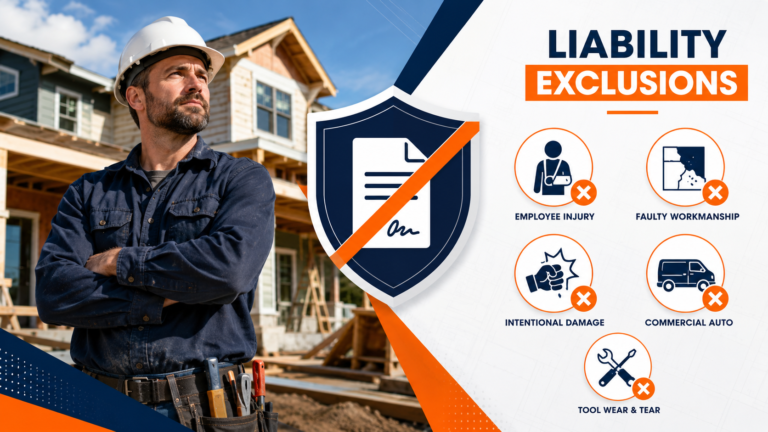
Keep in mind that general liability policies have exclusions. Damage to your own work, expected damage, professional errors, or intentional acts may require different coverage or may not be covered at all.
Your Tools Are Stolen
Many contractors depend on thousands of dollars in tools and equipment. If those tools are stolen from a vehicle, trailer, workshop, or job site, replacing them can interrupt operations and eliminate months of profit.
Tools and equipment insurance, often written as inland marine coverage, may protect portable equipment against certain types of theft and damage.
Contractors should review storage requirements carefully. Some policies limit coverage when tools are left unattended, stored in an unlocked vehicle, or kept at a job site overnight.
You Cause a Business Vehicle Accident
If you cause an accident while driving for work, you may face claims for:
- Vehicle repairs
- Medical expenses
- Lost income
- Property damage
- Legal defense
- Injury settlements
A personal auto insurer could dispute or deny coverage if the vehicle was being used for an excluded commercial purpose.
Before using a personal vehicle for contracting work, disclose the business use to your insurer and confirm the coverage in writing.
A Client Claims Your Advice Caused a Loss
General liability insurance is not designed to cover every claim involving professional advice or services.
A home inspector, engineer, designer, project manager, consultant, or technology contractor may need professional liability insurance, also called errors and omissions insurance.
This policy may help cover claims alleging:
- Professional negligence
- Incorrect advice
- Design errors
- Missed deadlines
- Failure to provide promised services
- Financial losses caused by professional mistakes
The SBA identifies professional liability insurance as relevant for businesses providing services and facing claims involving errors, malpractice, or negligence.
Does an LLC Let You Work Without Insurance?
Creating a limited liability company does not eliminate the need for insurance.
An LLC may help separate certain business liabilities from the owner’s personal assets, but that protection is not absolute. An owner may still face personal responsibility for:
- Personal negligence
- Personal guarantees
- Intentional misconduct
- Certain unpaid taxes
- Mixing personal and business finances
- Obligations personally accepted in a contract
An LLC also does not provide money to replace stolen tools, repair a damaged vehicle, hire an attorney, or pay a covered settlement.
Business structure and business insurance perform different functions. Many contractors benefit from having both.
What Insurance Should a Solo Contractor Consider?
A contractor without employees may not need every type of commercial insurance. However, solo contractors still face liability, property, vehicle, and income risks.
| Coverage | Main purpose | Commonly relevant for |
|---|---|---|
| General liability | Third-party injuries and property damage | Contractors working with customers or on customer property |
| Commercial auto | Business-related vehicle accidents | Contractors driving to jobs or transporting equipment |
| Tools and equipment | Theft or damage to portable equipment | Tradespeople with valuable tools |
| Professional liability | Claims involving professional errors or advice | Consultants, inspectors, designers, and specialists |
| Commercial property | Business property at a listed location | Contractors with offices, shops, or storage space |
| Cyber liability | Data breaches and cyber incidents | Contractors storing customer or payment information |
| Disability insurance | Partial income replacement after a qualifying disability | Solo contractors who depend on their physical ability to work |
The appropriate policies depend on what you do, where you work, and which losses would be difficult to pay independently.
Can You Get a Contract Without Insurance?
It may be possible to obtain small residential or freelance jobs without insurance. However, many larger clients will not hire an uninsured contractor.
A client may be concerned that an uninsured contractor cannot pay for property damage or injuries. The client may also want to avoid disputes involving its own insurance policy.
Working without insurance can limit access to:
- Commercial projects
- Government contracts
- Property management work
- Subcontracting opportunities
- Construction sites
- Higher-value residential projects
- Jobs requiring proof of licensing and insurance
Insurance can therefore be more than financial protection. It can also serve as a business credential that helps contractors qualify for better projects.
What Is a Certificate of Insurance?
A certificate of insurance, commonly called a COI, is a document summarizing a contractor’s active insurance policies.
It typically shows:
- Contractor or business name
- Insurance company
- Policy types
- Policy numbers
- Coverage dates
- Coverage limits
- Certificate holder
A certificate provides evidence of insurance but does not replace the policy or automatically change its terms.
A client may also request an additional insured endorsement. This is different from simply being listed as the certificate holder, so contractors should send the complete request to their insurance agent.
How to Decide Whether You Can Work Uninsured
Before starting work without insurance, ask yourself:
- Does my state require coverage for my trade?
- Does my license require insurance or a bond?
- Do I have employees or workers who may be classified as employees?
- Do I use a vehicle for business?
- Does the client’s contract require insurance?
- Could my work injure someone?
- Could I damage expensive customer property?
- How much would it cost to replace my tools?
- Could a professional mistake cause a customer financial loss?
- Could I personally afford a lawsuit?
If one serious accident could put you out of business, operating without insurance may not be a reasonable risk.
When comparing policies, review the exclusions, deductibles, coverage limits, subcontractor conditions, and completed operations coverage—not just the monthly premium.
Frequently Asked Questions
Is it illegal to work as a contractor without insurance?
Not always. There is no universal federal law requiring every contractor to carry the same business insurance. However, state laws, licensing rules, vehicle requirements, workers’ compensation laws, and contracts may make insurance mandatory.
Can a handyman work without insurance?
A handyman may be legally able to work without insurance in some states, depending on licensing rules and project value. However, general liability insurance is highly relevant because handyman work can cause customer injuries or property damage.
Can a general contractor hire an uninsured subcontractor?
A general contractor may be able to hire an uninsured subcontractor, but doing so can create significant financial and insurance risks. The general contractor’s insurer may charge additional premiums, exclude the subcontractor’s work, or treat the subcontractor as part of the contractor’s payroll during an audit.
Do I need insurance if I only perform small jobs?
Small projects can still produce expensive claims. A minor repair could cause a fire, water damage, personal injury, or damage to valuable property. The size of the invoice does not necessarily determine the size of the potential loss.
Do I need insurance if the customer signs a waiver?
A waiver may not eliminate all legal responsibility. Its enforceability can depend on state law, the wording of the document, and the circumstances of the claim. A waiver also does not replace vehicle, workers’ compensation, licensing, or contractual insurance requirements.
Can I use the client’s insurance?
You should not assume that a customer’s policy covers your work. Homeowners and commercial property policies may pursue recovery from a contractor who caused the damage. Contractors should maintain their own coverage unless protection under another policy has been specifically confirmed.
What is the most important insurance for a contractor?
General liability insurance is often the starting point because it addresses common claims involving third-party injuries and property damage. However, commercial auto, tools and equipment, professional liability, and workers’ compensation may be equally important depending on the business.
Conclusion
You may be able to work as a contractor without insurance, but your options could be limited by state rules, licensing requirements, vehicle laws, and client contracts.
More importantly, working uninsured means accepting full responsibility for the financial consequences of injuries, property damage, theft, professional mistakes, and lawsuits. An accident that seems unlikely can become far more expensive than several years of insurance premiums.
Before accepting your next project, check the requirements for your trade and state, review the contract, and identify the losses your business could not comfortably pay. Then compare coverage from licensed insurance professionals who understand your type of contracting work.
The right insurance package should match your actual risks—not simply satisfy a paperwork requirement. Protecting your business today can help ensure that one unexpected claim does not prevent you from taking the next job.
Editorial review: This guide was researched and reviewed by the Coverage Editorial Team using government agencies, insurance regulators, licensing authorities, policy documentation, and current industry pricing sources.