
What Insurance Documents Should You Request From a Subcontractor?
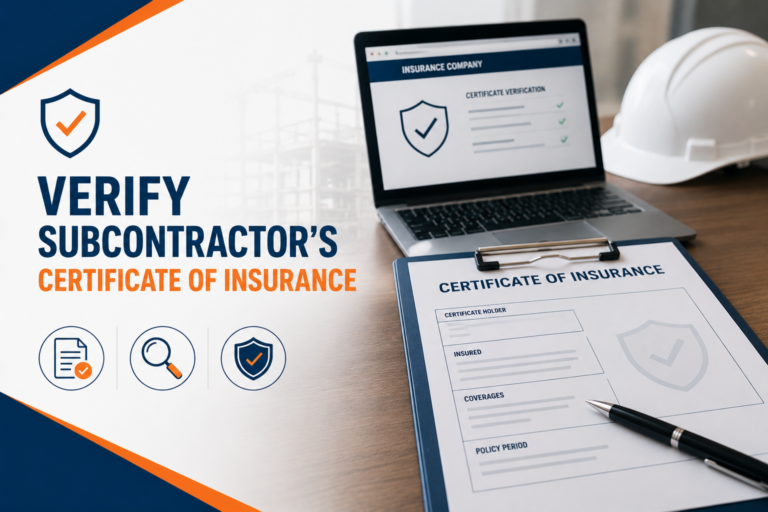
Before a subcontractor enters a job site, the hiring contractor should collect documents proving that the subcontractor carries appropriate insurance for its work. At a minimum, this usually includes a current certificate of insurance, proof of workers’ compensation coverage or a valid exemption, and copies of any contractually required endorsements.
Collecting only a certificate of insurance is often insufficient. A certificate summarizes selected policy information, but it does not change the insurance contract, guarantee that every claim will be covered, or automatically make the hiring contractor an additional insured.
The exact documents depend on the subcontractor’s trade, project risks, state laws, vehicles, employees, and contractual requirements. A roofing subcontractor, for example, may need different insurance documentation from a solo drafting consultant or cleaning company.
Subcontractor Insurance Document Checklist
Before work begins, consider requesting:
- Certificate of insurance
- General liability additional insured endorsement
- Completed operations additional insured endorsement
- Primary and noncontributory endorsement
- Waiver-of-subrogation endorsement
- Proof of workers’ compensation coverage
- Valid workers’ compensation exemption, when permitted
- Commercial auto insurance certificate
- Commercial umbrella or excess liability evidence
- Professional liability certificate, when relevant
- Pollution liability certificate, when relevant
- Surety bond documentation, when required
- Updated documents after policy renewal
- Written subcontractor agreement
- Current license and business registration information
The U.S. Small Business Administration notes that businesses may be legally required to purchase certain insurance and that requirements vary by state and business activity. It recommends evaluating risks and obtaining coverage appropriate for the company’s operations.
1. Certificate of Insurance
The certificate of insurance, commonly called a COI, is usually the first document requested from a subcontractor.
A COI may show:
- Subcontractor’s legal business name
- Insurance agent or broker
- Insurance companies
- Policy numbers
- Effective and expiration dates
- General liability limits
- Commercial auto liability
- Workers’ compensation
- Employers’ liability
- Umbrella or excess liability
- Certificate holder’s name and address
The certificate gives the hiring contractor a convenient summary of coverage in place when the document was issued.
What a Certificate Does Not Prove
A COI does not automatically prove that:
- Every subcontracted operation is covered
- The hiring contractor is an additional insured
- Completed operations coverage applies
- A waiver of subrogation exists
- Coverage is primary and noncontributory
- The policy will remain active
- A future claim will be paid
Texas insurance regulators explain that certificates cannot amend, extend, or alter policy coverage. Additional insured and waiver-of-subrogation boxes should be marked only when corresponding endorsements actually provide those protections.
The certificate should therefore be treated as a starting point rather than complete proof of contractual compliance.
2. General Liability Insurance Evidence
Most contractors should require subcontractors to carry commercial general liability insurance appropriate for their trade.
General liability may address covered claims involving:
- Third-party bodily injury
- Property damage
- Personal and advertising injury
- Ongoing operations
- Products-completed operations
- Legal defense expenses
The certificate should identify the general liability insurer, policy dates, and limits. Common contract requirements may include an each-occurrence limit, general aggregate, and products-completed operations aggregate.
The California Department of Insurance describes liability insurance as protection for a policyholder’s legal liability resulting from injury to others or damage to their property. The actual policy, however, determines what operations and claims are covered.
Review the Subcontractor’s Legal Name
The named insured on the certificate should match the entity signing the subcontract.
Potential problems include:
- The agreement is signed by an LLC, but the policy names only an individual.
- The subcontractor uses a DBA that is not connected to the insured entity.
- The certificate identifies an old business name.
- A related company owns the policy but is not performing the work.
Ask the subcontractor or its agent to explain any inconsistency before the project begins.
3. Additional Insured Endorsement
When the subcontract requires the hiring contractor, project owner, or another party to be an additional insured, request the actual endorsement.
Being listed as the certificate holder does not create additional insured status. A sentence typed into the COI’s description-of-operations section is also not a substitute for an endorsement.
An additional insured endorsement can provide a qualifying party with limited protection under the subcontractor’s liability policy for claims connected to the subcontractor’s work.
Check that the endorsement:
- Applies to the correct organization
- Matches the written contract
- Covers the subcontractor’s relevant operations
- Was effective before work or the accident
- Meets any project-specific requirements
- Is not limited in a way that conflicts with the subcontract
Insurance endorsements modify the underlying policy by adding, deleting, excluding, or changing coverage. The NAIC notes that an endorsement becomes part of the insurance contract and may affect the premium.
4. Ongoing Operations and Completed Operations Endorsements
Determine whether additional insured protection is required while the subcontractor is working, after work is completed, or during both periods.
Ongoing Operations
Ongoing operations coverage relates to work still being performed.
Potential examples include:
- A visitor trips over subcontractor equipment.
- An installer damages the customer’s flooring.
- Construction debris injures someone.
- Plumbing work causes immediate water damage.
Completed Operations
Completed operations coverage relates to qualifying injuries or property damage arising after the subcontractor finishes the work.
Examples may include:
- Installed wiring allegedly causes a later fire.
- A plumbing connection leaks after project completion.
- A mounted fixture falls several months later.
- Completed roofing work allegedly allows water intrusion.
Do not assume an ongoing operations endorsement automatically includes completed operations. If the subcontract requires both, collect documentation supporting both periods.
Retain completed operations endorsements after the project ends. A claim may arise long after the subcontractor has left the job site.
5. Primary and Noncontributory Endorsement
A contract may require the subcontractor’s insurance to be primary and noncontributory for the hiring contractor or project owner.
Primary generally means the subcontractor’s policy is intended to respond before the additional insured’s other applicable insurance.
Noncontributory generally means the subcontractor’s insurer will not seek contribution from the additional insured’s insurer for the covered claim, subject to the endorsement.
Additional insured status does not automatically provide primary and noncontributory treatment. Request the relevant endorsement or policy provision when the subcontract requires it.
Do not rely solely on COI wording. A certificate cannot create a primary and noncontributory obligation absent from the underlying insurance contract.
6. Waiver-of-Subrogation Endorsement
A waiver of subrogation limits an insurer’s right to pursue a protected party after paying a covered claim.
A subcontract may require a waiver under:
- General liability
- Workers’ compensation
- Commercial auto
- Commercial property
- Builder’s risk
- Umbrella or excess liability
Request the actual endorsement and confirm that it applies to the correct party and policy.
The endorsement may be:
Scheduled
A scheduled waiver specifically names the hiring contractor, project owner, or other protected party.
Blanket
A blanket waiver may apply automatically when the subcontractor agrees to provide the waiver in a qualifying written contract.
Blanket endorsements still have conditions. For example, the agreement may need to be signed before the loss occurs. Texas insurance guidance states that a certificate should accurately indicate whether a waiver is scheduled or provided through a blanket endorsement.
7. Workers’ Compensation Certificate
Request proof of workers’ compensation coverage from every subcontractor when required by state law or contract.
The document may identify:
- Workers’ compensation insurer
- Policy number
- Policy period
- Employers’ liability limits
- Insured business
- States covered by the policy
Workers’ compensation is primarily regulated at the state level. The U.S. Department of Labor directs private employers to the appropriate state workers’ compensation authority for applicable requirements.
New York’s Workers’ Compensation Board specifically advises employers to collect workers’ compensation certificates from subcontractors. It notes that insurers routinely charge general contractors premium for subcontractors that cannot prove they have their own coverage.
Verify State-Specific Forms
A standard commercial COI may not satisfy every state’s proof requirements.
For example, New York recognizes specific evidence such as:
- Certificate of Workers’ Compensation Insurance
- State Insurance Fund certificate
- Certificate of self-insurance
- Approved exemption documentation
The state’s Workers’ Compensation Board explains which forms constitute acceptable proof for licenses, permits, and government contracts.
Check the requirements in the state where the work is performed rather than assuming the same document works nationwide.
8. Workers’ Compensation Exemption Document
A subcontractor without employees may claim an exemption from workers’ compensation requirements. Do not accept a verbal statement or a handwritten declaration when the state requires an official certificate.
Request the applicable state-issued exemption document and verify:
- The correct business entity
- Effective date
- Expiration date
- State of issuance
- Eligibility conditions
- Whether the exemption applies to the specific project
An exemption does not necessarily prevent the hiring contractor’s insurer from charging premium for the subcontractor. It also does not conclusively establish that every worker used by the subcontractor is an independent contractor.
In New York, for example, only qualifying entities may obtain the state’s exemption certificate. The state also warns that general contractors routinely require proof of coverage and may be charged for uninsured subcontractor exposure.
9. Commercial Auto Insurance Certificate
Request commercial auto insurance evidence when the subcontractor uses vehicles for the project.
This is particularly important when the subcontractor:
- Carries tools or materials
- Makes deliveries
- Tows trailers
- Operates heavy vehicles
- Drives on the project site
- Transports workers
- Uses rented vehicles
- Allows employees to use personal vehicles for work
The certificate should show the required auto liability limit and the categories of covered vehicles when available.
Depending on the contract, coverage may need to include:
- Owned autos
- Hired autos
- Non-owned autos
- Any auto
Do not assume the general contractor’s auto policy covers vehicles independently owned or operated by subcontractors.
10. Commercial Umbrella or Excess Liability Evidence
Larger projects may require liability limits beyond the subcontractor’s primary policies.
A commercial umbrella or excess liability certificate may show additional limits above qualifying policies such as:
- General liability
- Commercial auto liability
- Employers’ liability
Confirm that the umbrella policy applies over the required underlying coverage and includes any necessary additional insured or waiver provisions.
The existence of an umbrella policy does not automatically mean it follows every endorsement in the underlying policy. Ask the agent to verify how the umbrella responds to the contract requirements.
11. Professional and Pollution Liability Documents
Some subcontractors need specialized liability insurance.
Professional Liability
Professional liability may be appropriate for subcontractors providing:
- Design services
- Engineering
- Consulting
- Inspections
- Technical recommendations
- Construction management
- Design-build services
Professional liability is commonly written on a claims-made basis. Review the policy period, retroactive date, and any requirement to maintain coverage after project completion.
Pollution Liability
Pollution liability may be relevant for:
- Environmental remediation
- Mold work
- Asbestos or lead work
- Fuel or chemical handling
- Excavation
- HVAC refrigerants
- Hazardous material transportation
A standard general liability policy may contain pollution exclusions. When the subcontract involves environmental exposure, request evidence of specific pollution coverage rather than assuming general liability is sufficient.
Supporting Documents to Request
The following are not substitutes for insurance documentation, but they can strengthen the subcontractor review process:
- Signed subcontractor agreement
- Form W-9
- Current contractor or trade license
- Business registration
- Applicable permits
- Surety bond documentation
- Safety program
- OSHA records when relevant and legally accessible
- Emergency contact information
- List of lower-tier subcontractors
A written subcontract does not conclusively establish that workers are independent contractors. The IRS evaluates the entire relationship, including behavioral control, financial control, and the relationship between the parties. No single factor or contract label determines status.
OSHA also states that prime contractors and subcontractors may share responsibility for compliance regarding subcontracted construction work. Insurance documents should therefore be part of a broader safety and compliance process.
How to Verify Subcontractor Insurance Documents
Do not simply file the documents without reviewing them.
Check the Business Name
Confirm that the named insured matches the subcontracting entity.
Verify Policy Dates
Coverage should be active before work begins and remain active throughout the project.
Review Coverage Limits
Compare every limit with the subcontract requirements.
Examine the Endorsements
Confirm additional insured, completed operations, primary and noncontributory, and waiver provisions through actual endorsements.
Contact the Issuing Agency
Use independently verified contact information when a document appears altered or inconsistent.
Verify the Insurance Company
The NAIC recommends confirming the company through state insurance department resources and its Consumer Insurance Search.
Track Expiration Dates
Create reminders before each policy expires. Suspend work when required documentation is not renewed.
Retain Records
Keep certificates, endorsements, contracts, and renewals for the period required by the agreement and applicable law, particularly when completed operations claims may arise later.
Frequently Asked Questions
Is a certificate of insurance enough for a subcontractor?
Usually not. You may also need additional insured, completed operations, primary and noncontributory, and waiver-of-subrogation endorsements.
Should every subcontractor carry general liability insurance?
It is generally advisable and is commonly required by contract. The necessary limits and coverage depend on the trade and project.
Should a sole proprietor provide workers’ compensation insurance?
State requirements vary. A valid exemption may be acceptable in some situations, while a general contractor or customer may still require coverage contractually.
Can a subcontractor provide an exemption letter?
Only when the document satisfies the applicable state’s requirements. An informal letter may not be valid proof.
Should commercial auto insurance be requested?
Yes, when the subcontractor uses vehicles in connection with the project.
How often should insurance documents be updated?
Request updated documents whenever coverage renews, expires, changes, or a new project imposes different requirements.
Can you verify a COI with the insurance company?
Yes. Contact the issuing agency or insurer using independently verified information, especially when the document appears incomplete or altered.
Should lower-tier subcontractors provide insurance?
Generally, the subcontract should require comparable documentation from lower-tier subcontractors when they are permitted to perform project work.
Conclusion
At a minimum, contractors should usually request a current certificate of insurance and proof of workers’ compensation coverage from each subcontractor. When required by contract, they should also obtain actual endorsements supporting additional insured status, completed operations, primary and noncontributory coverage, and waivers of subrogation.
Commercial auto, umbrella, professional liability, pollution liability, and bond documents may also be necessary depending on the subcontractor’s operations.
Do not rely on the COI alone. Check legal names, policy dates, limits, insurers, and endorsements. Verify workers’ compensation using state-specific resources, track expiration dates, and keep records after project completion.
A consistent subcontractor insurance process can reduce uninsured losses, premium-audit charges, project delays, and disputes over which party is responsible after an accident.
Editorial review: This guide was researched and reviewed by the Coverage Editorial Team using government agencies, insurance regulators, licensing authorities, policy documentation, and current industry pricing sources.