
When Should a New Contractor Buy Business Insurance?
A new contractor should generally buy business insurance before accepting the first project, entering a customer’s property, driving for work, or signing a contract that requires coverage. Waiting until after work begins can leave the contractor personally responsible for an accident, lawsuit, theft, or property damage that happens before the policy becomes active.
Not every contractor is legally required to purchase the same policies on the first day of business. Requirements vary by state, trade, business structure, vehicle use, number of employees, licensing rules, and customer contracts. However, the safest time to arrange coverage is usually during the business setup stage—not after a client asks for proof of insurance or a claim has already occurred.
The U.S. Small Business Administration includes obtaining business insurance among the key steps involved in launching a business. It also warns that accidents, lawsuits, and other unexpected events can threaten an uninsured company.
The Best Time to Buy Contractor Insurance
For most new contractors, the right time to purchase insurance is before the business begins operating publicly or performing paid work.
Ideally, coverage should be active before you:
- Sign your first customer contract
- Enter a customer’s home or business
- Begin physical work at a job site
- Advertise services that create professional obligations
- Use a vehicle for business purposes
- Purchase or transport expensive tools
- Hire an employee or subcontractor
- Rent an office, workshop, or storage unit
- Apply for a license that requires insurance
- Bid on a project requiring proof of coverage
Buying insurance early allows you to review policy limits, exclusions, deductibles, and contractual requirements without the pressure of a project start date.
It also reduces the risk of discovering that a client requires coverage you cannot obtain immediately.
Should You Buy Insurance Before Your First Job?
In most cases, yes.
Even a small first project can create a significant liability claim. The value of the job does not necessarily determine the size of the possible loss.
For example, a contractor completing a $300 repair could accidentally:
- Cause a fire
- Damage plumbing or electrical systems
- Injure a customer
- Damage expensive flooring or furniture
- Leave equipment where someone could trip
- Trigger a water leak that affects multiple rooms
Without insurance, the contractor may have to pay for repairs, medical expenses, legal representation, settlements, and judgments personally.
General liability insurance may help cover eligible third-party bodily injury and property damage claims. The SBA identifies general liability as protection against financial losses involving bodily injury, property damage, medical expenses, legal defense, and certain judgments.
For contractors who work inside homes, commercial buildings, or active construction sites, purchasing general liability insurance before the first job is usually a practical starting point.
Buy Insurance Before Signing a Client Contract
New contractors should review insurance requirements before signing any service agreement.
A customer, property manager, project owner, or general contractor may require:
- General liability insurance
- Commercial auto insurance
- Workers’ compensation
- Professional liability insurance
- Commercial umbrella insurance
- Specific policy limits
- Additional insured status
- A waiver of subrogation
- Completed operations coverage
Do not assume that any low-cost policy will satisfy the contract. A customer may require limits or endorsements that are not included automatically.
For example, a general contractor might require a subcontractor to carry $1 million in general liability coverage and name the general contractor as an additional insured. Purchasing a basic policy without checking these details could result in delays or additional costs.
A new contractor should send the complete insurance section of the contract to a licensed agent or broker before agreeing to it.
Buy Insurance Before Entering a Job Site
Liability can begin as soon as a contractor arrives at a customer’s property.
You do not need to complete the project before something can go wrong. A claim could arise while you are:
- Inspecting the work area
- Delivering materials
- Preparing an estimate
- Unloading equipment
- Testing a system
- Meeting with the property owner
Suppose a contractor places a toolbox in a hallway during an initial inspection. A customer trips over it and is injured before the actual repair begins. The contractor could still face a liability claim.
Insurance should therefore be active before the first site visit—not merely before the final invoice is issued.
Buy Commercial Auto Insurance Before Driving for Work
Contractors often begin using personal vehicles for business without realizing that personal auto insurance may not fully cover commercial activities.
Business use may include:
- Traveling between job sites
- Carrying tools and materials
- Making deliveries
- Visiting customers
- Transporting employees
- Towing a work trailer
- Driving a vehicle titled to the business
The National Association of Insurance Commissioners explains that business-owned vehicles generally need separate commercial vehicle coverage and that personal auto policies may not provide appropriate protection for business operations.
Commercial auto insurance should be considered before the vehicle is regularly used for contracting work.
New contractors should disclose the exact business use to their insurer, including:
- Who owns the vehicle
- Who drives it
- What it transports
- How many miles it travels
- Whether it tows a trailer
- Whether employees use it
- Whether it displays business signs
Waiting until after an accident to discuss business use could create serious coverage problems.
Buy Tools and Equipment Coverage When You Acquire Valuable Property
A contractor who depends on tools should consider insurance as soon as the replacement cost becomes difficult to absorb.
Tools and equipment coverage may protect portable business property such as:
- Power tools
- Hand tools
- Generators
- Compressors
- Ladders
- Testing devices
- Landscaping equipment
- Small construction machinery
This protection is often written as inland marine or contractor’s equipment insurance because the property moves between locations.
Coverage should ideally begin before tools are stored in a work vehicle, trailer, rented unit, or job site. Standard homeowners and renters policies may exclude or severely limit business-related property.
The NAIC notes that traditional homeowners insurance generally excludes business-related property losses and liability exposures, making separate business coverage important for contractors operating from home.
Contractors should maintain an inventory containing receipts, serial numbers, purchase dates, descriptions, and photographs of their equipment.
Buy Workers’ Compensation Before Hiring Employees
Workers’ compensation requirements are generally determined at the state level for employees of private companies. The number of employees that triggers mandatory coverage and the available exemptions differ by state.
A new contractor should investigate workers’ compensation requirements before the first employee begins working.
Workers’ compensation may help provide benefits for qualifying work-related injuries and occupational illnesses, including:
- Medical treatment
- Rehabilitation
- Partial wage replacement
- Disability benefits
- Death benefits
Do not wait until payroll has already started. Operating without legally required workers’ compensation can lead to penalties, lawsuits, stop-work orders, and direct responsibility for an injured employee’s expenses.
What About Subcontractors?
Hiring subcontractors does not automatically eliminate workers’ compensation or liability concerns.
Authorities and insurers may examine the actual relationship between the business and the worker. The IRS evaluates factors such as behavioral control, financial control, and the relationship between the parties when distinguishing employees from independent contractors.
Before a subcontractor starts working, a new contractor should:
- Use a written subcontractor agreement.
- Request a current certificate of insurance.
- Verify general liability coverage.
- Confirm workers’ compensation when applicable.
- Review any exclusions for subcontracted work.
- Ask how uninsured subcontractors affect policy audits and premiums.
The contractor’s own insurer should know that subcontractors will be used.
Buy Insurance Before Applying for Certain Licenses
Some contractor licensing boards, states, counties, and municipalities require insurance or bonding before issuing a license or permit.
Requirements may depend on:
- Trade classification
- Project value
- Residential or commercial work
- Number of employees
- Business structure
- Location
- Type of license
A contractor may need to submit a certificate of insurance showing specific limits. A licensing authority may also require a surety bond.
Insurance and surety bonds serve different purposes. Insurance can protect against covered losses, while a surety bond guarantees compliance with certain legal or contractual obligations.
Because licensing requirements vary, new contractors should check the official state or local licensing authority before purchasing coverage. This prevents buying a policy that does not meet the required limits or wording.
Buy Professional Liability Insurance Before Providing Advice
Some contractors provide more than physical labor. They may also offer:
- Designs
- Inspections
- Cost estimates
- Technical recommendations
- Project management
- Consulting services
- Plans and specifications
- Installation advice
Professional liability insurance, also called errors and omissions insurance, may help cover claims alleging that professional services caused a customer financial loss.
The SBA identifies professional liability coverage as relevant for businesses providing services and facing claims involving errors, negligence, or malpractice.
This coverage should generally be active before delivering the first professional service, report, recommendation, or design.
Many professional liability policies are written on a claims-made basis. The policy terms, retroactive date, and reporting requirements can affect whether a claim is covered. Contractors should discuss these details with an insurance professional before beginning work.
Buy Property Insurance Before Signing a Lease
A contractor renting an office, workshop, warehouse, or storage unit should arrange insurance before moving business property into the space.
The lease may require:
- General liability insurance
- Commercial property insurance
- Specific liability limits
- The landlord to be listed as an additional insured
- Coverage for improvements made to the property
Commercial property insurance may protect furniture, computers, inventory, tools, materials, and equipment located at the insured premises.
A business owner’s policy, commonly called a BOP, may combine general liability, commercial property, and business interruption coverage. The NAIC describes the BOP as one of the most commonly purchased policy packages for small businesses.
Do not rely on the landlord’s policy. The property owner’s insurance generally protects the building owner’s interests, not all of the contractor’s equipment, inventory, or liability exposures.
Can You Wait Until a Client Requests Insurance?
Technically, some contractors wait until a customer asks for a certificate of insurance. However, this strategy creates several risks.
You may discover that:
- The policy cannot be issued before the project begins.
- Your trade requires additional underwriting.
- The insurer will not cover a particular service.
- The client requires higher limits.
- An additional insured endorsement costs extra.
- Previous uninsured work will not be covered.
- You need several different policies.
- The premium is higher than expected.
Insurance generally does not cover an accident that happened before the policy became effective. Buying coverage after receiving a complaint, demand letter, or notice of damage will not retroactively insure the known event.
Arranging coverage early gives you time to compare options and include insurance costs in your pricing.
What Insurance Should a New Contractor Buy First?
The first policies depend on the contractor’s operations.
| Business situation | Coverage to consider first |
|---|---|
| Working at customer properties | General liability |
| Driving to jobs or carrying tools | Commercial auto |
| Owning expensive portable equipment | Tools and equipment coverage |
| Providing advice, designs, or inspections | Professional liability |
| Hiring employees | Workers’ compensation |
| Renting an office or workshop | Commercial property or a BOP |
| Storing sensitive customer information | Cyber liability |
| Accepting large or high-risk contracts | Commercial umbrella coverage |
Many solo tradespeople begin with general liability and then add commercial auto and tools coverage.
A consultant who works remotely may prioritize professional liability and cyber insurance instead.
How to Prepare Before Requesting Insurance Quotes
Insurance companies need accurate information to evaluate a contractor’s risk.
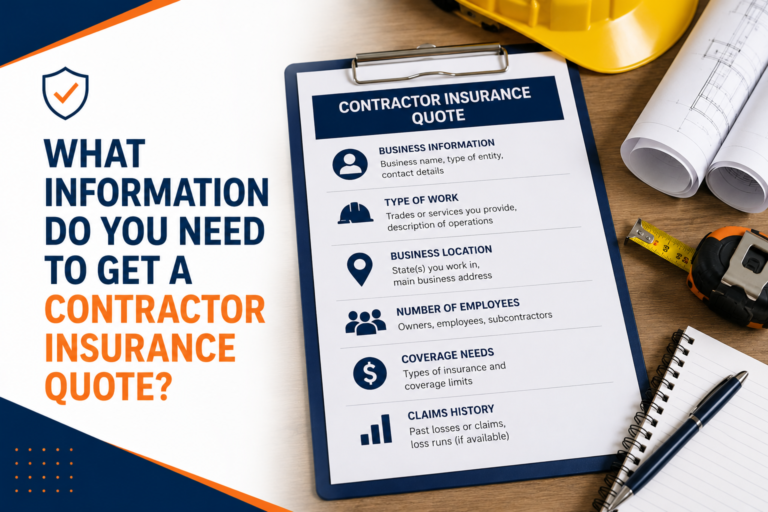
Before requesting quotes, gather:
- Business name and legal structure
- Business address
- Description of services
- Expected annual revenue
- Estimated payroll
- Subcontractor expenses
- Number of employees
- Vehicle information
- Tool and equipment values
- Prior insurance history
- Previous claims
- States where work will be performed
- Typical and maximum project values
Describe every major service accurately. Failing to disclose high-risk work can lead to incorrect pricing, exclusions, or claim disputes.
Compare more than the premium. Review:
- Coverage limits
- Deductibles
- Exclusions
- Completed operations coverage
- Subcontractor restrictions
- Coverage territory
- Additional insured options
- Claims-made versus occurrence coverage
- Cancellation terms
The NAIC recommends verifying that insurance agents and companies are properly licensed through the relevant state insurance department.
Frequently Asked Questions
Should I buy contractor insurance before registering my business?
You can research and request quotes before registration, but the insurer may need your final business name, structure, address, and start date before issuing the policy. Coverage should be active before you begin operations or perform work.
Can I buy insurance after signing a contract?
You may be able to purchase coverage afterward, but the policy must satisfy the contract and become active before the required date. Reviewing requirements before signing is safer.
Does a contractor need insurance before providing estimates?
It depends on the work. An estimate-only visit can still involve third-party injury or property damage risks. Consultants providing professional estimates or recommendations may also need professional liability coverage.
Can I purchase insurance on the same day I start a job?
Some policies can become effective quickly, but same-day coverage is not guaranteed. Underwriting, payment, inspections, or additional documentation may cause delays.
Will business insurance cover work completed before the policy started?
Usually not automatically. Coverage depends on the policy type, effective date, retroactive date, and other terms. Contractors should never assume that new insurance covers prior uninsured work.
Do I need insurance before hiring subcontractors?
Coverage should be reviewed before subcontractors begin working. Your policy may have subcontractor requirements, exclusions, audit conditions, or certificate-of-insurance rules.
What is the first insurance policy most contractors buy?
General liability is often the first policy because it addresses common third-party injury and property damage claims. Commercial auto, tools coverage, professional liability, or workers’ compensation may be equally urgent depending on the business.
Conclusion
A new contractor should generally buy business insurance before performing the first paid job or taking on a risk that could produce a claim.
Do not wait until after entering a customer’s property, driving for work, hiring an employee, purchasing expensive equipment, or signing a contract with insurance requirements. Coverage purchased after an incident will not normally protect you from a loss that has already happened.
Start by identifying your daily risks, checking state and licensing requirements, and reviewing upcoming contracts. Then compare policies from licensed insurance professionals familiar with your trade.
Buying insurance early does more than protect against unexpected costs. It can help you qualify for better projects, satisfy professional requirements, and present your new contracting business as prepared, credible, and ready to work.
Editorial review: This guide was researched and reviewed by the Coverage Editorial Team using government agencies, insurance regulators, licensing authorities, policy documentation, and current industry pricing sources.