
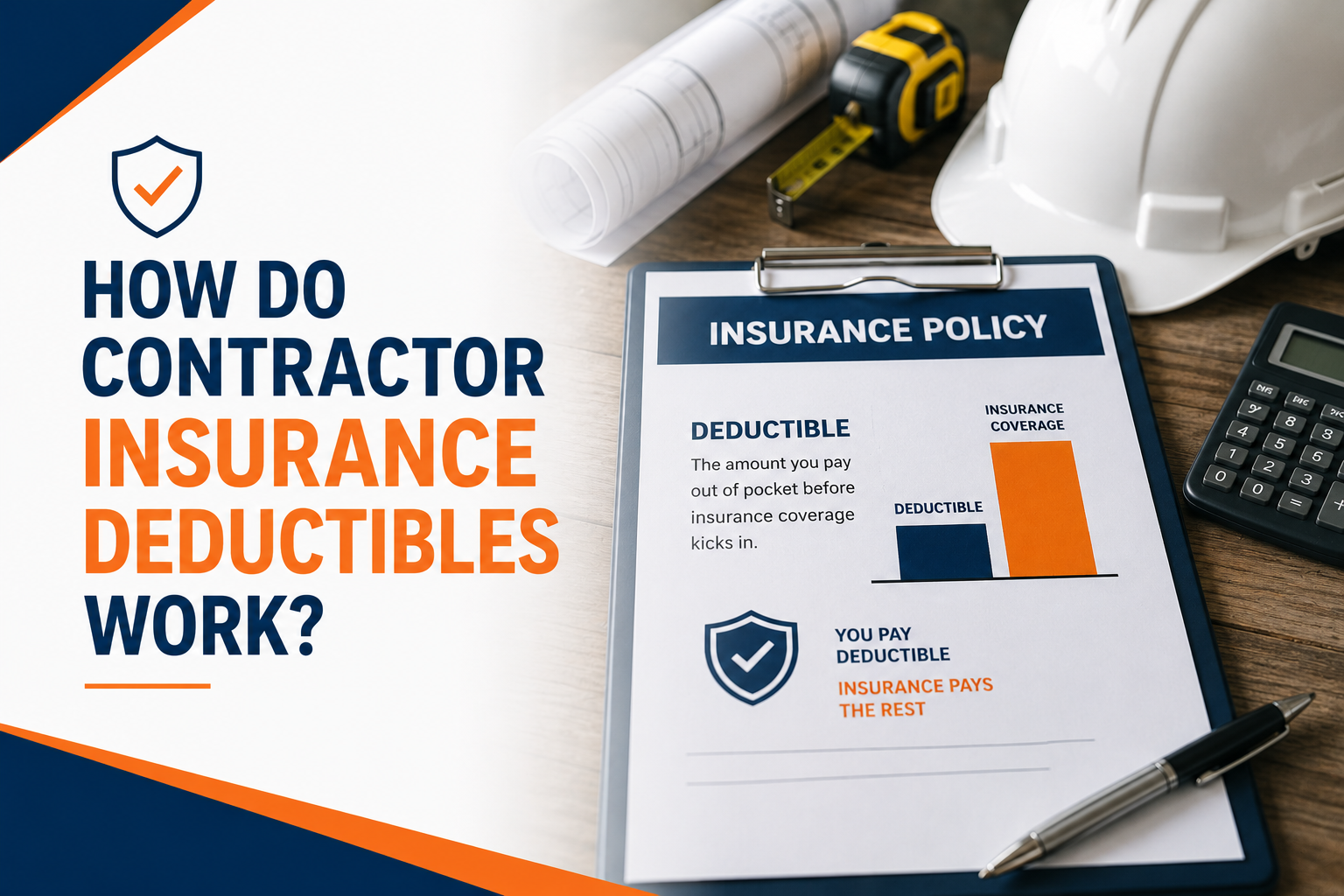
How Do Contractor Insurance Deductibles Work?
A contractor insurance deductible is the amount a contracting business must pay toward a covered claim before the insurance company pays its share.
For example, suppose a contractor has tools and equipment insurance with a $1,000 deductible. If covered tools worth $8,000 are stolen, the contractor would generally pay the first $1,000 and the insurer could pay the remaining $7,000, subject to the policy’s limits, valuation method, and exclusions.
Deductibles help divide risk between the contractor and the insurance company. Choosing a higher deductible can reduce the insurance premium, but it also increases the contractor’s out-of-pocket responsibility when a claim occurs.
Not every contractor insurance policy uses deductibles in the same way. General liability, commercial auto, property, tools and equipment, professional liability, and workers’ compensation policies can each have different deductible rules. Contractors should therefore review the declarations page and endorsements for every individual policy.
What Is an Insurance Deductible?
A deductible is the dollar amount or percentage of a covered claim that the policyholder must pay before the insurance company pays its portion.
The National Association of Insurance Commissioners defines a deductible as the amount or percentage of a claim the insured pays before the insurer pays its share. (content.naic.org)
Commercial insurance policies often use a fixed dollar deductible, such as:
- $500
- $1,000
- $2,500
- $5,000
- $10,000
The available options depend on the insurer, policy type, size of the business, and risk involved.
A deductible is separate from the premium. The premium is the amount paid to keep the policy active. The deductible is generally paid only when a covered claim occurs.
How a Contractor Insurance Deductible Works
The basic process is straightforward:
- A covered loss occurs.
- The contractor reports the claim.
- The insurer investigates the incident.
- The insurer determines the covered amount.
- The contractor is responsible for the deductible.
- The insurer pays the remaining covered amount, subject to the policy limits.
Deductible Example
A contractor has commercial property insurance with:
- A $2,500 deductible
- A $100,000 property limit
- A covered fire loss totaling $30,000
The claim could be calculated as follows:
| Claim calculation | Amount |
|---|---|
| Covered damage | $30,000 |
| Contractor’s deductible | $2,500 |
| Potential insurer payment | $27,500 |
This example assumes the entire $30,000 loss is covered and that no coinsurance penalty, valuation adjustment, or other limitation applies.
The California Department of Insurance explains that a commercial insurance deductible is the portion of a loss the business pays before the insurer pays a covered claim. (insurance.ca.gov)
Does Every Contractor Insurance Policy Have a Deductible?
No. Deductibles vary by policy and coverage section.
Some contractor policies may have:
- No deductible for certain liability claims
- A deductible applying only to property damage
- Separate deductibles for different types of losses
- A deductible for every claim or occurrence
- A percentage deductible for certain events
- A self-insured retention instead of a traditional deductible
For example, a commercial auto policy may have separate deductibles for collision and comprehensive coverage. General liability coverage may have no standard deductible or may include a property damage deductible endorsement. Tools and equipment coverage may use one deductible for theft and another for certain scheduled equipment.
The declarations page usually lists the main deductible amounts. However, endorsements can add or modify deductibles, so contractors should review the complete policy. State insurance regulators emphasize that the declarations, insuring agreement, exclusions, conditions, and endorsements collectively determine how coverage applies. (doi.sc.gov)
How General Liability Deductibles Work
General liability insurance may cover eligible claims involving:
- Third-party bodily injury
- Accidental property damage
- Personal and advertising injury
- Products-completed operations
- Legal defense expenses
A contractor’s general liability policy may have no deductible for some claims. Other policies may apply a deductible to property damage, bodily injury, or both.
General Liability Example
A remodeling contractor accidentally damages a customer’s hardwood floor. The covered repair cost is $12,000, and the policy has a $1,000 property damage deductible.
The contractor could be responsible for $1,000, while the insurer could pay the remaining $11,000.
However, the payment process may differ between policies. In some cases, the insurer may pay the claimant and then collect the deductible from the contractor. In others, the contractor may need to pay the deductible before the insurer issues payment.
Contractors should ask:
- Does the deductible apply to bodily injury, property damage, or both?
- Is it charged per claim or per occurrence?
- Does it apply to completed operations claims?
- Does it apply to legal defense expenses?
- Does the insurer collect it before or after settling the claim?
- Does the deductible reduce the available policy limit?
The policy wording—not the certificate of insurance—provides these answers.
Per-Claim vs. Per-Occurrence Deductibles
A deductible may apply per claim or per occurrence.
Per-Claim Deductible
A per-claim deductible can apply separately to each individual claim.
Suppose one accident causes three different customers to file claims. A per-claim deductible could potentially apply three times, depending on the policy wording.
Per-Occurrence Deductible
A per-occurrence deductible generally applies once to all covered claims arising from the same occurrence.
Using the same example, if three claims resulted from one incident, the contractor might pay only one deductible.
This distinction can have a major financial impact when one job-site event affects several people or properties.
Contractors should ask their insurance agent to identify the exact language defining a claim and an occurrence.
Deductibles for Tools and Equipment Insurance
Tools and equipment coverage commonly includes a deductible because it protects the contractor’s own property.
Suppose a contractor has:
- $25,000 in tools and equipment coverage
- A $1,000 deductible
- $6,500 in covered stolen tools
The potential insurer payment would be $5,500.
If the covered loss were only $800, the insurer would generally pay nothing because the loss is below the $1,000 deductible.
This means contractors should avoid choosing a deductible so high that most realistic tool claims would fall below it.
Other factors can also reduce the payment, including:
- Per-item limits
- Actual cash value
- Replacement cost conditions
- Unscheduled equipment limits
- Theft restrictions
- Unlocked vehicle exclusions
- Coverage limits for rented or borrowed equipment
A deductible does not make an excluded loss covered. The incident must first satisfy the policy’s coverage requirements.
Commercial Auto Insurance Deductibles
Commercial auto insurance commonly applies deductibles to physical damage coverage rather than third-party liability coverage.
Collision Deductible
Collision coverage may pay for damage to the insured work vehicle after an accident, subject to the deductible.
For example, if a work van suffers $9,000 in covered collision damage and has a $1,000 deductible, the insurer could pay $8,000.
Comprehensive Deductible
Comprehensive coverage may apply to non-collision losses such as theft, vandalism, fire, hail, or falling objects.
A policy could use different deductibles for collision and comprehensive claims.
The NAIC notes that deductibles represent the amount paid out of pocket before insurance responds and that increasing a deductible can reduce the premium. (content.naic.org)
Liability coverage for injuries or damage caused to another person often works differently and may not carry the same deductible as physical damage coverage.
Commercial Property Deductibles
Commercial property insurance may cover buildings, office equipment, inventory, materials, and property stored at an insured location.
Property deductibles may apply separately to each covered loss. However, certain causes of loss may have special deductibles.
Examples include:
- Wind or hail deductibles
- Named-storm deductibles
- Water damage deductibles
- Theft deductibles
- Equipment breakdown deductibles
- Earthquake deductibles under separate coverage
Some deductibles are fixed dollar amounts, while others may be calculated as a percentage of the insured property value.
A contractor with coastal property, expensive equipment, or several business locations should verify whether the policy contains any percentage or location-specific deductibles.
Professional Liability Deductibles
Professional liability insurance, also called errors and omissions insurance, may protect contractors against claims involving professional advice, designs, inspections, estimates, or project management services.
These policies frequently use a deductible or self-insured retention.
Contractors should determine whether the amount applies to:
- Damages only
- Legal defense expenses
- Damages and defense expenses combined
- Every claim
- Related claims treated as one claim
Suppose a construction consultant has a $5,000 professional liability deductible and faces a covered claim requiring $40,000 in defense expenses and settlement costs. The contractor may be responsible for the first $5,000, but the exact calculation depends on whether defense costs are subject to the deductible and how the policy treats the claim.
Deductible vs. Self-Insured Retention
A self-insured retention, commonly abbreviated as SIR, is similar to a deductible but can place more responsibility on the contractor.
With a traditional deductible, the insurance company may begin handling the claim and then require the contractor to pay or reimburse the deductible.
With an SIR, the contractor may be responsible for handling and funding the claim until the retention has been exhausted. The insurer’s obligation may not begin until the contractor has paid the required amount and satisfied the policy conditions.
The California Department of Insurance explains that commercial umbrella insurance may use a self-insured retention when no underlying policy applies. In that situation, the insured must pay the retention before the umbrella coverage responds. (insurance.ca.gov)
| Feature | Deductible | Self-insured retention |
|---|---|---|
| Contractor pays part of loss | Yes | Yes |
| Insurer may manage claim immediately | Often | Not always |
| Contractor may handle early claim expenses | Less commonly | More commonly |
| Insurer responds after amount is satisfied | Yes | Yes |
| Exact duties depend on policy | Yes | Yes |
A small contractor should not accept a large SIR without understanding who will investigate claims, hire attorneys, communicate with claimants, and document the retained expenses.
Do Higher Deductibles Lower Contractor Insurance Premiums?
Generally, choosing a higher deductible can reduce the premium because the contractor agrees to retain more risk.
The California Department of Insurance advises that higher commercial insurance deductibles can lower the rate but warns businesses not to select deductibles large enough to threaten their financial stability. (insurance.ca.gov)
New York’s Department of Financial Services similarly suggests that small businesses may consider increasing a deductible to reduce premiums, provided the resulting out-of-pocket exposure remains manageable. (dfs.ny.gov)
The premium savings should be compared with the additional risk.
For example:
| Deductible option | Annual premium | Contractor’s maximum initial claim cost |
|---|---|---|
| $500 deductible | $2,900 | $500 |
| $1,000 deductible | $2,650 | $1,000 |
| $2,500 deductible | $2,300 | $2,500 |
These figures are illustrative only. The best option depends on the actual quotes and the contractor’s cash reserves.
Saving $350 annually may not be worthwhile if increasing the deductible by $1,500 would create a cash-flow problem after a loss.
How to Choose the Right Deductible
A contractor should choose an amount the business could pay immediately without borrowing money or delaying payroll, materials, taxes, or essential operations.
Consider:
- Available emergency cash
- Frequency of minor claims
- Value of tools and equipment
- Number of vehicles
- Maximum project size
- Contract requirements
- Previous claims
- Annual premium savings
- Whether several deductibles could apply during one year
A contractor with stable cash reserves may comfortably accept a higher deductible. A new business with limited savings may benefit more from a lower deductible, even when the premium is higher.
One practical approach is to keep at least the deductible amount available in a separate business emergency fund.
Common Deductible Mistakes Contractors Make
Choosing the Highest Deductible Only to Lower the Premium
A lower premium provides little benefit if the contractor cannot afford the deductible after a claim.
Assuming One Deductible Applies to Every Coverage
General liability, commercial auto, property, and equipment policies may each have different deductibles.
Ignoring Per-Claim Language
Several claims arising from one event could trigger multiple deductibles when the policy applies the amount per claim rather than per occurrence.
Confusing the Deductible With the Coverage Limit
The deductible is the contractor’s share of a covered claim. The limit is the maximum the insurer will pay.
Failing to Review Endorsements
An endorsement may introduce a special deductible for water damage, roofing operations, completed work, theft, or another exposure.
Not Reporting Small Claims
A contractor should not automatically avoid reporting an incident because the initial estimate appears below the deductible. Damage or injury can become more serious later, and liability claims should be reported according to the policy’s notice requirements.
Commercial claims should generally be reported promptly so the insurer can investigate and control costs before the dispute becomes more expensive. (insurance.ca.gov)
Frequently Asked Questions
What is a contractor insurance deductible?
It is the amount the contractor must pay toward a covered loss before the insurance company pays its share.
Does general liability insurance have a deductible?
Some policies do, while others may provide certain liability coverage without one. A deductible may apply only to property damage or through a policy endorsement.
Is the deductible paid for every claim?
It depends on whether the policy applies the deductible per claim, per occurrence, per location, or in another way.
What happens when a claim is below the deductible?
The insurance company generally does not pay the loss. However, the contractor may still need to report the incident under the policy conditions.
Does a deductible reduce the policy limit?
It may or may not, depending on the policy and endorsement. Contractors should ask whether the limit is applied before or after the deductible.
Can a client require a maximum deductible?
Yes. Construction agreements and commercial clients may restrict the deductible or self-insured retention a contractor is allowed to carry.
Is a higher deductible always better?
No. A higher deductible may lower the premium, but it increases the amount the contractor must fund after a claim.
Are deductibles tax-deductible business expenses?
Insurance-related tax treatment depends on the business, expense, and applicable tax rules. Contractors should ask a qualified U.S. tax professional how claim payments and insurance expenses apply to their specific situation.
Conclusion
Contractor insurance deductibles determine how much of a covered loss the business must pay before the insurer contributes.
A higher deductible can reduce the premium, but it should never exceed the amount the contractor can comfortably pay after an unexpected incident. Contractors should compare deductibles across general liability, commercial auto, tools and equipment, commercial property, and professional liability policies because each coverage may operate differently.
Before purchasing or renewing insurance, review whether the deductible applies per claim or per occurrence, whether defense costs are included, and whether the policy uses a self-insured retention.
The best deductible is not necessarily the lowest or highest available. It is the amount that creates a reasonable balance between affordable premiums and manageable out-of-pocket risk.
Editorial review: This guide was researched and reviewed by the Coverage Editorial Team using government agencies, insurance regulators, licensing authorities, policy documentation, and current industry pricing sources.