
Do Independent Contractors Need Workers’ Compensation Insurance?
Independent contractors often do not need workers’ compensation insurance when they work alone and have no employees. However, that is not a nationwide rule.
The answer depends on state law, the contractor’s business structure, worker classification, trade, and client contracts. Some licensing boards also require coverage even when the contractor has no employees.
In addition, a contractor who hires “1099 workers” may still need workers’ compensation. A tax form or written contract does not automatically make someone an independent contractor.
Therefore, every contractor should answer three separate questions:
- Does state law require coverage?
- Does a client or general contractor require proof?
- Would voluntary coverage protect the owner after an injury?
Quick Answer by Situation
| Contractor’s situation | Is workers’ compensation usually needed? |
|---|---|
| Sole proprietor working completely alone | Often not required, but state rules vary |
| Single-member LLC with no workers | May be exempt, depending on state law |
| Contractor with one or more employees | Often required |
| Contractor using part-time or temporary workers | Often required |
| Contractor paying helpers with Form 1099 | Depends on their true legal classification |
| Subcontractor working for a general contractor | The contract may require proof of coverage |
| Contractor in a specially regulated trade | Coverage may be required without employees |
| Contractor performing government work | Special requirements may apply |
| Independent contractor wanting coverage for personal injuries | Voluntary coverage may be available |
Workers’ compensation for private-sector workers is mainly regulated at the state level. Therefore, contractors must check the rules where they perform work. The U.S. Department of Labor provides contact information for each state’s workers’ compensation authority.
What Does Workers’ Compensation Insurance Cover?
Workers’ compensation provides benefits after a qualifying work-related injury or illness.
Depending on state law, benefits may include:
- Medical treatment
- Partial replacement of lost wages
- Temporary or permanent disability benefits
- Rehabilitation services
- Death benefits for eligible dependents
The policy also gives insured employers important legal protection. In many cases, an employee receives statutory benefits instead of bringing a standard injury lawsuit against the employer.
Texas illustrates this difference clearly. An employer without workers’ compensation can lose important legal defenses if an injured employee files a lawsuit.
When Independent Contractors Usually Do Not Need Coverage
A person who is genuinely self-employed and works alone may be exempt from mandatory workers’ compensation.
For example, New York does not require coverage for a sole proprietor without employees. However, the owner may purchase voluntary coverage. Partnerships and LLCs without employees may also qualify for an exemption under the state’s rules.
Oregon also states that businesses do not need to provide workers’ compensation to workers who meet the state’s independent contractor test. A true independent contractor is normally outside the workers’ compensation system unless coverage is arranged.
Still, contractors should not assume that these examples apply everywhere. Each state defines covered workers and business-owner exemptions differently.
A 1099 Does Not Automatically Create an Independent Contractor
Many businesses believe that issuing Form 1099-NEC removes the need for workers’ compensation. That assumption can create serious liability.
Worker status depends on the facts of the relationship. Important factors may include:
- Who controls the work
- Who sets the schedule
- Who supplies tools
- Whether the worker can earn a profit or suffer a loss
- Whether the worker serves other customers
- Whether the services form a regular part of the hiring business
- Whether the worker operates a separate business
The IRS also examines control and independence when classifying workers for federal tax purposes. However, a federal tax determination does not necessarily decide workers’ compensation status under state law.
Washington makes this distinction explicit. Its Department of Labor & Industries states that a Form 1099 has no bearing on workers’ compensation coverage. A worker must satisfy the state’s strict exemption tests.
Therefore, a signed independent contractor agreement is useful evidence. However, it cannot override the actual working relationship.
When an Independent Contractor May Need Workers’ Compensation
Several situations can create a legal or practical need for coverage.
The Contractor Hires Employees
A contractor who hires employees will often need workers’ compensation.
Coverage requirements may apply to:
- Full-time employees
- Part-time employees
- Temporary workers
- Seasonal workers
- Family members
- Borrowed workers
- Leased employees
- Day laborers
New York, for example, requires a sole proprietor with employees to provide coverage. Its rules can include part-time, borrowed, leased, family, and volunteer workers.
The threshold is not identical in every state. Some states require coverage from the first employee. Others provide limited exemptions based on business structure or worker count.
The Contractor Uses Misclassified Workers
A contractor may call someone a subcontractor even when the law treats that person as an employee.
This often occurs when the worker:
- Works only for one contractor
- Follows detailed daily instructions
- Uses the contractor’s tools
- Cannot hire assistants
- Has no separate business
- Receives an hourly wage
- Performs the contractor’s normal trade
If a state later finds an employment relationship, the hiring contractor may owe unpaid premiums, penalties, benefits, and other costs.
Washington warns that businesses can become responsible for unpaid workers’ compensation premiums, penalties, and interest when workers were incorrectly treated as exempt contractors.
State Law Creates a Construction Presumption
Construction workers may face stricter classification rules than workers in other industries.
New York presumes that a person performing services for a construction contractor is an employee. The contractor must prove that the worker or separate business meets the state’s detailed independent contractor test.
The test looks beyond business cards and tax forms. It examines control, tools, licensing, financial investment, public availability, and the right to work for other customers.
As a result, a one-person subcontractor may still be treated as an employee for workers’ compensation purposes.
The Licensing Authority Requires It
Some contractor licensing boards impose their own coverage rules.
California currently requires workers’ compensation when a licensed contractor has employees. It also bars exemptions for several classifications, including concrete, HVAC, asbestos abatement, roofing, and tree service contractors. Those classifications need coverage even without employees.
A 2026 CSLB report states that current California law is scheduled to require proof of coverage from all licensed contractors by January 1, 2028.
This example shows why checking general state employment rules is not enough. A separate licensing law may create an additional requirement.
A Client Requires a Certificate
A general contractor, developer, property manager, or government agency may require workers’ compensation before allowing a subcontractor onto the job.
That requirement can apply even when the subcontractor could legally claim an owner-only exemption.
New York’s Workers’ Compensation Board notes that general contractors routinely request proof from subcontractors. As a result, some sole proprietors purchase policies to qualify for particular projects.
A contractual requirement is separate from a legal requirement. A contractor may not violate state law by remaining uninsured, yet still be ineligible for the project.
The Contractor Performs Government Work
Public contracts may impose additional rules.
Texas generally allows private employers to choose whether they purchase workers’ compensation. However, private employers working under certain government contracts must provide coverage for employees assigned to the project.
Contractors should review the bid documents before submitting a proposal. The contract may require proof before work begins.
Should a Self-Employed Contractor Buy Voluntary Coverage?
A legal exemption does not always mean that remaining uninsured is the best decision.
Self-employed tradespeople face significant injury risks. A fall, electrical shock, vehicle accident, or tool injury can prevent the owner from working for months.
Voluntary workers’ compensation may provide:
- Work-injury medical benefits
- Disability income benefits
- Death benefits for dependents
- Access to projects requiring coverage
- A certificate that satisfies client requirements
However, owner eligibility varies. A policy may automatically exclude the owner unless the owner elects coverage.
Contractors should ask the agent to confirm in writing whether the owner is included. Buying a policy that covers only employees will not protect an excluded owner.
Workers’ Compensation vs. Health Insurance
Health insurance and workers’ compensation serve different purposes.
Health insurance may pay some medical costs. However, it may not provide workers’ compensation wage benefits or employer liability protection.
A health plan may also investigate whether another policy should pay first after a work-related injury.
Therefore, contractors should not assume that personal health insurance fully replaces workers’ compensation.
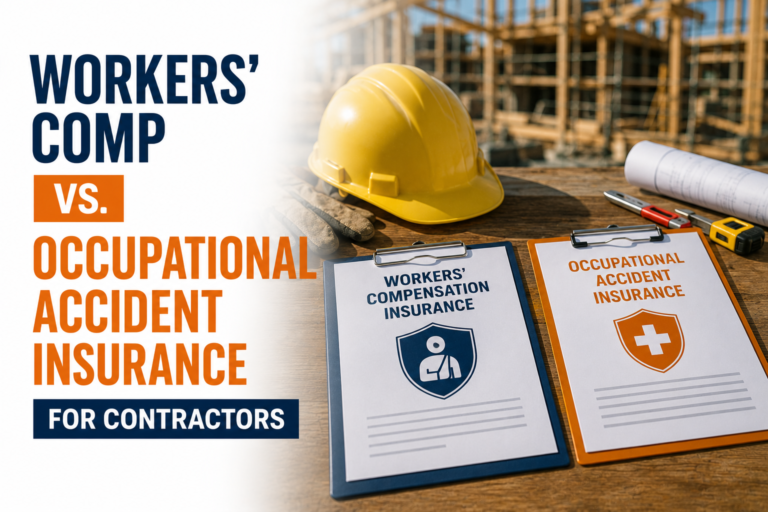
Workers’ Compensation vs. Occupational Accident Insurance
Some independent contractors purchase occupational accident insurance.
This coverage may offer limited benefits for:
- Accidental injuries
- Medical expenses
- Temporary disability
- Accidental death
However, occupational accident insurance is not always statutory workers’ compensation.
Texas warns that alternative policies do not count as workers’ compensation under state law. Employers using them can lose legal protections and may remain responsible for costs above the policy’s limits.
Before choosing an alternative plan, contractors should compare:
- Medical limits
- Disability limits
- Benefit periods
- Exclusions
- Occupational disease coverage
- Legal defense protection
- Compliance with client contracts
- Recognition under state law
A cheaper policy may provide much narrower protection.
What Happens if an Uninsured Independent Contractor Is Injured?
The outcome depends on legal classification.
The Worker Is Truly Independent
A genuine independent contractor may have no workers’ compensation claim against the hiring business.
The worker may need to rely on:
- Health insurance
- Disability insurance
- Personal savings
- Occupational accident coverage
- A liability claim against a negligent party
The Worker Was Actually an Employee
The hiring business may face:
- A workers’ compensation claim
- Unpaid insurance premiums
- State penalties
- Interest
- Medical and disability costs
- A stop-work order
- Civil litigation
- License consequences
New York states that business owners can become personally liable for medical care and lost wage benefits when they fail to carry required coverage. The state can also impose penalties and other enforcement measures.
Can a General Contractor Be Liable for a Subcontractor?
In some states, a general contractor can face exposure when a subcontractor lacks required workers’ compensation.
The exact rules vary. Possible consequences include:
- The subcontractor’s workers being included in the general contractor’s premium audit
- Responsibility for benefits after an injury
- Contract violations
- Loss of project access
- Increased insurance costs
For this reason, general contractors often request a current certificate before work begins.
They may also require:
- Policy number
- Effective dates
- Workers’ compensation carrier
- Employer’s liability limits
- Waiver of subrogation
- Notice of cancellation
- Proof of owner inclusion or valid exemption
A certificate alone does not change worker classification. It also does not guarantee that coverage will remain active.
How to Decide Whether You Need Coverage
Use the following process.
Step 1: Identify Everyone Who Performs Work
Include employees, helpers, day laborers, relatives, subcontractors, and temporary workers.
Do not review payroll records alone. Include unpaid and irregular labor when state law may treat those people as employees.
Step 2: Apply the Correct State Test
Use the workers’ compensation test for the state where the work occurs.
Do not rely only on:
- Form 1099
- An LLC
- A written subcontract
- A contractor license
- A business tax number
Washington notes that even a contractor registration number does not automatically create an exemption.
Step 3: Review Licensing Rules
Check the state contractor board and any trade-specific authority.
Some license classifications have stricter insurance requirements.
Step 4: Read Client Contracts
Look for requirements involving:
- Workers’ compensation
- Employer’s liability
- Waivers of subrogation
- Certificates of insurance
- Owner inclusion
- Subcontractor coverage
Step 5: Confirm Owner Coverage
Ask whether owners, partners, LLC members, and corporate officers are included or excluded.
The answer can affect both the premium and available benefits.
Step 6: Keep Documentation
Maintain:
- Worker classification records
- Written contracts
- Certificates of insurance
- License information
- Proof of independent business operations
- Policy endorsements
- Exemption certificates
- Renewal dates
Review these documents before every policy audit.
Questions to Ask an Insurance Agent
Before purchasing a policy, ask:
- Does my state require coverage for my business structure?
- Am I personally included in the policy?
- Can I elect coverage for myself?
- How does the policy treat subcontractors?
- What records will the insurer request during an audit?
- Will uninsured subcontractor payments affect the premium?
- Does the policy meet my clients’ contract requirements?
- What employer’s liability limits are included?
- Can the insurer issue certificates quickly?
- What happens if I hire my first employee?
The agent should understand construction and contractor classifications.
Frequently Asked Questions
Does a sole proprietor need workers’ compensation?
A sole proprietor working alone is often exempt. However, state law, licensing rules, and client contracts may still require coverage.
Does a one-person LLC need workers’ compensation?
Possibly. Some states exempt an LLC with no employees. Other states or licensing boards may require coverage.
Does paying someone with a 1099 avoid workers’ compensation?
No. Worker status depends on the actual relationship, not the tax form.
Can a general contractor require an exempt subcontractor to buy coverage?
Yes. A private contract can require coverage even when state law offers an exemption.
Does general liability cover employee injuries?
General liability is not a substitute for workers’ compensation. Employee injury exclusions commonly apply.
Can an independent contractor cover themselves?
Many states allow voluntary coverage. The contractor must verify that the policy includes the owner.
Is occupational accident insurance the same as workers’ compensation?
No. It may provide narrower benefits and may not satisfy state or contract requirements.
Which state’s law applies?
Usually, the work location and employment relationship matter. Multi-state contractors should obtain state-specific advice.
Conclusion
Independent contractors do not always need workers’ compensation insurance. A genuine sole proprietor with no employees may qualify for an exemption.
However, the answer changes when the contractor hires workers, uses subcontractors, enters regulated trades, or signs contracts requiring coverage.
A Form 1099 does not decide worker status. Neither does a written independent contractor agreement.
Contractors should check the workers’ compensation authority and licensing board in every state where they operate. They should also confirm whether owners are covered or excluded.
Even when insurance is optional, voluntary coverage may protect the contractor’s income and help secure better projects.
Editorial review: This guide was researched and reviewed by the Coverage Editorial Team using government agencies, insurance regulators, licensing authorities, policy documentation, and current industry pricing sources.